Get Full Government Meeting Transcripts, Videos, & Alerts Forever!
Get email alerts on the Gateway Code Permitting topic
No spam. Unsubscribe anytime.
Arcata planners affirm staff interpretation for Gateway code permits, emphasizing layered review
Summary
The Arcata City Planning Commission affirmed the zoning administrator’s interpretation that projects in the Gateway form‑based code that do not meet ministerial (objective) standards will require a gateway use permit plus design review, preserving flexibility for reuse projects but adding required findings tied to gateway objectives.
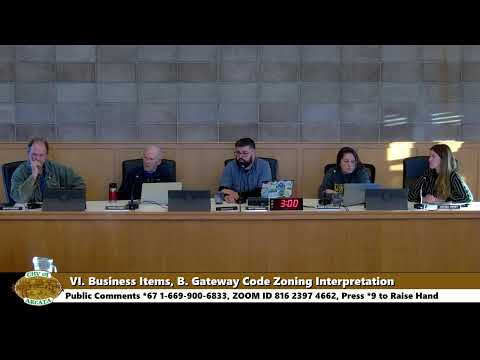
The Arcata City Planning Commission on March 10 affirmed a staff zoning interpretation clarifying how the recently adopted Gateway form‑based code will be applied to projects that do not meet ministerial (objective) design standards.
Development Director David Loya presented the interpretation and three paths: the commission can affirm the staff interpretation, appeal it, or send it back for staff revision. Loya explained that the Gateway code creates a ministerial pathway for projects that meet bright‑line standards — including minimum housing and form requirements — which allows applicants to proceed directly to building permit under objective design standards. Projects that fail those standards, that expand an existing nonconforming use or otherwise do not qualify for the ministerial route must instead pursue a gateway use permit and undergo design review, Loya said. The gateway use permit incorporates standard use‑permit findings and adds additional findings tied to gateway policy objectives, such as minimizing off‑site impacts and advancing area design goals.
“Basically, what I’m saying in this zoning interpretation is you apply everything in the process if you don’t meet the ministerial requirements,” Loya said. “You have to do a design review, whatever that process looks like. You also have to do a gateway use permit.”
Commissioners asked for clarification about how often the gateway permit will be required and whether the layered procedures might discourage modest rehabilitation of existing businesses. Loya said many existing buildings in the Gateway area are likely nonconforming and that the approach is intended to balance policy objectives with flexibility; he also suggested staff can develop flowcharts or guidance and consider targeted exemptions for small, low‑impact repairs to reduce procedural burden.
After discussion, Commissioner Strickland moved to affirm the zoning administrator’s interpretation as described in the staff report; the motion was seconded and approved by voice vote. Commissioners signaled interest in follow‑up materials — including a flowchart to help applicants and a possible future study session with council — and staff said they will monitor early projects to identify opportunities for code amendments or process streamlining.
The commission’s action sets an administrative application pathway: projects that fail to meet the Gateway code’s ministerial thresholds will generally be reviewed through a gateway use permit process layered on existing design‑review and use‑permit procedures. Staff emphasized that the coastal zone overlap for roughly half the Gateway area adds additional review complexity for some projects and will be handled on a case‑by‑case basis.