
Commerce Committee hears bill to revive MODESA to spur downtown investment
Get AI-powered insights, summaries, and transcripts
Subscribe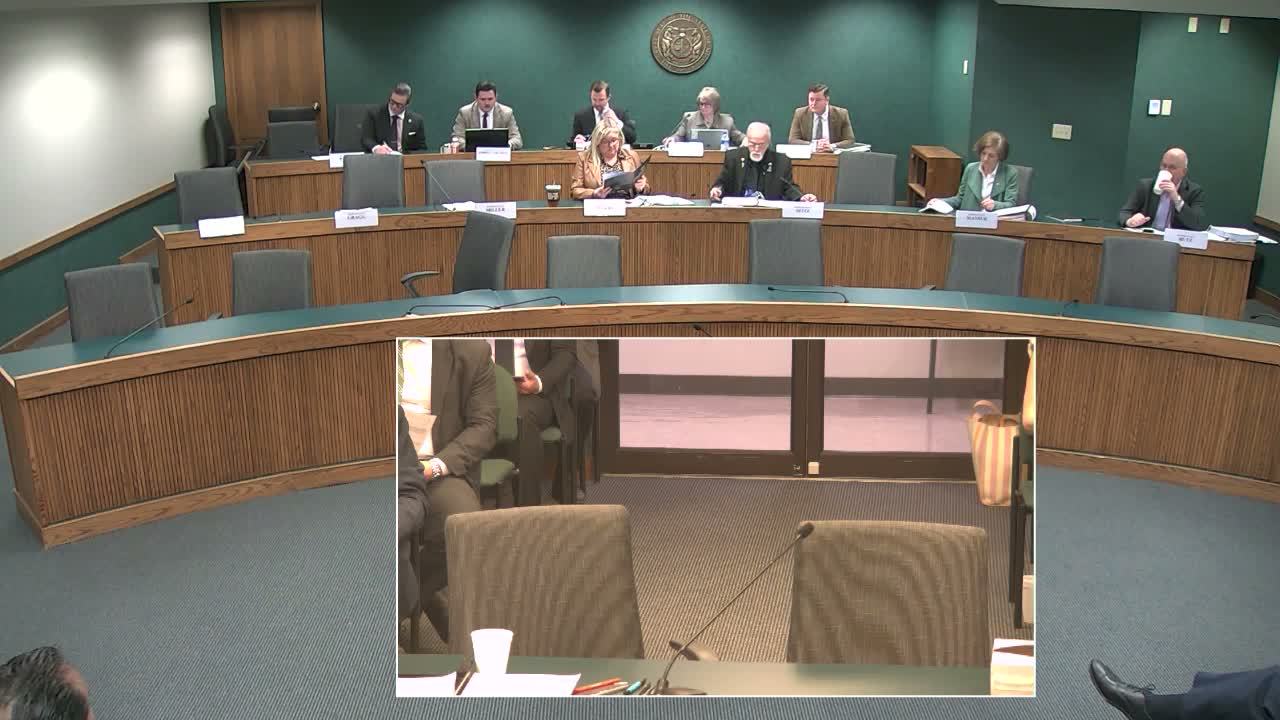
Summary
A public hearing on House Bill 33 95 proposed to reauthorize the Missouri Downtown Economic Stimulus Act (MODESA). Sponsor Representative Christ and a slate of business and civic leaders said the program previously attracted billions in private investment and urged adding residential development; no opposition testified and no vote was taken.
Representative Christ, sponsor of House Bill 33 95, told the Commerce Committee the bill would reauthorize and update the Missouri Downtown Economic Stimulus Act, saying the program—known as MODESA—relies on private investment with the state sharing a portion of incremental tax revenues only after projects generate new revenue.
"With no risk to the state, we can jump start major new private investments in our cities, put our people to work, and generate millions of dollars in tax revenue," Representative Christ said in opening remarks, proposing a substitute to refine the bill’s language and telling members he would convene a House committee subcommittee for further drafting.
The sponsor and multiple supporters emphasized MODESA’s prior impact in Kansas City and St. Louis. Blake Cordish of the Cordish Companies said the program enabled roughly $2,000,000,000 in private investment over 20 years, created about 10,000 jobs and helped draw tens of millions of visitors to downtown projects such as Power and Light and Ballpark Village. "We can't do it without MODESA," Cordish said, arguing the bill’s modernized form should explicitly allow residential components as well as office and entertainment uses.
Ryan McClure, executive director of the Gateway Arch Park Foundation, said his organization’s related LLC now owns the Millennium Hotel site in downtown St. Louis and is demolishing the existing structure to clear the way for redevelopment. "Without this legislation, quite simply, this project can't happen," McClure said, urging the committee to consider the site as part of any MODESA district designation.
Committee members pressed witnesses on details. When asked whether property taxes would be avoided after development, Cordish said property taxes "will be dependent upon the city's determination" and that some cities have used pilot arrangements, but that in the projects he described property taxes would be paid. On project eligibility, Cordish described a "but for" test that the Department of Economic Development would review to determine whether incentive sharing was necessary for a project to proceed.
Other witnesses who went on record in support included the Economic Development Corporation of Kansas City, Greater Saint Louis Inc., the Downtown Council of Kansas City, the Hispanic Chamber of Commerce of Greater Kansas City, the Municipal League of Metro St. Louis, JE Dunn, and the Missouri Chamber of Commerce and Industry. They highlighted downtown revitalization, job creation and the program’s prior track record as reasons to reauthorize a modernized MODESA.
No witnesses testified in opposition. The sponsor said he expects to file a substitute that will refine statutory language and that the bill will be further considered in a House committee subcommittee. The hearing concluded with no formal vote taken.
The committee adjourned the public hearing; next procedural steps for the bill were not set during the hearing.