
Millcreek presenter says rising special-education and English-learner needs are straining school buildings and budgets
Get AI-powered insights, summaries, and transcripts
Subscribe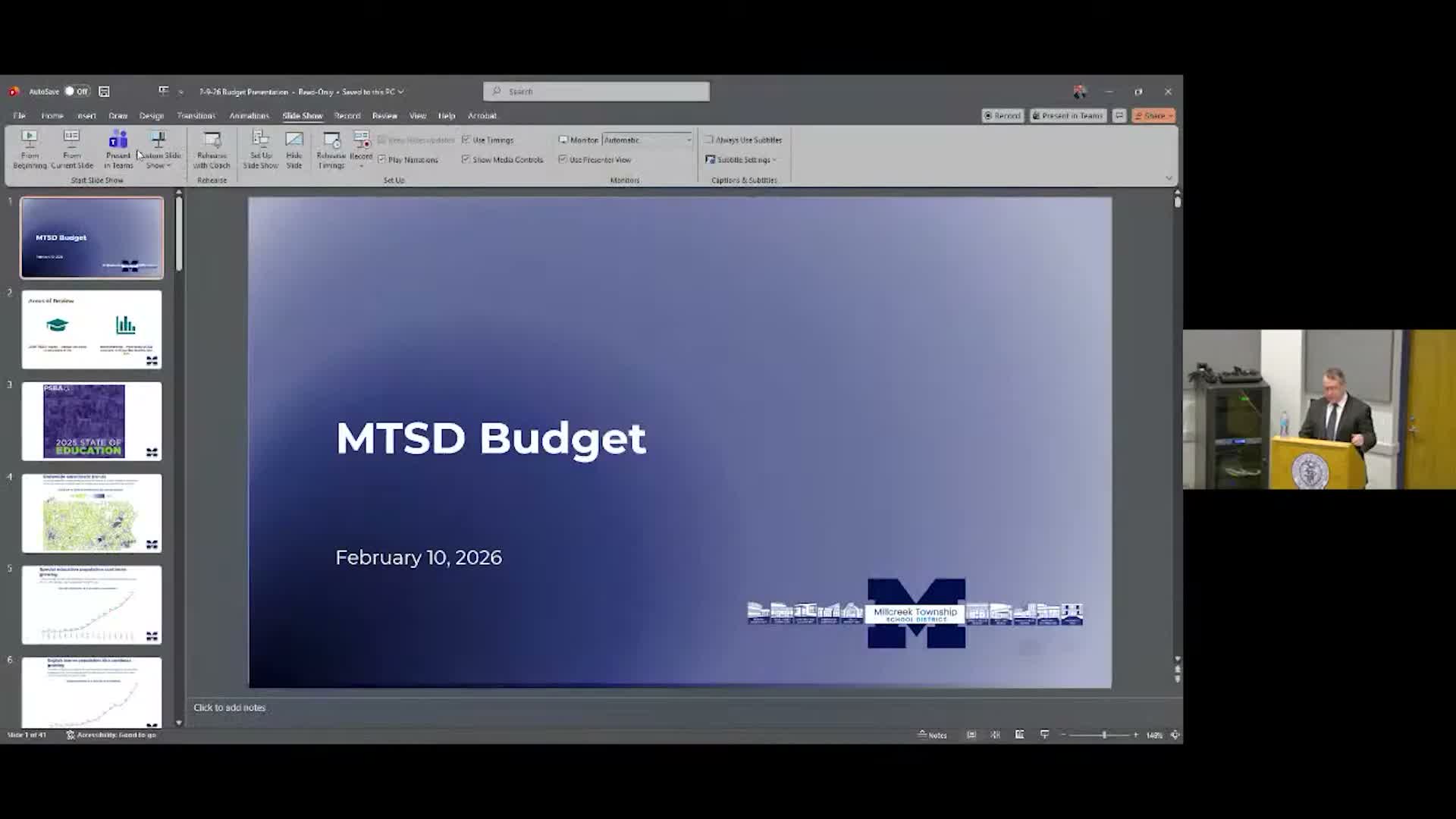
Summary
An unnamed Millcreek Township SD presenter told the board that stable overall enrollment hides growing special-education and English-learner populations, which require lower student-to-staff ratios and are driving space and budget pressure; the presenter outlined a draft budget timeline for March–May.
An unnamed district presenter for Millcreek Township SD told the board that while total enrollment is relatively flat, growing special-education and multilingual-learner (MLL/EL) populations are creating a shortage of usable classroom space and driving up costs.
“Why is that? Because ratios—well, our kindergarten classroom could be, what, 1 to 20, and autistic classrooms 1 to 8,” the presenter said, noting the lower ratios for special programs and adding that placing an additional autistic classroom costs roughly $210,000. The presenter said Millcreek’s special-education share rose from about 14.7% in 2013 to about 20.8 most recently, and EL/MLL share climbed from about 1.2% to roughly 5.4%.
The presenter described state mandates—especially special-education ratios—as effectively unfunded, saying the state continues to add requirements without covering the full cost. “We’re not a mental health facility. We are a school,” the presenter said, arguing that local schools are being asked to provide services while community mental-health resources are overextended in Erie County.
The presentation used Pennsylvania School Boards Association benchmarking to show typical district responses to fiscal pressure: about 73% plan tax increases, roughly 54% expect to use fund balance, 44% plan to postpone maintenance and smaller shares plan staffing reductions or outsourcing. The presenter said Millcreek relies heavily on local revenue—about 63.8% of its total revenue in 2024—making it more sensitive to local tax decisions.
The presenter reviewed state funding mechanics, including equalized mills, market-value/personal-income aid ratios, and the Basic Education Funding Commission’s findings. He said the commission estimated Millcreek’s funding shortfall at about $13.8 million, though more than $3 million of that could be reduced when accounting for local effort capacity. He added that not raising taxes to the Act 1 index since 2019 cost an estimated $8.3 million in foregone annual revenue and that matching a higher comparable district’s tax rate would yield roughly $17 million more a year.
On expenditures, the presenter said Millcreek spends a similar share on direct instruction as other districts (about 56%) but ranks low in state and federal revenue per student (about 418 of 500 for state revenue and about 379 of 500 for federal funds). He characterized the result as a compounding effect: lower local effort or lower state subsidy reduces available resources, which in turn limits spending.
Regarding reserves, the presenter acknowledged the district holds some fund balance but said its per-budget reserve level is relatively low compared with comparable IU 5 districts. During questions, a board member asked that the slide deck be shared; the presenter said a draft budget will be brought in March, a proposed final in April and final approval is expected in May.
The presentation emphasized that mounting mandated costs—pensions, charter reimbursement and special-education requirements—are outpacing state and federal revenue growth and that Millcreek’s reliance on local taxes, combined with higher property values and incomes used in subsidy formulas, reduces the district’s state aid.