
Commissioners approve first reading of rezoning at US 30 and 600 W; ask for septic and traffic data before second reading
Get AI-powered insights, summaries, and transcripts
Subscribe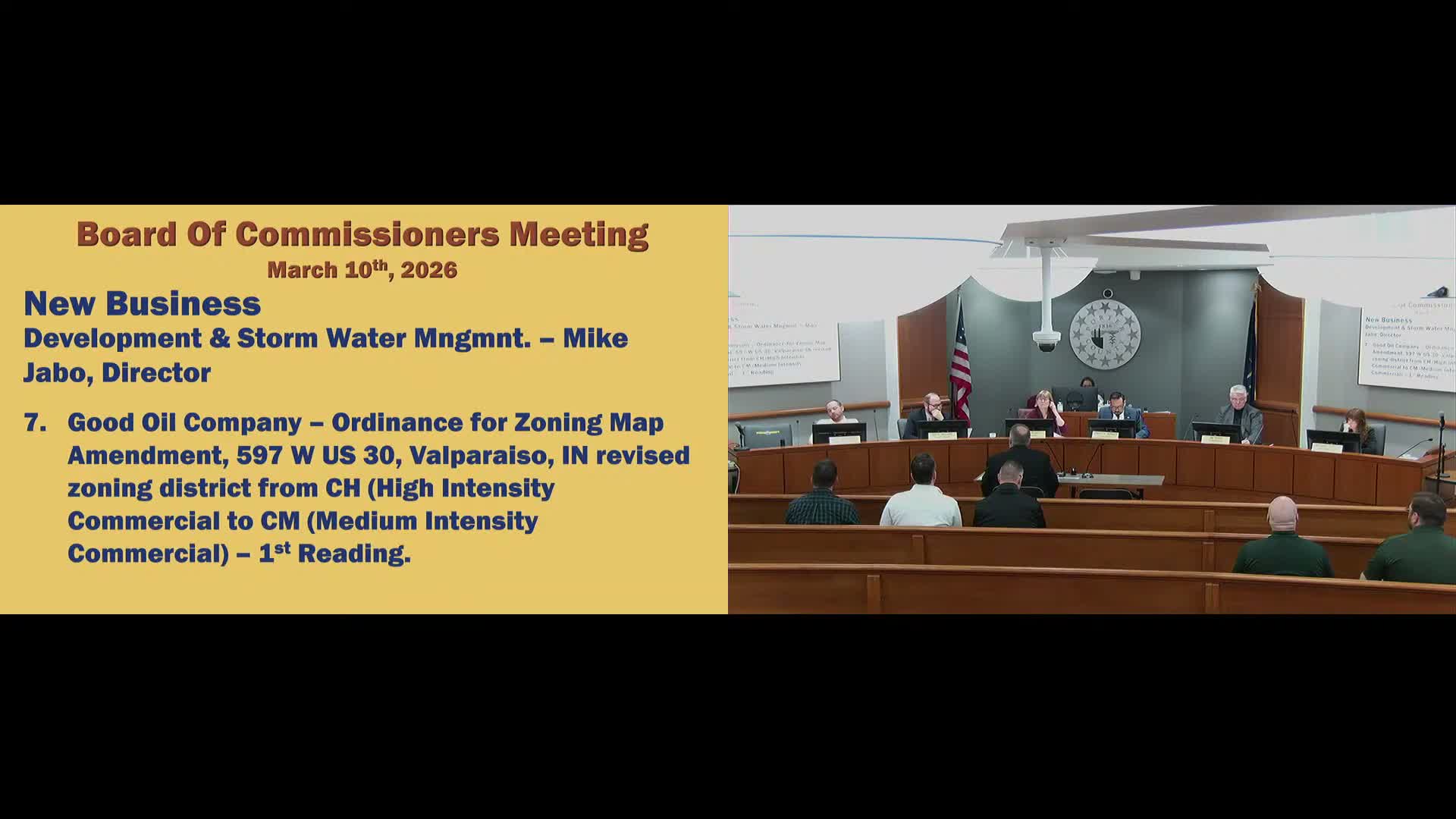
Summary
Developers seeking to rezone 597 W US 30 from high‑intensity commercial to medium‑intensity commercial won first‑reading approval March 10; commissioners asked for state septic capacity findings and circulation/traffic information before the second reading.
Developers representing Good Oil presented a rezoning request for the northeast corner of U.S. 30 and County Road 600 W — roughly an 8.5‑acre site — asking to change the zoning from CH (high‑intensity commercial) to PM (medium‑intensity commercial) to allow a convenience store with fueling and four additional trade/warehouse buildings. Matt Rossman, representing the developer, said the team cut the original density plan and that “we've reduced that down to 4 additional buildings, not counting the c‑store,” and that the site plan and septic approach remain under design.
Why it matters: rezoning would allow subdivision of the parcel into individual lots (the developer said five total buildings in the current proposal) and recordable commitments limiting some uses; commissioners said those commitments can be recorded with property deeds so restrictions carry with ownership changes. Several commissioners said they supported moving the request forward to a second hearing only after the developer returns with firm technical findings on wastewater (septic) capacity and traffic/circulation plans.
What commissioners and staff asked for: multiple commissioners pressed the developer on whether a commercial septic system would support the proposed uses and the number of lots the site could sustain. The developer and their consulting engineer, Adam McAlpine, explained that septic design must be permitted by the Indiana State Department of Health and that soil conditions are sandy and historically served by septic; the sanitary district had already indicated it would not provide a sewer connection because of capacity constraints. Commissioner concerns about emergency and truck circulation also prompted requests for a clearer turnaround plan and evidence that emergency vehicles could access and manoeuvre the site.
Public hearing and vote: the board opened the public hearing; no members of the public spoke for or against the project. After discussion and a request that the plan commission/developer return with the septic capacity report and additional circulation/traffic detail at second reading, the board voted to approve the zoning map amendment on first reading and directed the petitioner to provide the requested technical follow‑up.
Next steps: the developer will return with state health / septic capacity findings and additional circulation/traffic analysis for the second reading; the planning commission and, if needed, the BZA will review downstream variance and subdivision steps before permits are issued.