Get Full Government Meeting Transcripts, Videos, & Alerts Forever!
Get email alerts on the Facility Expansion topic
No spam. Unsubscribe anytime.
Veterans training campus seeks planning approval for hub and phased trade‑school expansion across Arkansas–Oklahoma border
Summary
UHP founder Matt Essey told the county ERC his veterans training campus plans an immediate classroom 'hub' and physical‑plant building in Arkansas and a phased trade‑school expansion; staff discussed grading, addressing, water/septic complications because infrastructure crosses the state line, and the need for waivers if septic sits off the served parcel.
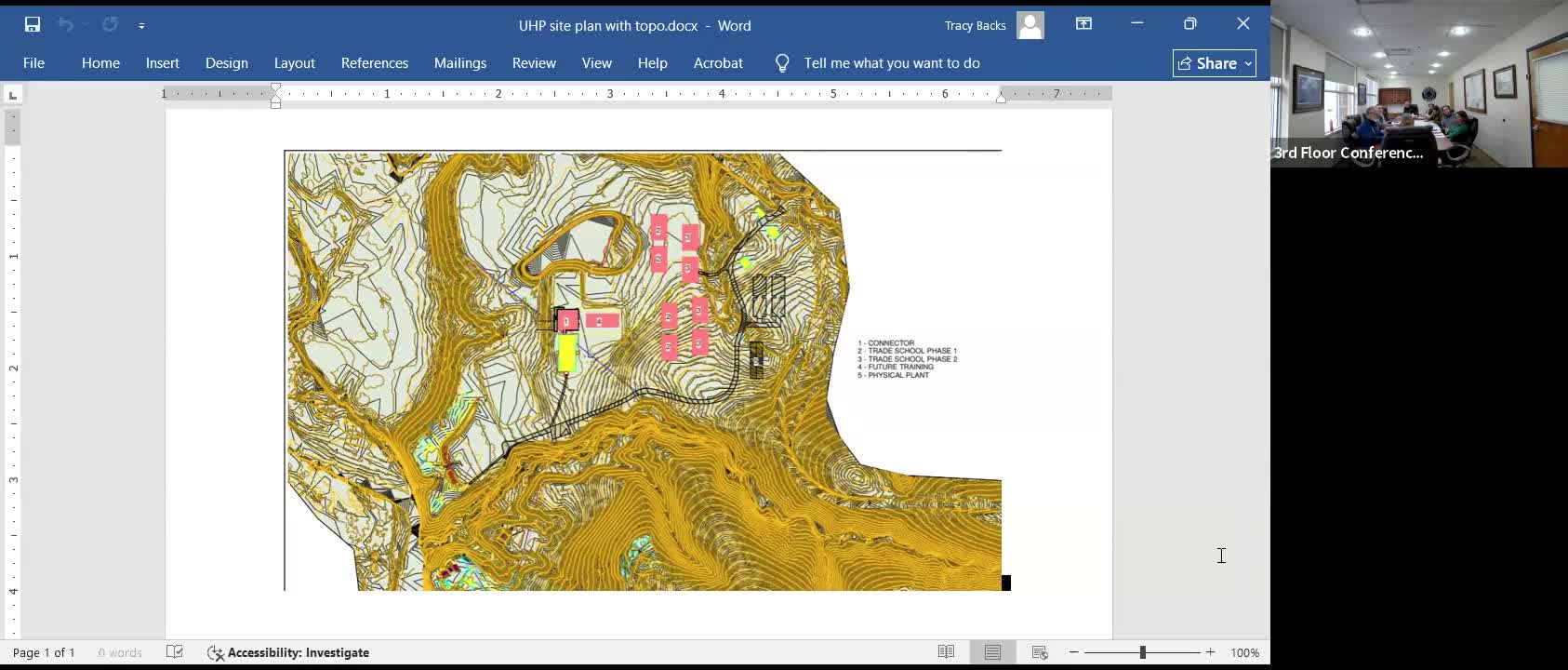
Matt Essey, founder of the University of Health and Performance (UHP), asked the county for guidance on a multi‑phase expansion of a veterans training campus that straddles the Arkansas–Oklahoma border. He said UHP currently operates a residential training program and plans to expand classroom capacity with an immediate 'hub' building and a short‑term "physical plant," followed by trade‑school buildings; UHP projects scaling to 1,000 beds by 2030.
Essey said the hub and physical plant are the most immediate needs, and he would prefer to start site grading for the trade‑school parcels while finishing full design details. Planning staff confirmed grading can proceed by right and reviewed the planning calendar: intake and submittal deadlines fall in the next weeks and a standard 6–8 week review begins at the date of application. "If site grading can happen now and we can come back with full plans in a month or two, then I think that works," Essey said.
Lonnie Harrell said he will coordinate hydrant and access needs with the responding fire department (Gentry/Gallatin) and confirmed the roads at the site are adequate now but cautioned about water availability as the campus grows. County health and building staff discussed complications from cross‑state infrastructure: wells and septic lines currently serve some buildings on the Oklahoma side while the proposed Arkansas buildings may rely on that supply or require new wells and septic permitting. Caroline Eastman of the Arkansas Department of Health told the group plumbing and engineering approvals may need state coordination and urged early water testing and septic design; she noted a county regulation typically requires septic systems be on the same property as the structure served, so a waiver will be necessary if septic is sited off‑parcel in Oklahoma.
Building safety clarified that the Arkansas‑side buildings proposed for the current submittal are business/education occupancy (vocational training), not sleeping barracks, and that structural and MEP engineering stamps will be required. The applicant provided two Arkansas addresses for campus entries and staff said 911/EMS and the sheriff's office already have topography and site plans and will assign building and street numbers once the layout is finalized.
Staff advised the applicant to assemble the standard large‑scale submittal packet (drainage report, utility letters for electric/water/septic/gas, lighting and waste enclosure plans) and to expect the county to forward engineering reviews to Carver if the planning board votes to send the application to engineering. The planning board will also consider any septic waiver request alongside the large‑scale application. The applicant and staff agreed to continue coordination and return with full materials by the county submittal deadlines.