Get Full Government Meeting Transcripts, Videos, & Alerts Forever!
Get email alerts on the Industrial Development topic
No spam. Unsubscribe anytime.
Quorum court moves IDA ordinance to next meeting amid debate over eminent domain, recall and board makeup
Summary
Benton County justices voted to place a proposed three-county Industrial Development Authority ordinance for third reading at the next quorum court meeting, advancing a regional plan tied to a time‑sensitive EDA grant. Justices pressed for guardrails including a recall provision and limits on eminent domain.
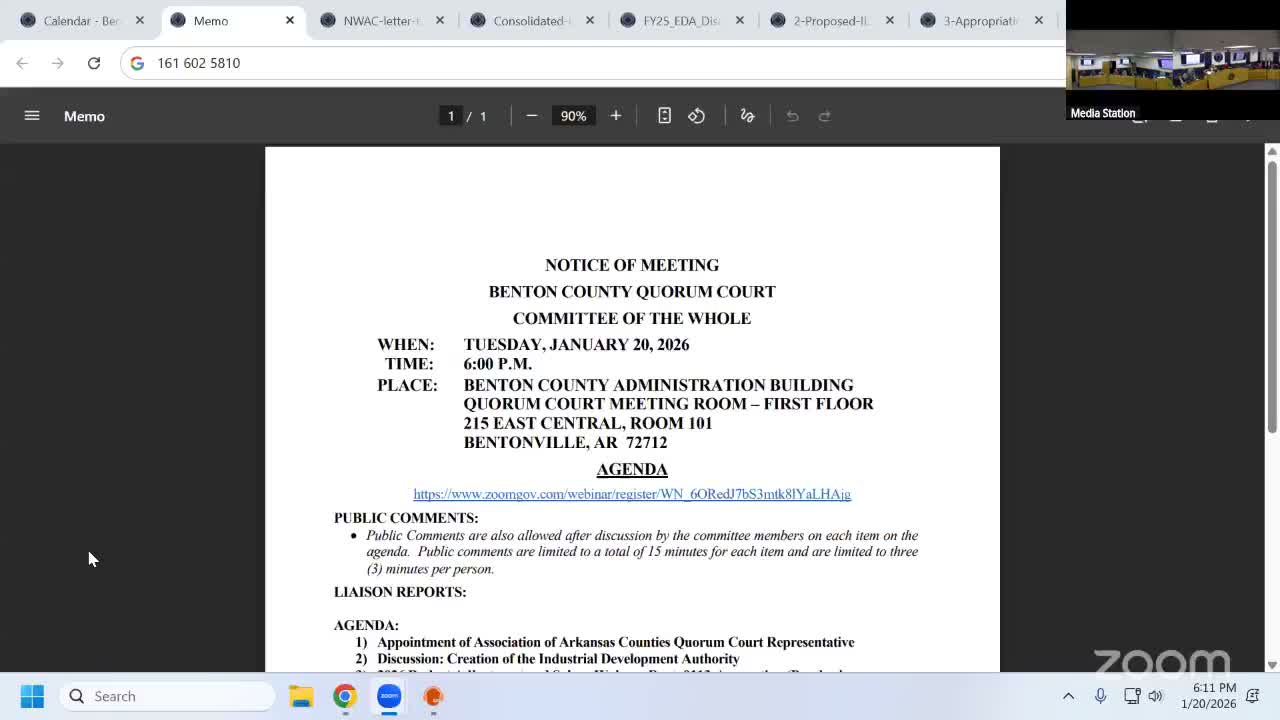
Benton County’s quorum court voted Jan. 20 to place a proposed three‑county Industrial Development Authority (IDA) ordinance on the agenda for third reading at the next quorum‑court meeting, setting up a formal vote after a week of additional review and counsel.
The courtroom discussion centered on the IDA’s purpose — to create shovel‑ready, engineered sites intended to attract higher‑wage manufacturing and technology projects — balanced against concerns from several justices about accountability, board composition and the authority’s power to condemn land.
“An IDA exists to do one thing, and that is to solve a real‑estate problem and develop new sites that can accommodate a different class of technology and manufacturing projects,” said Ron Maloney, a regional economic developer with the Northwest Arkansas Council. Maloney said the Council would provide initial office space and staff support to keep IDA operating costs low.
Members who support the IDA pointed to a chance to pursue a federal Economic Development Administration grant — officials said an application window closes March 3 — and argued that the authority would allow the region to compete for projects private developers will not prepare. "If we put our A‑plus team on the field," Maloney said, "we'd rather go A‑plus than A‑minus."
Public commenters also weighed in. Tom Allen, of Bentonville, told the court he was “definitely in favor” of the IDA, urging justices to support the measure. Leon Castor, of Bella Vista, thanked staff for the packet but cautioned that a reported $50,000,000 grant opportunity requires careful due diligence and that local infrastructure limits — for example, recent sewer hookup fees — must be addressed before moving forward.
Opponents and cautious members repeatedly raised three issues: how seats would be apportioned across the three counties, whether appointed board members would be sufficiently accountable to elected officials and voters, and whether the authority’s statutory power to use condemnation should be constrained. Several justices urged specific language in Benton County’s authorizing ordinance to (1) clarify that at least one board member will be an elected official, (2) include a recall mechanism for appointees and (3) require Quorum Court approval before any condemnation action.
Maloney responded that Arkansas law provides judicial review for condemnation and that the circuit court — not the IDA alone — must approve any taking. He also noted the draft operating agreement contemplates oversight measures, annual reporting and legislative audit requirements.
After extended discussion and clarifying exchanges, Justice Armas made a motion to place the draft IDA ordinance on next Thursday’s quorum court agenda for third reading; Justice Jones seconded. The roll call vote was recorded in open session as 12 yes, 1 abstain and 1 no. Joseph Bollinger registered the abstention; Justice Rosenbaum cast the lone no vote.
The motion does not itself create the IDA. If the quorum court approves third reading and ultimately adopts the ordinance, Benton County, along with Washington and Madison counties, would transmit authorizing documents to circuit court as required by state statute to form the authority. Court members said they will use the intervening week to consult their county attorneys, finalize stipulations (recall language, clarification on JP appointments, and condemnation procedures) and circulate any updated ordinance text before the January quorum‑court meeting.
What happens next: The IDA ordinance will appear on the quorum‑court agenda for third reading at the next meeting. If adopted, county judges will petition circuit court to formally create the IDA; members said they would also proceed with a coordinated effort to ensure the authority’s founding documents reflect the guardrails requested during the Jan. 20 discussion.
(Reporting note: quotes and attributions are drawn directly from the court transcript of the Jan. 20 meeting.)