Get Full Government Meeting Transcripts, Videos, & Alerts Forever!
Get email alerts on the Signage Regulation topic
No spam. Unsubscribe anytime.
Commission hears DOT on proposed scenic-corridor rule to curb off-premise billboards on XNA connector
Summary
The Benton County court discussed a proposed ordinance to prohibit off‑premise billboards along the XNA connector; Arkansas Highway Commission staff described federal permitting and right-of-way compensation, while several justices raised property-rights and compensation concerns.
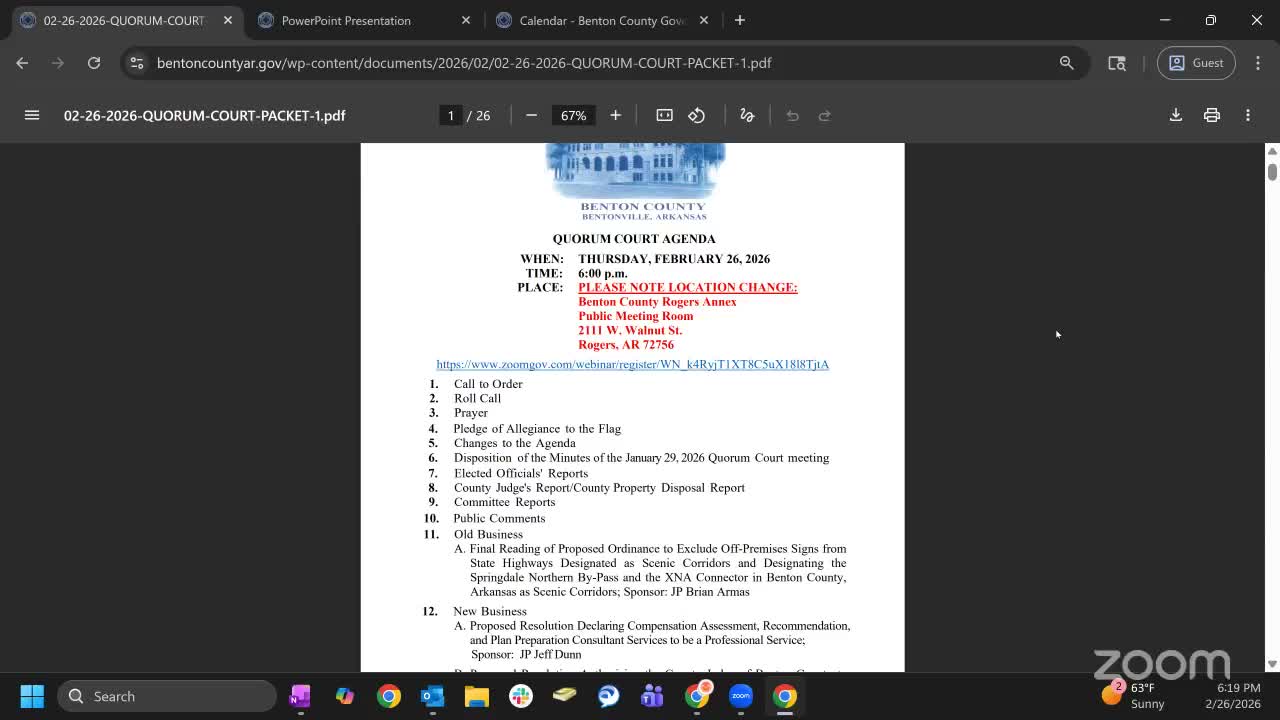
Benton County commissioners took up the final reading of an ordinance (item 11a) that would limit off-premise advertising along the XNA connector and other designated city-corridor highways. Philip Caldo, chairman of the Arkansas Highway Commission, and department staff described why the commission supports a scenic-corridor designation and how state and federal rules interact with local controls.
Caldo told the court the ordinance would make signage regulation uniform along the corridor, preserve Northwest Arkansas's appearance and help tourism. DOT staff explained that federally funded NHS routes will require permits and that the department enforces spacing, size and other standards under federal beautification rules.
A justice on the court (identified in the transcript as Justice Ristin, speaker 10) objected to the ordinance on private-property grounds, saying it "takes rights away from private landowners" and argued that limiting property owners' ability to place signage without compensation is unfair. "After we do this, they won't have the right to have to sell somebody else off-site signs... that's called stealing," the justice said.
State DOT staff (William, right-of-way division) responded that compensation is paid for land the state acquires for right-of-way through appraisal and negotiation, and that limitations on off-premise advertising beyond the right-of-way do not automatically generate additional compensation. DOT staff described the appraisal and acquisition process, administrative hearing rights for property owners and the department's practice of seeking compliance and using its legal division when necessary.
Commissioners asked whether state regulation already covers the corridor; DOT staff said the state regulates a portion of highways and that the scenic-corridor designation and permitting would be used to "get ahead" of billboards before they are installed, noting the long lifetime of modern monopole displays. Staff said illegal signs are handled by notice letters and administrative processes, and that federal funding conditions influence what the department permits.
Why it matters: The ordinance intersects with private-property concerns, federal funding/designation rules, and local land-use authority. Commissioners pressed staff on compensation formulas, condemnation risk and the process for municipal concurrence on scenic-route designations.
What happens next: The meeting record shows extended Q&A and then continued routine business; the transcript does not record a clear, uncontested board action on the ordinance within the public discussion excerpt. Other agenda items proceeded, including grant applications and appropriation votes later in the session.