Get Full Government Meeting Transcripts, Videos, & Alerts Forever!
Get email alerts on the Public Safety topic
No spam. Unsubscribe anytime.
Benton County fire trustees outline apparatus needs and ask to present budget request before August
Summary
The Benton County Fire Protection Association told the Committee of the Whole on Jan. 17 that countywide apparatus and staffing pressures—aging engines, rising training and equipment costs, and growing EMS demand—justify a coordinated county budget request; trustees asked to present specific cost estimates before the August budget cycle.
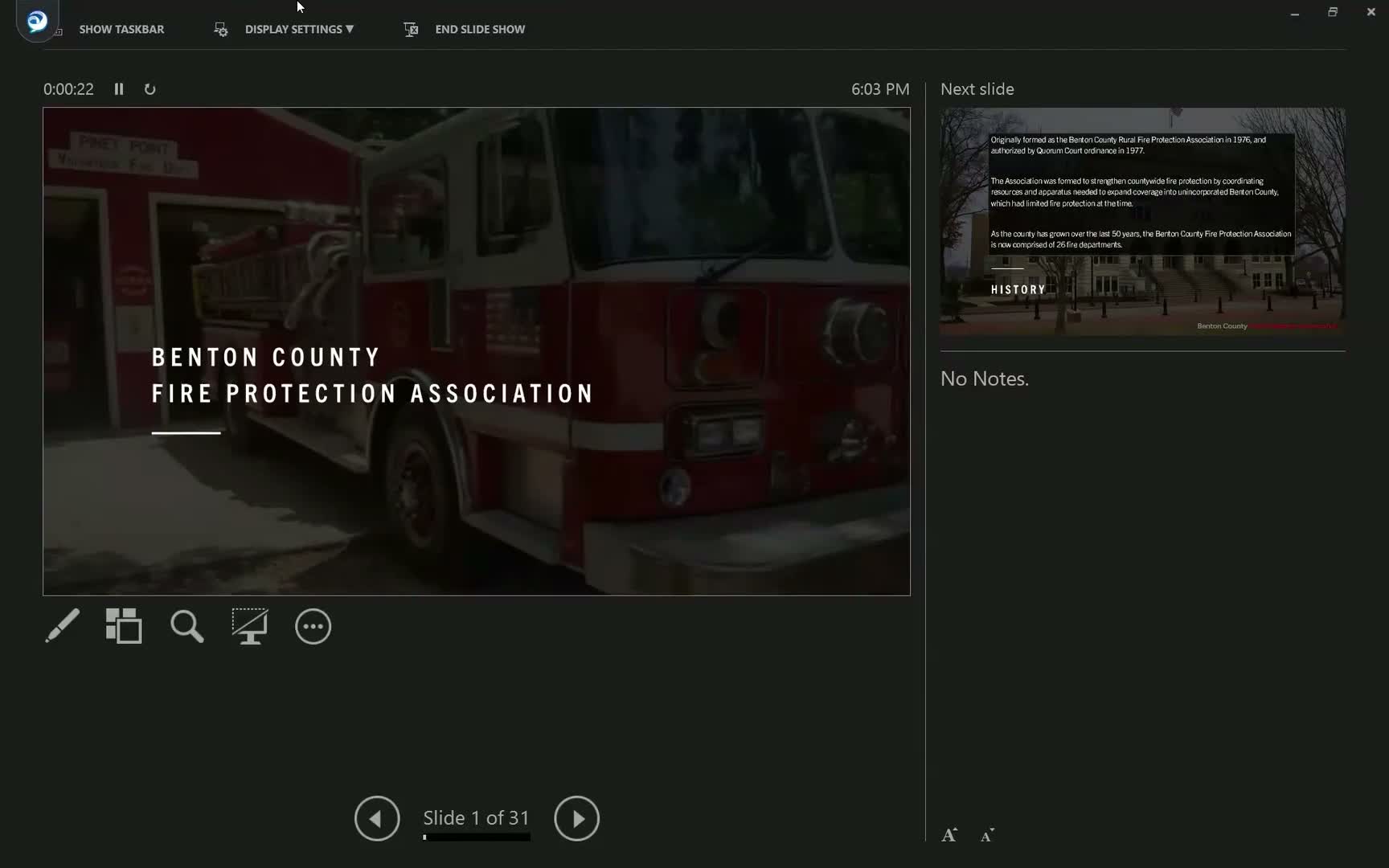
Glenn Bowen, northeast trustee of the Benton County Fire Protection Association, told the Benton County Committee of the Whole on Jan. 17 that the association represents 26 fire departments and manages county apparatus and standards for unincorporated Benton County.
"Benton County Fire Protection Association, we have 26 fire departments," Bowen said in the presentation, outlining coverage that he said includes 62 stations across approximately 884 square miles and a mix of 29 24/7‑staffed stations and volunteer stations.
Why it matters: county funding pays for apparatus acquisition, replacement and life‑cycle management that association officials say sustain volunteer departments and mutual aid across municipal boundaries. Association figures cited during the presentation included roughly 522 full‑time firefighters and 340 volunteers and detailed purchase and maintenance costs that officials argued exceed routine operating budgets.
Association leaders gave several specific figures to illustrate rising expense pressures: first‑year fully loaded cost for a new full‑time firefighter (salary, benefits and equipment) was estimated at about $65,000–$70,000; advanced, internet‑capable radios were described as ‘‘about $10,000’’ each; and new engines and tenders were quoted in the presentation at several price points, with one trustee saying a county purchase was about $420,000 and a staffed municipal purchase closer to $900,000.
Presenters described how the county allocates apparatus: departments submit needs, the association prioritizes based on call volume, staffing and population, and approved apparatus remain county property with county oversight of lifecycle maintenance. "Assets remain county owned," Bowen said, adding the county photographs and audits assets annually to confirm condition and use.
Committee discussion focused on placement, rotation and equity. Trustees and committee members debated whether county‑owned vehicles should be placed on staffed, high‑volume stations (to maximize immediate response) or rotated to extend service life across lower‑volume rural districts. One committee member said, "We trust you guys to do what's right with this money based on the guys' need," signaling support for the association's stewardship but also urging clear accountability.
Association officials emphasized mutual aid and operational standardization. The presenters said countywide radio standard operating procedures and a Mayday SOP are being developed so multi‑department responses use common terms and benchmarks; rollout of the radio SOP was cited as planned for March 1.
Next step: the association asked to meet with county decision‑makers before the court’s August budget cycle and to provide a prioritized list of apparatus and associated costs. "If we can talk to you before August, that'd give you guys a little bit of time to prepare," Bowen said.
No formal vote or budget decision was taken at the meeting. Committee members encouraged the association to return with specific, pre‑priced proposals to inform the budget work that will follow.
Ending: The committee closed the discussion with an agreement to receive the association’s materials ahead of budget deliberations and to schedule follow‑up as requested by the trustees.