Get Full Government Meeting Transcripts, Videos, & Alerts Forever!
Get email alerts on the Transit Fare System topic
No spam. Unsubscribe anytime.
Jonesboro committee forwards Cubic fare‑payment agreement, citing mobile and retail payments
Summary
The Jonesboro Public Services Committee voted to forward Resolution 26014 to the full City Council, a measure to authorize a platform service agreement with Cubic Transportation Systems that would add contactless, card and phone payments and reusable reloadable fare cards to local buses.
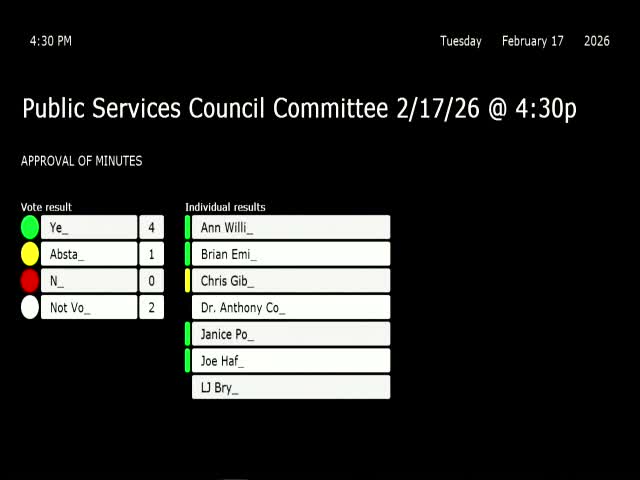
The Jonesboro Public Services Committee voted by voice to forward Resolution 26014, authorizing the city to enter a platform service agreement with Cubic Transportation Systems Inc., to the full City Council for consideration.
Lee, who provided the briefing to the committee, said the proposed system would allow riders to pay fares on buses with credit and debit cards, tap-to-pay and phone payments and would make refillable, reusable fare cards available at retail locations. "What this is is a way for us to be able to collect fares in the buses with credit card, debit card, tap to pay, phone payments," Lee said. "But, also, it will allow for customers, to be able to purchase those cards that are refillable, reusable."
A committee member raised a concern about the per-card cost listed in the vendor request for proposals, saying, "it was showing that each card costs roughly $14.15," and asked how the city would address replacement and fee schedules if riders frequently misplace cards. Lee acknowledged the issue and said the agency had considered replacement policies and other processes but had not finalized a fee structure: "We have some ideas, but we don't have anything fully, finalized yet."
Lee also described current ticketing costs and procurement: one-time-use tickets now must be preprinted in proprietary batches (the agency orders them in large runs, in the transcript described as batches of 5,000) and are intended to be disposable, creating recurring printing expense that refillable cards could reduce. Lee said retail loading (for example, loading cards at stores such as Walmart) would let riders add small amounts to cards while running errands.
Committee members asked whether the vendor supplied ridership projections tied to the new payment options. Lee said she had not seen specific projections but said the convenience could make transit easier for occasional riders and visitors, and "in essence allow for that increase."
The resolution was moved to forward to the full council by a committee member and seconded by another; Chair called for a voice vote and members responded "aye."
The committee also discussed related transit items later in the meeting: an in-house transit app in testing, real-time tracking and enunciators, placement of passenger shelters (28 of 45 installed so far), and staffing increases to restore a five-route service and two trolley routes during daytime hours. Lee said the transit app is being tested with staff and select users and will include trip-planning features and live updates to Google and Apple mapping services.
The resolution will next be considered by the full City Council; the committee did not adopt the agreement at this meeting and instead forwarded it for council action.