Get Full Government Meeting Transcripts, Videos, & Alerts Forever!
Get email alerts on the Bond Program topic
No spam. Unsubscribe anytime.
Council hears staff briefing on proposed 2026 streets, alleys and sidewalks bond; cost and strategy debate continues
Summary
City staff outlined candidate street, alley and sidewalk projects for a potential 2026 bond, estimating about $207 million in candidate projects (about $241 million after multi-year escalation). Council members pressed staff for a clear recommendation on whether to prioritize full reconstruction, concrete-panel replacements or asphalt overlays; staff will return with refined options before a possible Feb. 9 election call.
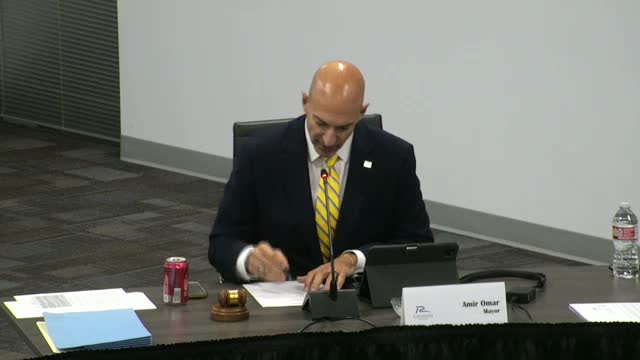
City staff on Monday evening presented a detailed briefing to the Richardson City Council on candidate streets, alleys and sidewalks for a potential 2026 bond program, laying out project lists, repair strategies and budget tradeoffs.
The presentation, led by Charles Goff (assistant team manager), said the city’s roadway network totals about 639 miles and roughly 1,500 lane-miles. Goff told the council that the staff’s list of candidate projects for the bond would total about $207,000,000 in current dollars. Accounting for a multi-year escalation factor, staff said the program’s planning-level total would be roughly $241,000,000. Goff also reviewed the city’s pavement-condition index (PCI) methodology and the remaining streets with PCI below 25 that have not yet been addressed.
Why this matters: Council members and staff framed the discussion as a choice between doing fewer full reconstructions of the worst streets or using bond dollars for more targeted concrete-panel replacements and freeing annual maintenance (PAYGO) dollars to cover overlays and other needs. Don Magner (city manager) said the choice affects how much the city can accomplish and its long-term operating and debt capacity.
Staff recommendations and tradeoffs: Goff described two primary approaches for the streets proposition. Option 1 would include $20–$25 million in the bond for localized concrete-panel replacement (half-panel or full-panel work), which staff said would allow the city to spread repair dollars across more lane miles. Option 2 would conserve bond dollars for full-depth reconstruction of fewer streets. Goff noted that both approaches use standard construction methods the city has employed since 2012; the difference is where bond funds would be applied versus annual maintenance PAYGO funds.
Sidewalks: For sidewalks, staff proposed a $15,000,000 allocation in the bond package that would fund two commercial areas, two residential areas and set aside $4.5 million to pursue about 43 miles of sidewalk gaps. Goff warned that $4.5 million would not close all gaps and that the linear feet addressed will vary depending on right-of-way constraints, terrain and whether grants or development activity resolve some gaps in the interim.
Council reaction: Council members asked for more granular prioritization and for staff to recommend a single, clearly justified strategy. Council Member Justice pressed staff on whether PCI scores are ranked within the 0–25 range; Goff responded that the PCI provides that granularity but that other factors — utilities under the street, localized versus widespread failure — influence prioritization. Mayor Pro Tem Hutchenrider urged staff to "call a time out and rethink what we're doing" if necessary, asking whether the city should consider more overlays or other shifts given rising construction costs. Magner said that to "truly ... catch up" the city would need substantially more funding and reminded council that operating constraints and state-imposed property tax caps could affect both operating and debt capacity going forward.
Quotable: Pat Hayden of the Richardson Bicycles Coalition told the council, "It's my sole mission ... to give everybody in this community the ability to get around by other means other than a car," urging the council to include shared paths in the bond. Goff summarized technical scope points, saying, "We have 639 miles of streets and alleys in Richardson." Magner said, "To truly, you know, catch up, we should probably be spending $200,000,000 a bond program on streets," underscoring the scale of need.
Next steps: Staff said it will accept council feedback, present a facilities briefing next week, continue refinement through December and January, and return with a recommendation and project criteria prior to the council’s decision about calling an election on the bond (staff referenced a target date of Feb. 9). No formal action or vote occurred at the meeting.
Notes on transcript numbers: the staff presentation materials and spoken briefing set the candidate project list at about $207 million and a planning-level escalation to roughly $241 million; the original transcript contains an apparent numeric transcription error in the escalation line, which staff clarified during discussion.