Get Full Government Meeting Transcripts, Videos, & Alerts Forever!
Get email alerts on the Ethics Complaint topic
No spam. Unsubscribe anytime.
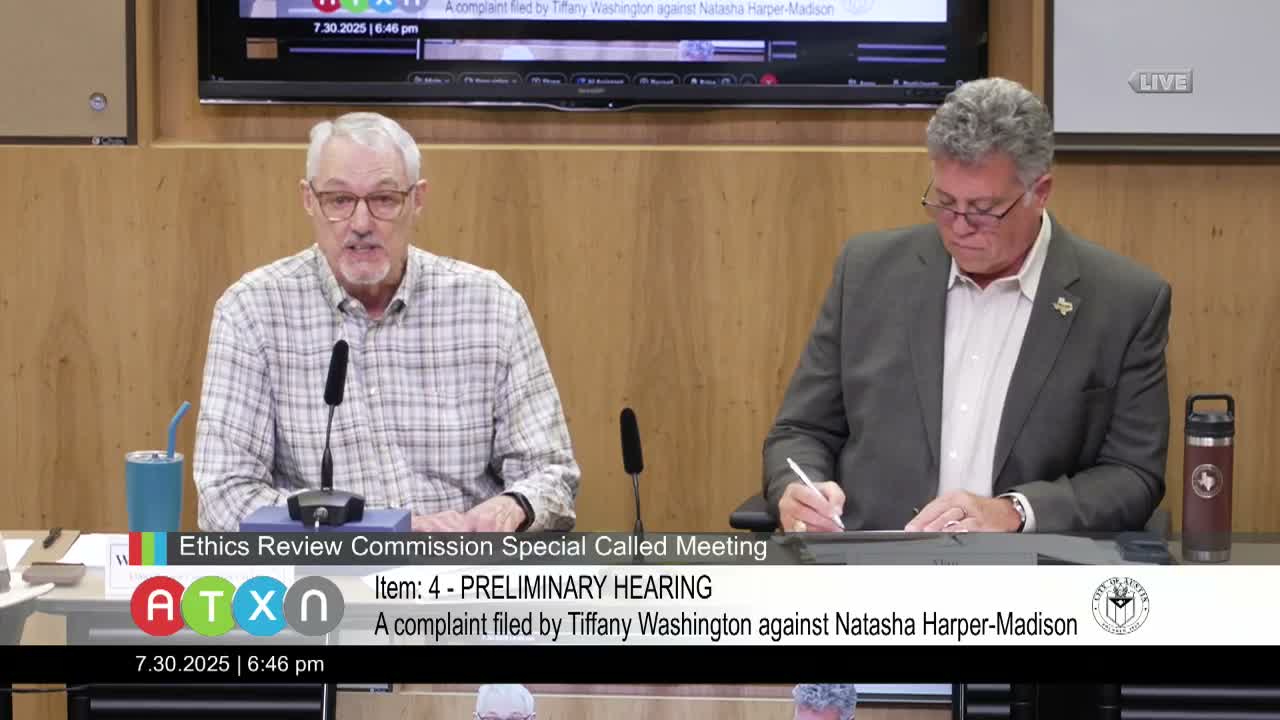
Austin ethics commission hears preliminary complaint alleging Council member lobbied for developer, finds no motion to proceed
Summary
At a July 30 special meeting the Austin Ethics Review Commission heard testimony from Tiffany Washington alleging Council Member Natasha Harper Madison used official social media to lobby for Eureka Holdings and made defamatory statements; after questioning commissioners made no motion to find reasonable grounds and the preliminary matter closed without scheduling a final hearing.
Tiffany Washington told the Austin Ethics Review Commission on July 30 that she had submitted a 43-page packet of evidence alleging Council Member Natasha Harper Madison used her council-linked social media to attack constituents and publicly lobby for a developer called Eureka Holdings. Washington, who identified herself as a U.S. Navy veteran and a local farmer, said the conduct undermined impartiality and public trust and asserted a range of possible code violations.
The allegation centers on whether Madison’s social-media comments and public lobbying amount to prohibited conduct under Austin City Code provisions cited by commissioners: sections 2-7-1 (declaration of policy), 2-7-2 (definitions) and 2-7-62 (standards of conduct). Washington said she provided exchanges with Madison and community activist Steven Brown, and told the commission, “I submitted a 43 page document, of evidence” documenting the interactions.
The commission’s chair read the preliminary-hearing procedure that governs whether reasonable grounds exist to schedule a final hearing. Commissioners asked detailed questions about what the code means by terms such as “represent” and “special privilege,” whether Washington could show a financial tie or other compensable benefit to Madison, and whether the exhibits tied specific actions to the statutory elements. Commissioner Brian McGiffin focused on whether Washington’s packet showed a direct connection or compensation from Eureka Holdings; Washington said she had provided text messages and multiple exhibits across submissions and asked the commission to investigate further.
Assistant City Attorney Caroline Webster advised the panel on jurisdictional questions and noted that some portions of the matter had already been subject to prior jurisdictional review. After the complainant’s presentation and roughly 20 minutes of questions from commissioners, Chair Ross Pumphrey asked for a motion to find reasonable grounds to proceed to a final hearing. “Without a motion, the case is actually closed,” he said; no commissioner moved and the commission did not schedule a final hearing.
Washington told commissioners she may return with additional filings; commissioners and counsel signaled that jurisdictional issues and code definitions (including a lack of a clear definition for “special privilege”) are topics the commission’s working groups and staff could address going forward. The commission indicated one jurisdiction question regarding portions of the complaint will be revisited on a future agenda once posted.
The complainant’s full packet and the exhibits she referenced were noted in the record but not reviewed line-by-line during the preliminary hearing. No subpoenas, sanctions or formal findings of violation were made at the meeting; the preliminary-stage decision to not schedule a final hearing does not resolve the merits of the complaint.