Get Full Government Meeting Transcripts, Videos, & Alerts Forever!
Get email alerts on the Ada Transition Plan topic
No spam. Unsubscribe anytime.
City presents ADA transition plans for pedestrian crossings and urban trails; public survey open through Aug. 15
Summary
City staff and consultants told the Mayor's Committee for People with Disabilities that an ADA transition plan for pedestrian crossings and urban trails — funded by a Safe Streets and Roads for All federal grant — is in public outreach; the survey is open through Aug. 15, with a 50% draft due in November and a final plan expected June 2026.
City staff and consultants on Friday outlined a two‑year Americans with Disabilities Act transition planning effort for pedestrian crossings and urban trails and urged people with disabilities to identify specific locations where accessibility problems make crossings unsafe or impassable.
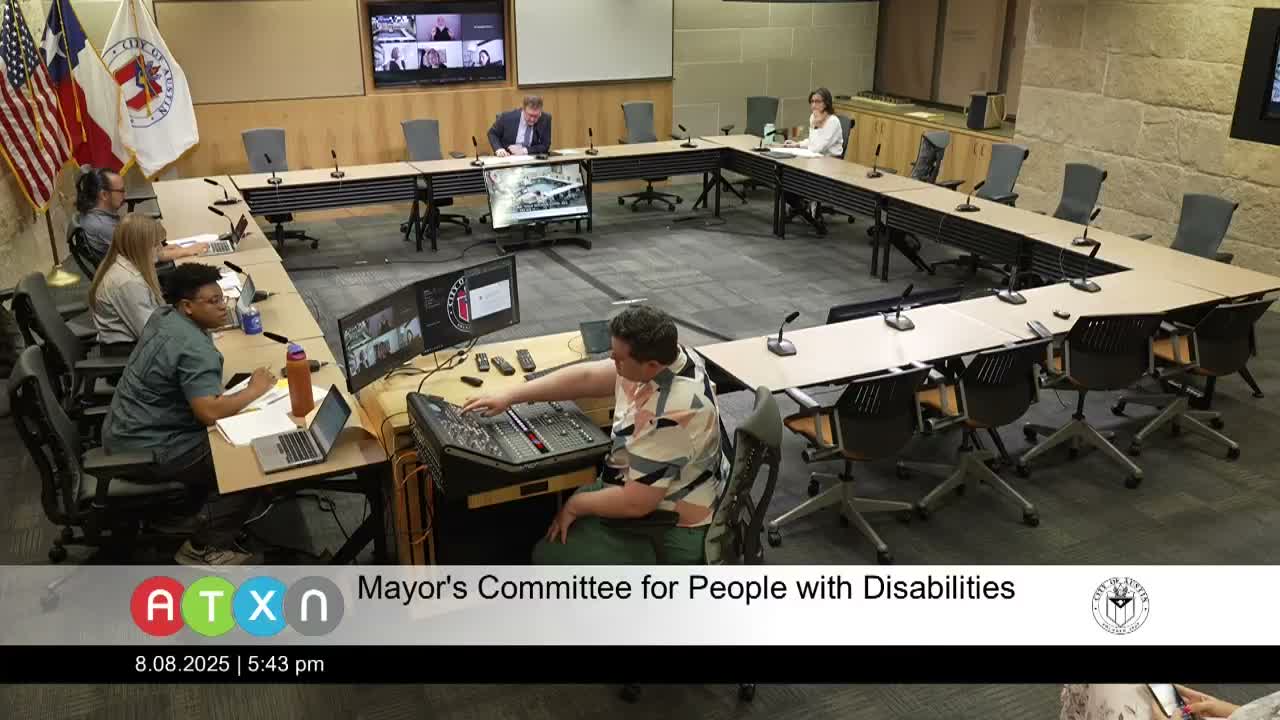
"We are currently in the public outreach phase for our ADA transition plans," said Jettal Bhakta, the pedestrian crossing program manager with Transportation and Public Works, as she opened a presentation to the Mayor's Committee for People with Disabilities. Bhakta said the effort covers pedestrian crossings and urban trails and uses community-submitted information plus technical analysis to prioritize improvements.
Consultant Shida Karugati of DKS Associates described the plan's focus areas: missing or malfunctioning pedestrian buttons and signals, short crossing intervals, missing or faded crosswalks, ramps that are not ADA‑compliant or misaligned with crosswalks, obstacles in paths, insufficient audible cues, poor lighting and trail conditions such as steep inclines, cracked pavement and narrow or obstructed paths.
The city is collecting feedback primarily through a brief online survey, available in English and Spanish, that allows respondents to mark problematic locations on a map and provide demographic information. Karugati said the survey and outreach will close Aug. 15 and that staff have conducted open houses and in‑person events during outreach that began in late June.
Bhakta and Karugati said the program is funded at the planning stage by a Safe Streets and Roads for All federal grant; that funding covers field evaluations, development of cost estimates and scheduling to remove barriers but does not itself fund construction of improvements. "We are able to collect these locations, go out into the field and evaluate them, and then come up with some cost estimates and a schedule to eliminate those barriers to access," Bhakta said. Staff added that identified projects could pursue implementation grant funding through the same program or be incorporated into other projects as funding becomes available.
Timeline milestones presented to the committee include a 50% draft plan targeted for November and a final plan anticipated in June 2026. Staff asked commissioners to circulate the survey and to submit specific crossings or trail segments for evaluation; they provided a project email (mobilitybonds@AustinTexas.gov) and phone number ((512) 974-2300) for follow up.
During questions, commissioners raised concerns about relying solely on a public survey and asked whether the project would include independent field evaluation. Karugati said the approach is "two‑pronged": community-identified locations will be combined with backend analysis of pedestrian generators, proximity to schools (including the Texas School for the Blind and Visually Impaired), bus stops and parks to identify candidate locations for inspection.
Commissioners also asked about funding for construction. Bhakta said the current federal grant pays for the planning effort, and staff confirmed that future implementation depends on separate funding sources, including competitive implementation grants and potential inclusion of projects in future bond packages.
The committee closed the discussion by thanking staff and agreeing to help promote the survey and solicit location suggestions from communities across Austin.