Get Full Government Meeting Transcripts, Videos, & Alerts Forever!
Get email alerts on the Digital Equity topic
No spam. Unsubscribe anytime.
Local nonprofits tell Austin commission GTOPS funding supports digital‑equity services
Summary
Representatives from Latinitas, Universal Tech Movement, Open Austin and Austin Freenet told the Technology Commission that GTOPS grants helped sustain adult digital‑literacy classes, device distribution and workforce pathways, and urged continued commission oversight of equity‑focused funding.
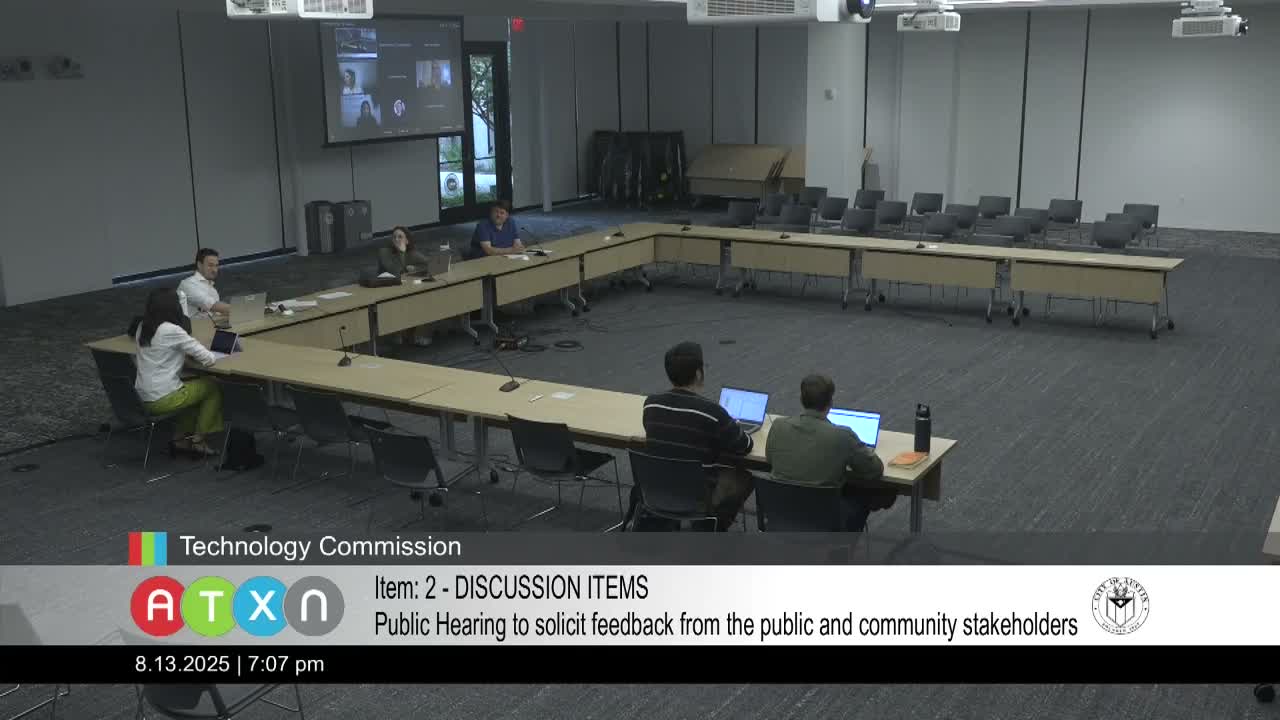
Five community organizations told the City of Austin Technology Commission on Aug. 13 that GTOPS funding and the commission’s review process have been essential to local digital‑equity work.
Gabriela King Guardia, executive director of Latinitas, described 15 years of GTOPS engagement and said recent capacity and mini grants helped expand adult digital‑literacy programs that serve Latino residents. “These opportunities have been essential to advancing our mission and really bridging the digital divide,” she said.
Former commission chair Nehemiah Pitts reviewed the commission’s history and accomplishments, saying the Technology Commission helped double GTOPS funding to $400,000 and pushed the city to adopt a Digital Inclusion Strategic Plan and a regional broadband needs assessment. Pitts warned that sunsetting or diluting the commission could reduce direct community engagement and policy leadership, and he recommended quarterly listening sessions, deeper cross‑sector collaboration and a refreshed digital‑inclusion strategy.
Michael Ward Jr., president and CEO of Universal Tech Movement (UTM), and Michael Brown, UTM senior director, presented the organization’s annual report, highlighting pathways from digital literacy to occupational training and claiming that UTM’s participants have seen average income increases they estimated at about $40,000. Ward said GTOPS-funded classes and partnerships with local nonprofits have allowed UTM to support hundreds of residents each year and to scale services beyond Austin.
Liani Lai, executive director of Open Austin, said participating in GTOPS cycles and panel review strengthened the organization’s grant-writing capacity and connected volunteers with civic‑tech projects. Jasmine Vargas, interim executive director of Austin Freenet, said the organization has used multiple GTOPS capacity grants to support device distribution, digital‑literacy training and its Digital Inclusion Week festival.
Commissioners asked presenters about metrics, training content, collaboration across commissions and how to broaden public engagement. Speakers urged the commission to preserve GTOPS oversight, continue community review panels, and expand listening sessions to reach marginalized and geographically isolated residents.
The commission did not take formal funding decisions at the meeting; several commissioners said they would work with staff to ensure the organizations’ testimony is included in the clerk’s record and follow up on requests for additional materials.