Get Full Government Meeting Transcripts, Videos, & Alerts Forever!
Get email alerts on the Artificial Intelligence topic
No spam. Unsubscribe anytime.
City briefing details new Texas AI law, preemption risks for Austin policies
Summary
City intergovernmental relations staff briefed the Technology Commission on recently passed and pending Texas bills that regulate government use of AI, set statewide rules for autonomous vehicles and alter franchise definitions for streaming services; staff warned some measures preempt local rules and noted an effective date for the AI law of Jan. 1, 2026.
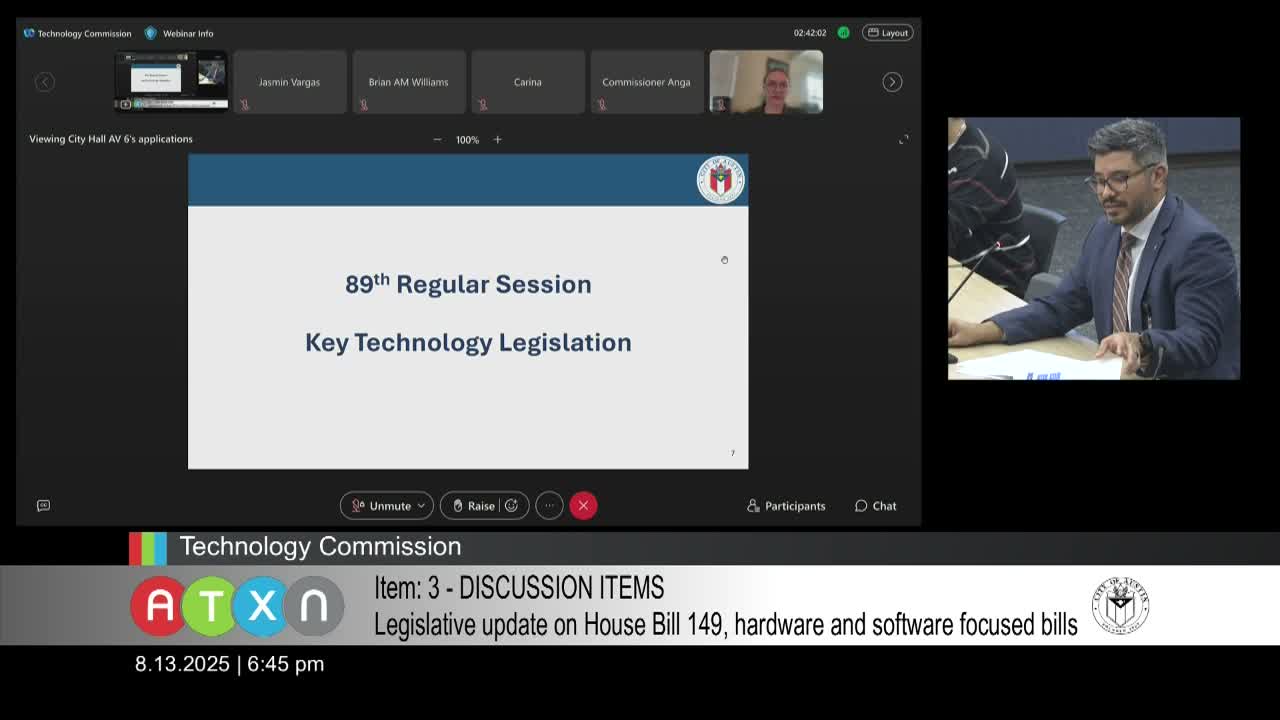
Rick Ramirez, deputy intergovernmental relations officer for the City of Austin, told the Technology Commission on Aug. 13 that the Texas Legislature passed a package of bills this session that together reshape how state and local governments will use and govern artificial intelligence.
Ramirez summarized HB 149 as the primary AI bill: it requires government agencies to disclose to people when they are interacting with an AI system, prohibits AI-driven “social scoring” and certain biometric identification when civil liberties are implicated, establishes the Texas Artificial Intelligence Council, and preempts local AI regulation. Ramirez said the law’s effective date is Jan. 1, 2026, and that implementing rules and council guidance are forthcoming.
The presentation flagged two companion measures. Ramirez described HB 3512 as a training bill that will require certain local-government employees to complete certified AI training (programs to be developed in coordination with the Department of Information Resources and the new Texas Cyber Command). Ramirez said SB 1964 targets “heightened-scrutiny” or high-risk AI systems by adding requirements for ethics, risk management, transparency and complaint handling.
Commissioners asked whether HB 149 would preempt the city’s existing AI policies. Ramirez said the city attorney’s office is working with departments to interpret the law and that the legal team is advising departments on compliance; he said it was “probably” that the state law will preempt some local rules and that staff will return with detailed guidance.
Ramirez also briefed the commission on other session items that affect municipal operations: SB 2807 (autonomous-vehicle statewide standards) is in rulemaking and limits local regulation; SB 924 clarifies cable and video-service definitions and explicitly excludes internet streaming, a change that could affect franchise-fee revenue; and a number of high-profile bills did not pass, including a proposed statewide homeless-data sharing network (HB 636) and a drone ban tied to foreign-made components (HB 41), which Ramirez said could have grounded much of the city’s drone fleet.
Ramirez closed by reminding the commission that many details will be set in agency rulemaking, and he encouraged commissioners to send follow-up questions through staff. “The legal department and the departments are analyzing right now what that impact might be,” he said.
The commission did not take formal action on policy changes at the meeting; staff said they will provide legal analysis and implementation guidance to departments and the commission as rules are published.