Get Full Government Meeting Transcripts, Videos, & Alerts Forever!
Get email alerts on the Growth Management topic
No spam. Unsubscribe anytime.
Carlsbad council receives growth‑management report as public critics press for MMLOS monitoring and action on Ponto open space
Summary
At its March meeting the Carlsbad City Council received the FY 2024–25 Growth Management Program monitoring report; residents and advocates urged the council to fix gaps in multimodal level‑of‑service (MMLOS) monitoring and to address an open‑space deficit at Ponto. Staff said it will return with options by September.
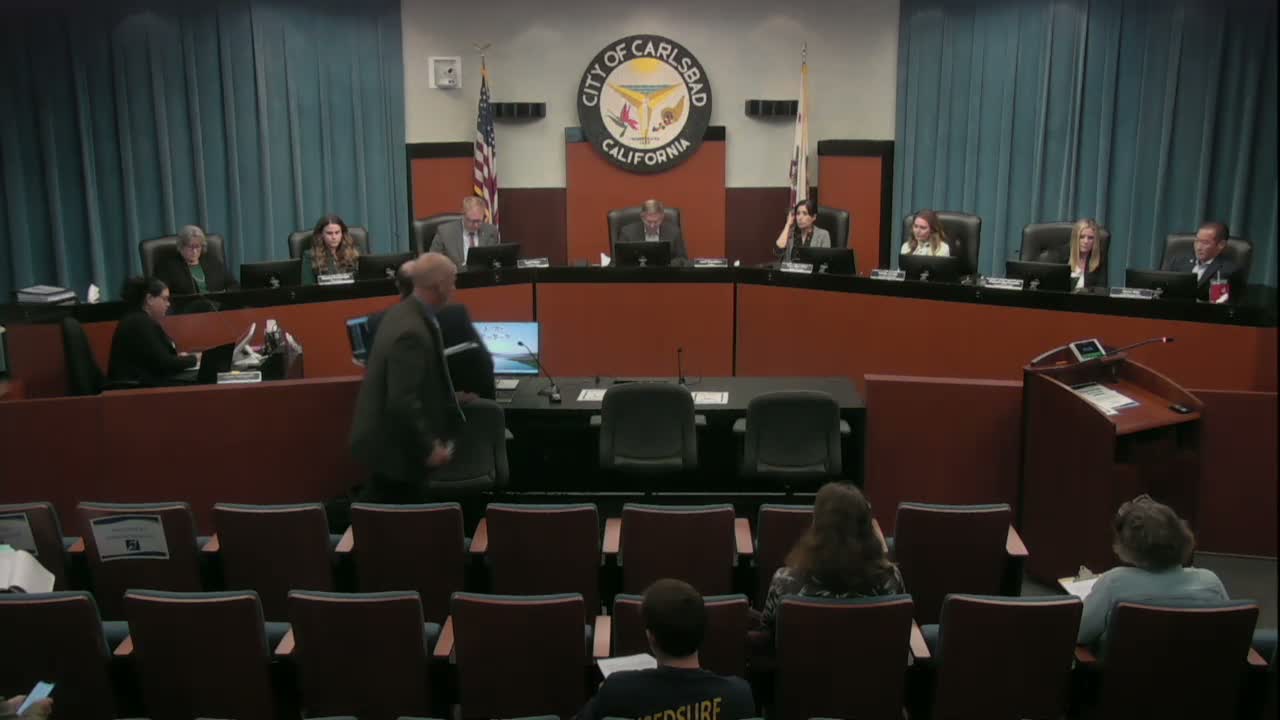
The Carlsbad City Council on March 11 received the city’s FY 2024–25 Growth Management Program monitoring report while members of the public urged changes to how the city measures multimodal performance and demanded action to restore open space at Ponto.
City staff told the council the monitoring report shows the city currently meets the municipal code’s public‑facility standards under existing population numbers but also identifies facilities that will need to be constructed as buildout continues. Assistant Director of Community Development Eric Lardy said MMLOS (multimodal level‑of‑service) was an emerging concept when the city adopted it, that staff and consultants have struggled to develop a workable compliance methodology, and that staff will return to the council by September seeking policy guidance.
Why it matters: the MMLOS approach determines how the city evaluates circulation, mitigation and developer obligations. Critics say gaps in MMLOS monitoring let projects avoid required traffic mitigation and may leave evacuation and emergency routes unassessed.
Residents and advocacy groups used the public hearing to press those points. Paige Desino of Preserve Calavera told the council that the report omits key documentation about Local Facilities Management Zone exemptions and lacks percent‑of‑open‑space figures for several zones, and urged workshops and engagement with the Environmental Sustainability Commission on Ponto’s future.
Steve Linke of the Equitable Land Use Alliance argued the circulation section lacks the required MMLOS monitoring and asked the council to reject that component. “Don’t be fooled by claims that cities can no longer use vehicle level of service,” Linke said, and he asserted the city’s historical grading scheme overstated capacity—calling it a “fake LOS grading scheme” that masked Es and Fs on many streets. Linke recommended a date‑certain review within six months and restoration of enforceable vehicle level‑of‑service monitoring for evacuation routes.
City Manager Patnaud and staff responded that MMLOS has not been implemented successfully elsewhere, that staff paused further action while awaiting appellate litigation outcomes, and that the appellate court’s December 2025 decision in the city’s favor cleared the path for staff to present options this fall. Lardy said staff needs explicit policy direction from council before undertaking a new MMLOS methodology or proposing amendments to circulation and growth management standards.
Councilmembers voiced frustration about state law constraints—several said recent state housing statutes and legal interpretations limit local tools such as moratoria or other enforcement mechanisms. Councilmember Acosta thanked residents for their comments and asked staff to return with options. Councilmember Burkholder and others said they welcome more clarity on what the city can and cannot do under state law.
Action: Council moved to receive and file the monitoring report and adopted the accompanying resolution unanimously. Staff pledged to return by September with proposals and a recommended path forward on MMLOS and related circulation standards.
Next step: staff will prepare options for council consideration in September, per the timeline discussed in the meeting.