
Child‑care providers tell TWC KinderConnect failures threaten participation as commission advances fraud-rule with in‑person site‑visit amendment
Get AI-powered insights, summaries, and transcripts
Subscribe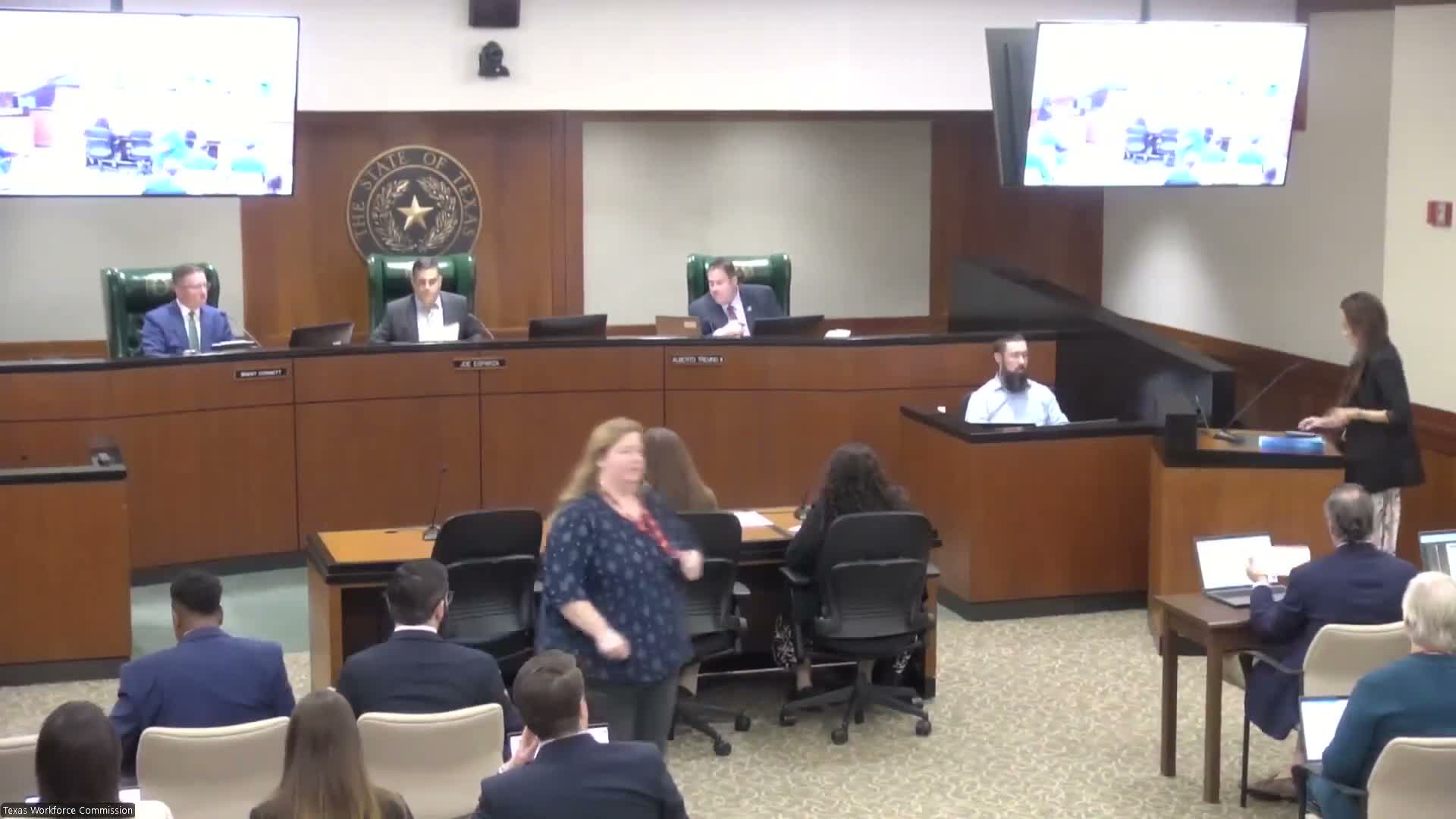
Summary
Providers told the Texas Workforce Commission that KinderConnect errors, delayed authorizations and inconsistent reimbursements are forcing centers to absorb compliance risk and drop participants. The commission approved publishing proposed 40 TAC chapter 809 fraud‑detection rules for public comment and added “in person” before site visits.
At a Texas Workforce Commission meeting, multiple child‑care providers told commissioners that technical failures and administrative delays in the state’s KinderConnect system are creating compliance problems, payment uncertainty and the risk that providers will stop participating in the subsidy program.
"When the childcare system struggles, it's not just a provider issue. It becomes a workforce issue for the employers and the communities across Texas," said Kayla Linder, president‑elect of the Texas Lisonbee Child Care Association and cofounder of Fractal Education, during the public‑comment period.
Why it matters: Commissioners are considering changes to 40 Texas Administrative Code chapter 809 that would strengthen fraud detection and enforcement for the child‑care services program. Providers warned that an enforcement focus that does not account for recurring system errors could penalize programs for mistakes they cannot control and could reduce provider participation, which in turn limits access to care for working families.
Providers described concrete consequences. Jill Goodrich, executive director of Opportunity School in Amarillo, said her program spent more than $70,000 in scholarships and more than $100,000 last year to bridge gaps caused by delayed approvals. Margie Reed, a center operator in Mexia, said inconsistent attendance reporting in KinderConnect leaves centers unable to budget reliably and has led her to consider refusing Child Care Services payments.
Staff presented a proposed rule to amend subchapter F of chapter 809 on fraud fact‑finding and improper payments and recommended publishing the draft in the Texas Register for a 30‑day public comment period. Reid O'Brien of the Office of General Counsel told the commission the purpose is "to further strengthen the integrity of Texas' child care services program by enhancing fraud detection, prevention, and enforcement mechanisms." He also asked for authority to make non‑substantive edits needed for publication.
During debate, Commissioner Connick proposed — and the commission adopted — an amendment to add the words "in person" before site visits in section 809.114(d). With that amendment included, the commission voted to publish the proposed rule for public comment.
What commissioners said: Chairman Esparza and several commissioners acknowledged the problems reported by providers and asked staff to keep them apprised of system improvements. Executive director Steve Pier told the commission staff considers the KinderConnect issues a top priority and will continue work on system fixes.
Next steps: The rule will be published for a 30‑day public comment period as amended; staff may make minor non‑substantive changes required for publication. Commissioners said they will monitor staff progress on system reliability and communications with providers.