
Panel reviews OPR 'miscellaneous' bill that would register massage establishments and tweak licensure rules
Get AI-powered insights, summaries, and transcripts
Subscribe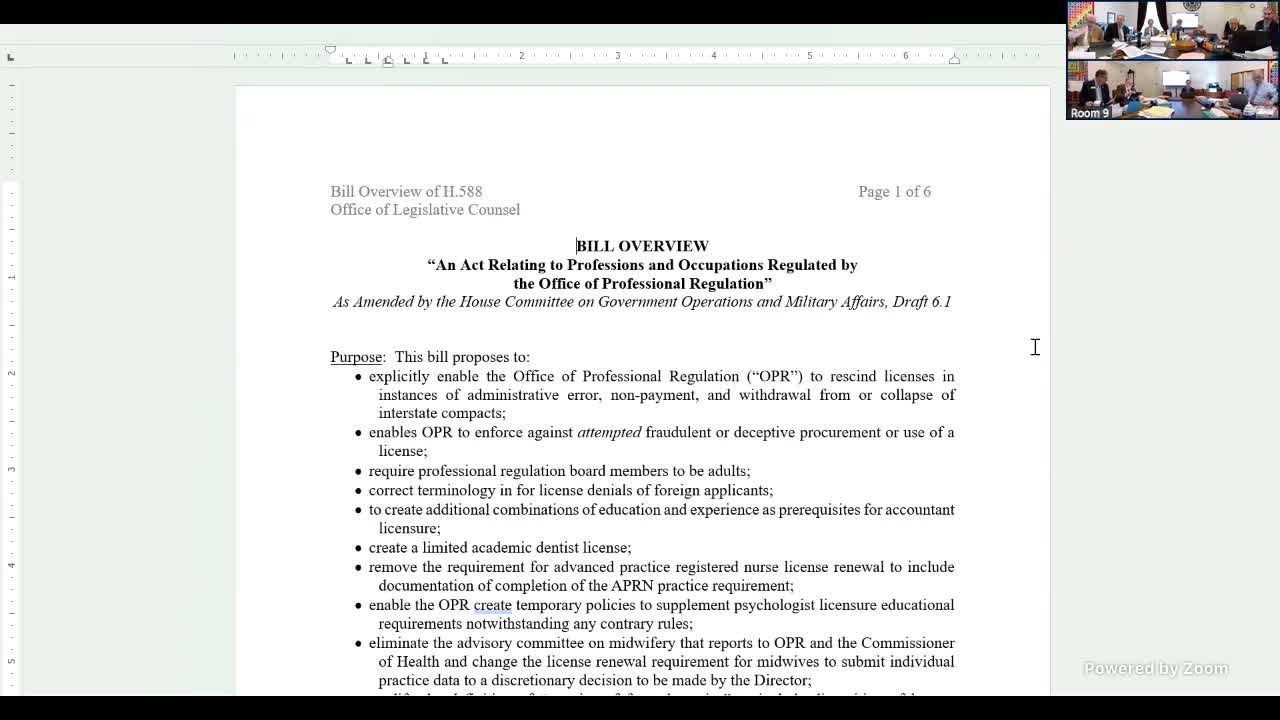
Summary
The committee examined a miscellaneous Office of Professional Regulation bill (referred to as H.588 in the hearing) that would create establishment registration for massage/bodywork businesses, add inspection and disclosure requirements, and make a range of profession-specific changes; Ways and Means offered a tiered fee schedule estimated to raise modest revenue.
The House Appropriations Committee on March 11 considered a multi-part bill from the Office of Professional Regulation that would change licensing and operational rules across several regulated professions and add a new registration tier for massage establishments.
Legislative counsel Tim Dublin said the bill makes several cross-cutting changes—enabling OPR to rescind licenses in certain administrative-error or compact-withdrawal cases, requiring professional regulation board members to be adults, adjusting foreign-applicant terminology, and creating limited academic dentist licensure and changes to APRN renewal documentation. Dublin also said the bill requires OPR to report on whether speech-language pathology assistants should be regulated (a Sunrise review-style report) and dissolves an advisory committee on midwifery.
A central and lengthier discussion centered on requiring registration of massage establishments. Dublin said the statutory definition would cover any location ‘‘where the practice of massage or the practice of bodywork is regularly engaged in’’ or places that represent themselves to the public using terms such as ‘‘massage therapy’’ or ‘‘bodywork.’’ He explained the bill is intended to create an additional enforcement avenue—registration would let the director require establishments to display registration, disclose information to clients before the first treatment, and make it easier to sanction establishments for unprofessional conduct; individuals would remain licensed separately.
Committee members asked whether a sole practitioner working from a rented room in a building would be treated as an establishment. Dublin said sole proprietors generally would be licensed as individuals and an exemption in the bill would exempt a location "provided solely by a single massage therapist" from establishment registration, though individuals remain subject to professional sanctions for misconduct.
A Ways and Means amendment presented to the committee proposed a tiered establishment fee: an initial registration fee of $50 and renewal $75 for businesses with two practitioners; an initial $100 and renewal roughly $275 for businesses with three or more. Ways and Means staff said OPR data are limited, but estimated initial-year revenue from registration could be on the order of $15,000 and renewal-year receipts around $40,000; they described those figures as approximate given uncertain counts of businesses by size.
The bill also expands the definition of funeral-service practice to include disposition by cremation, alkaline hydrolysis, and natural organic reduction, and it removes the midwifery advisory committee while changing midwife license‑renewal data requirements. Dublin noted the bill contains a separate amendment allowing pharmacists to prescribe certain COVID medications.
The committee heard questions about rulemaking authority and enforcement tools; counsel and staff pointed to statutory sections (26 VSA provisions) that permit OPR rulemaking on disclosure, display of registration, client acknowledgments, complaint processes and other implementation items. Committee members asked for OPR testimony if the committee wanted deeper policy or enforcement detail.
No final vote on the bill is recorded in the transcript; committee staff said additional amendments were expected and that the committee would likely bundle votes at a later time.