
Santa Fe County funds $3 million for developer assistance, backs Lamplighter redevelopment and advances supportive‑housing planning
Get AI-powered insights, summaries, and transcripts
Subscribe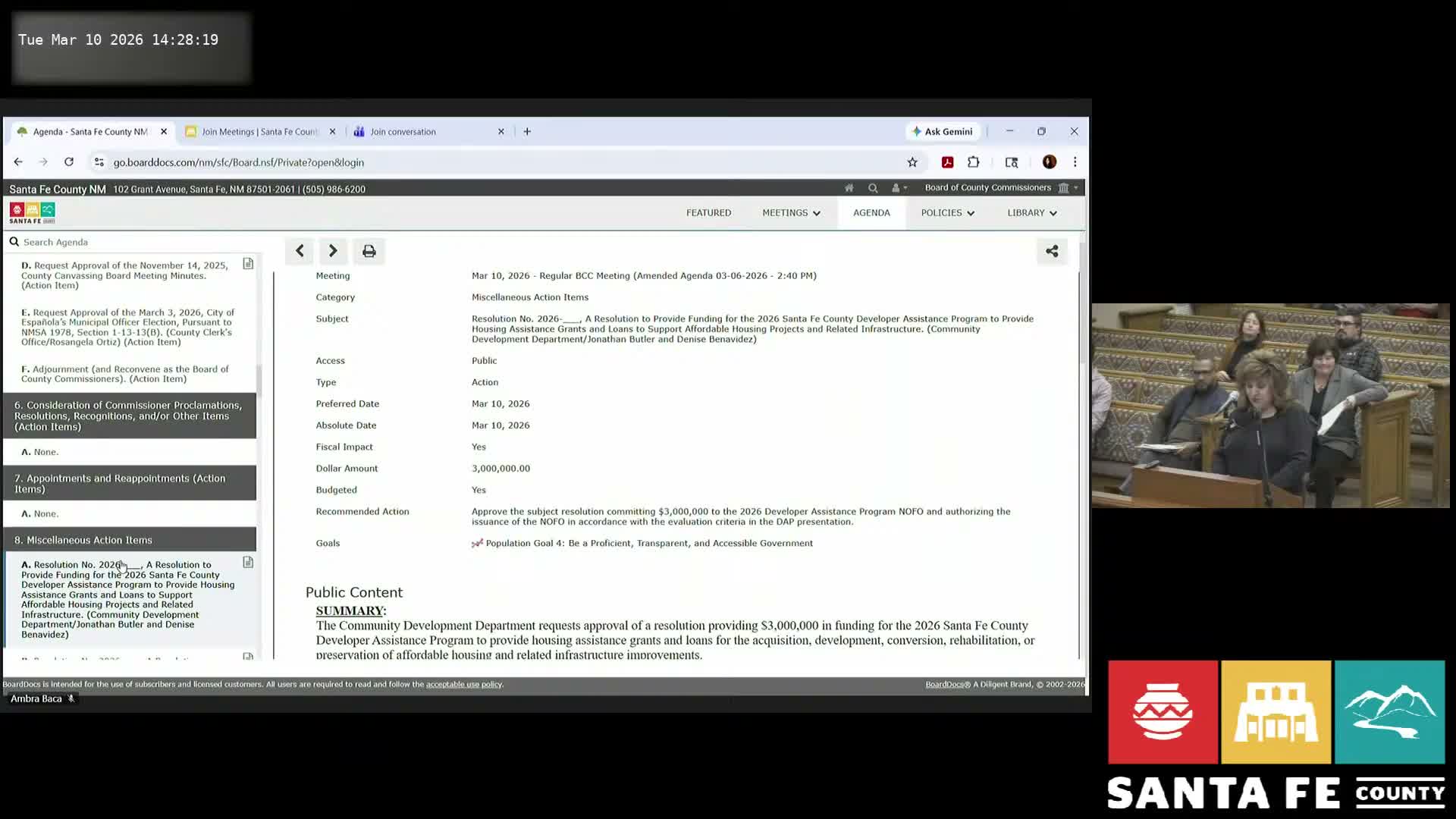
Summary
The Board approved $3 million for the county's 2026 developer assistance program, approved $1 million toward the Lamplighter Inn redevelopment and received a feasibility briefing on a 40‑unit trauma‑informed permanent supportive housing pilot. Commissioners urged matching funds and long‑term services commitments.
The Santa Fe County Board of County Commissioners voted March 10 to allocate $3,000,000 to the 2026 developer assistance program to help finance affordable housing projects countywide and approved a separate $1,000,000 allocation to support the Lamplighter Inn redevelopment.
Denise Benavides, community development staff, told the board the developer assistance program provides gap financing — grants and loans — to qualified developers serving low‑ and moderate‑income households, and that the county's 2023 affordable housing plan estimates a need for roughly 600 subsidized rental units countywide. She said the recommended 2026 package would leverage state and federal housing resources and aims to support both multifamily and single‑family affordable options.
Jonathan, a county staff presenter, outlined a separate resolution to accept New Mexico Department of Workforce Solutions funds and to allocate $1,000,000 from the developer assistance program to the Bella Luz LLP Lamplighter Inn redevelopment, a conversion planned to create about 58 long‑term affordable units. Developer representative Jen Lopez said partners identified a roughly $2.5 million funding shortfall and described a proposed capital stack that included the county's $1,000,000, an estimated $900,000 from Workforce Solutions and about $600,000 from the city of Santa Fe. Lopez told commissioners the project budget is roughly $15.8 million and that, if approved, closing must occur quickly to meet lender and grant deadlines.
Commissioners pressed for accountability and contingency planning. Commissioner Lisa Kokari Stone asked for documented commitments and possible memorandum of understanding language; county counsel and staff said closing and the presence of the full capital stack would be required before county funds are disbursed. County staff said the county's authority to proceed would be conditioned on capital being in place simultaneously, and that any failure of partners to deliver would require the board to revisit the county's commitment.
The board also heard a detailed feasibility briefing on trauma‑informed permanent supportive housing (PSH) from Project Moxie, funded by a community foundation grant. Consultant Jen Lopez recommended starting with a 40‑unit PSH pilot to serve people experiencing chronic homelessness, noting that a project of that scale is more competitive for state funding and Low‑Income Housing Tax Credit equity. The consultants modelled conservative operating assumptions and said the project may require a county‑backed services reserve (worst‑case modeled at roughly $300,000 to $400,000 per year for 15 years) to underwrite supportive services until other revenue streams (Medicaid billing, vouchers, philanthropic or settlement funds) are secured.
Commissioner Hank Hughes urged a substantial county commitment to help unlock tax‑credit equity and other partners; several commissioners suggested combining county, city, hospital and settlement resources to spread the services obligation. Commissioners discussed timing and whether to include service‑reserve funding in the 2026 budget process or to act sooner. Staff said many capital sources are time‑sensitive and that a clear county services guarantee would speed private investor confidence.
What happens next: The Lamplighter resolution passed unanimously. Staff said if the full capital stack is not in place at closing the county would not disburse funds and would return to the board for further direction; staff will provide the documentation required at closing and follow the county procurement and developer assistance rules. Consultants and staff said next steps on PSH include additional site feasibility, a service‑provider solicitation and a refined budget that identifies specific funding sources for the services reserve.