
Permeable reactive barrier sharply reduces PFAS levels at former municipal fire training site, officials say
Get AI-powered insights, summaries, and transcripts
Subscribe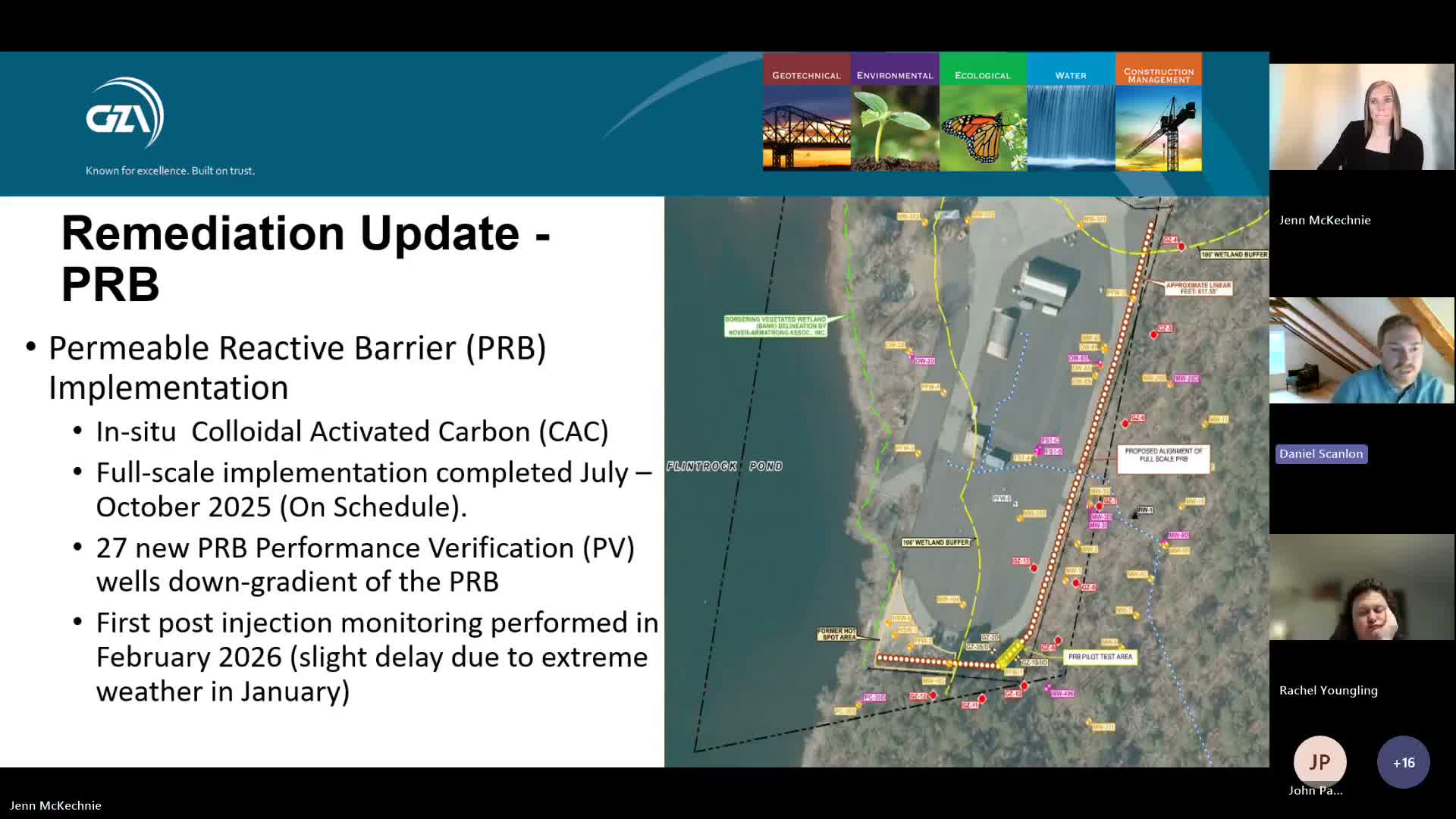
Summary
Consultants and Barnstable County reported that a permeable reactive barrier (PRB) installed July–October 2025 at the former Municipal Fire Training Site produced large early declines in PFAS concentrations in downgradient monitoring wells; officials said monitoring will continue and reinjection may be required as the barrier’s absorptive capacity is finite.
A permeable reactive barrier (PRB) installed at the former Municipal Fire Training Site in Hyannis has produced large early reductions in PFAS concentrations in downgradient monitoring wells, Barnstable County and its consultant GZA reported at a public update.
Dan Scanlon, senior project manager for GZA, said the PRB injection work (conducted July–October 2025) used a colloidal activated carbon product described in presentation materials as “PlumeStop” and that GZA installed 27 performance‑validation monitoring wells downgradient of the barrier. "Pre-injection PFAS‑6 concentrations were upwards of 9,000 parts per trillion," Scanlon said, and he added that the first post‑injection sampling round collected in February showed concentrations in several wells "approaching non‑detect levels." "Those are really encouraging results to see this level of decline," he said.
Project leaders stressed these early results are preliminary and that continued monitoring is required. Matt Smith, the licensed site professional (LSP) and professional engineer serving as person in charge of remediation, said the carbon’s effective absorptive lifetime is estimated at about 10 years and that "if we get to a point where we start to see increasing concentrations downgradient, then a reinjection would be required" to maintain efficacy.
David Leone, designated LSP of record for the site, clarified that the 10‑year figure refers to the carbon’s absorptive capacity rather than a sudden breakdown and release: once receptor sites on the carbon are filled, the barrier would no longer sorb additional PFAS and "the step at that point would be to inject more carbon," he said.
John Paquin of GZA said the PRB is intended as a stabilization and containment measure to prevent further migration toward nearby drinking‑water supply wells while additional assessment and remediation planning continues. Paquin added that the PRB approach is passive (no pumping once installed) and that the county may consider decommissioning parts of the existing pump‑and‑treat system if monitoring shows the barrier is effective over time.
The county and consultants said they will continue scheduled post‑injection monitoring (another round about six months after the first post‑injection samples) and evaluate long‑term options, including reinjection or other emerging technologies as appropriate.
The meeting included public questions about permanence; in response, Scanlon said the injected carbon remains in place and is not physically removed. Officials repeatedly emphasized the need for continued sampling and monitoring before any decisions to alter the on‑site treatment system are made.