
Outside analysts tell New Britain board state funding falls short for special education
Get AI-powered insights, summaries, and transcripts
Subscribe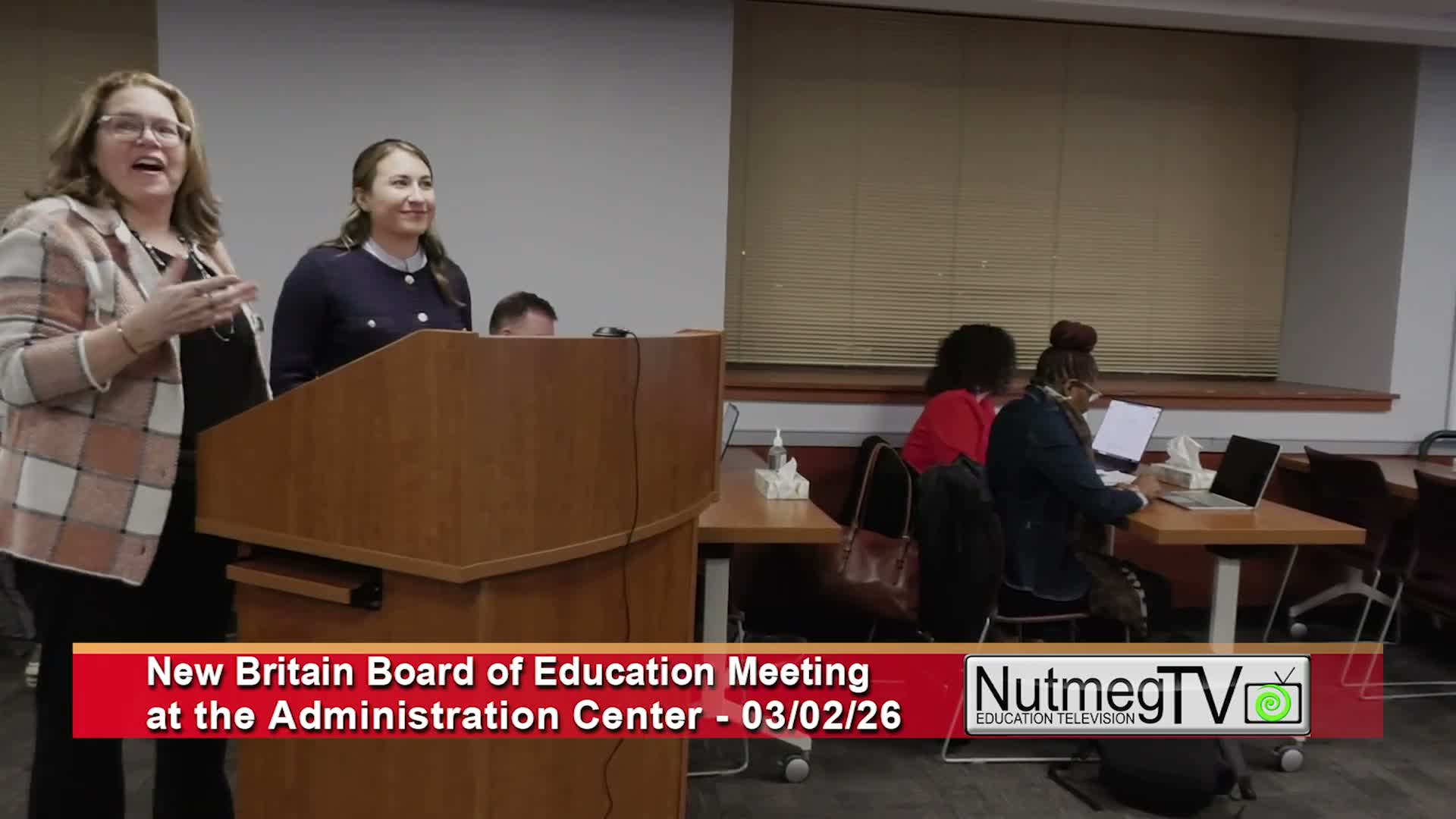
Summary
Presenters from the School and State Finance Project told the New Britain Board of Education that Connecticut’s special-education funding remains under-resourced, with reimbursement tiers and a partially funded seed grant leaving districts to cover the bulk of special-education costs.
Erica Haynes, director of community engagement for the School and State Finance Project, and Jeanette Luna, the project’s senior data and policy analyst, told the New Britain Board of Education that the share of Connecticut students identified with disabilities has risen sharply even as overall enrollment declines.
The presenters said the state’s data show large increases—particularly in autism and in students identified as having other health impairments—and stressed that students receiving 504 accommodations are not fully captured in state public datasets. Luna said that students with disabilities are disproportionately male and are about twice as likely as their general-education peers to be chronically absent or suspended.
Haynes and Luna reviewed academic outcomes, noting persistent gaps on the SBAC: students with disabilities are overrepresented in the lowest proficiency band and underrepresented among students scoring at higher levels. They also reported lower college enrollment (about 44 percent for students with disabilities versus roughly 70 percent for general-education students for the 2018–2024 window) and emphasized that these outcomes have not substantially improved.
On finance, the presenters described three primary state funding pathways: the Education Cost Sharing (ECS) foundation grant, excess-cost reimbursement that begins after districts exceed a 4.5-times per-pupil threshold, and a new ’seed’ grant added in 2025 intended specifically for special-education support. Jeanette Luna said excess-cost reimbursements historically fall well short of full costs (typically in the mid-60s percent range rather than the higher tiers the state described) and that the seed grant was funded below the calculated need—roughly $130 million allocated versus a theoretical $190 million funding share at a 50 percent weight—leaving districts to cover a large remainder.
Luna urged sustained local and state advocacy and offered tools—an online action center and district-level dashboards—to help board members and residents monitor finance, submit testimony and contact state legislators. Haynes encouraged board members to ask for data and to bring constituents to hearings; she said the organization will share slides and an action link with the board.
The presenters answered clarifying questions from the board about how 504 students differ from IEP students in funding and reporting and about teacher shortages in special education. Haynes and Luna emphasized that funding unpredictability and late state grant approvals complicate district budgeting.
The board requested the presentation materials and follow-up resources; the superintendent agreed to circulate the slides to board members.
The presentation concluded with a call to advocacy and concrete resources the board and community can use to press for fuller state funding.