Get Full Government Meeting Transcripts, Videos, & Alerts Forever!
Get email alerts on the Budget Tax topic
No spam. Unsubscribe anytime.
San Marcos Council advances FY2026 budget and sets maximum proposed tax rate after public hearings
Summary
On Sept. 2 the San Marcos City Council approved the first reading of the fiscal 2026 budget and set a maximum proposed tax rate of 67.69¢ per $100 of taxable value, directing a second public hearing and final vote on Sept. 16. Staff warned state legislation could limit future local spending and flagged an estimated $2 million annual EMS shortfall.
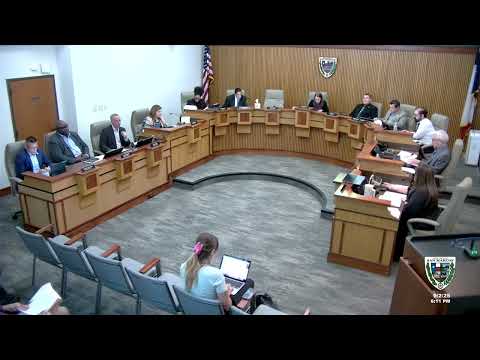
The San Marcos City Council on Sept. 2 approved the first reading of the proposed fiscal year 2026 budget and set the maximum proposed tax rate at 67.69¢ per $100 of taxable value, moving both items to a second public hearing and final vote on Sept. 16.
Finance Director John Locke opened the budget presentation with the city’s broad revenue and expense picture, saying the proposed operating budget totals about $371.1 million while the capital improvements program is roughly $114.8 million. He warned that sales‑ and property‑tax growth has slowed and that state legislation such as House Bill 73 and a version of Senate Bill 10 could materially restrict the city’s ability to raise and spend local revenue in future years.
“We're estimating an additional $2,000,000 tied to emergency medical services under the changing service model,” Locke said, calling the EMS estimate a major factor that changed the fiscal outlook.
The presentation described three tax‑rate options: the current 60.30¢ rate, a no‑new‑revenue rate (62.78¢), an intermediate option (64.96¢), and staff’s recommended option (67.69¢). Locke showed how the recommended rate would provide about $3.5 million for current and future needs, with $2.2 million for ongoing expenses and $1.3 million for one‑time items.
During citizen comment earlier in the meeting, residents urged larger allocations for human‑services funding. Casey Baker said increasing the Human Services Advisory Board allocation would be worth a modest tax increase: “If I know that my property taxes are going to helping my neighbors meet their … living expenses, then I think it's worth paying a little bit more,” Baker said.
After staff questions and council discussion, the council voted unanimously, 7–0, to approve the budget ordinance on first reading and to set the tax ordinance for first reading at the council’s chosen maximum. Both the budget and the tax‑rate ordinance will return on Sept. 16 for the second public hearing and final votes.
What happens next: the council will hold a second public hearing on Sept. 16 (6 p.m., City Hall), at which members may adopt the budget and set the tax rate. Staff emphasized the chosen fiscal year 2026 rate will affect future years because of statutory voter‑approval multipliers and potential state limits on local revenue growth.