Get Full Government Meeting Transcripts, Videos, & Alerts Forever!
Get email alerts on the Municipal Budgeting topic
No spam. Unsubscribe anytime.
San Marcos council grills FY2026 budget and asks staff to model higher tax scenarios
Summary
City staff presented a $366.4 million FY2026 budget and three tax-rate scenarios; council directed staff to prepare the budget on the 'long-term focused' 64.96¢ rate and to run additional scenarios near 67¢–68¢ that would narrow or erase projected FY2027 shortfalls.
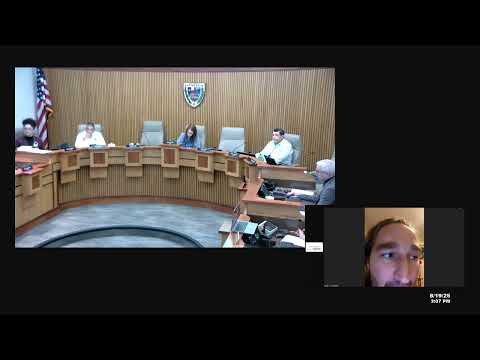
San Marcos City Manager Reyes and finance staff presented the proposed FY2026 budget on Aug. 19, telling the City Council the $366,400,000 spending plan includes $122,800,000 for the general fund and new investments in human services and community navigation.
Reyes said the proposal reflects months of departmental work and noted the budget funds $750,000 for human-services grants, a new Office of Community Support and Resource Navigation, tenant-protections funding of $70,000, and pay and benefits changes. "The $366,400,000 budget includes $122,800,000 for the general fund," Reyes said during the presentation.
Finance staff laid out three tax-rate choices for council: the no-new-revenue rate (6.278¢), a staff-recommended long-term-focused rate (64.96¢), and the voter-approval rate (70.47¢). Staff said the long-term-focused rate would generate roughly $1.9 million in additional FY2026 capacity and reduce a projected FY2027 shortfall; the voter-approval rate would produce about $6.7 million. Staff also warned multiple state bills under consideration could cap city budget growth and force significant cuts.
Council members pressed staff on recurring costs that are currently funded with federal or ARPA dollars and will expire in FY2027–28. Reyes and budget staff identified about $1.1 million in expiring items that include eviction-prevention services, diversion beds, cybersecurity/staffing and a mental-health-clinician collaboration; staff agreed to provide a line-item list and the meeting history for those commitments.
Public safety and emergency services also factored into the conversation. Fire Chief Les Stevens noted the city has already purchased a new engine for Station 7 and recommended operating it from Station 5 until a permanent station can be built; staff estimated full staffing for Engine 7 at 15 positions and about $2.2 million annually. Assistant City Manager Lanzow Anderson said Emergency Service District 1 has withdrawn and ESD 9 is considering withdrawal; council has commissioned a 12–18 month EMS study examining four options — regional partnership, municipal EMS, fire-based EMS, or private third-party providers.
After extended discussion, council did not adopt a final tax rate at the workshop but gave staff direction. Several members said they will support using the long-term-focused rate of 64.96¢ as the baseline for the upcoming budget documents; others asked staff to also produce scenarios at roughly 67¢ and 68¢ that would eliminate or materially reduce the projected FY2027 shortfall. Mayor (speaker 1) summarized the plan: staff will return with the 64.96¢ budget and additional modeled options ahead of the Sept. 2 and Sept. 16 public hearings and the Sept. 16 adoption vote.
The presentation and the council’s request for additional scenarios set the schedule for public review: the neighborhood commission will see the proposal on Aug. 20, and two public hearings on the budget and tax rate are set for Sept. 2 and Sept. 16.
What happens next: staff will provide the requested drill-down of expiring ARPA/federal-funded items, run the extra tax-rate scenarios council requested, and place the recommended budget and utility-rate items on the Sept. 2 public hearing agenda. The council will take final action on Sept. 16.