Get Full Government Meeting Transcripts, Videos, & Alerts Forever!
Get email alerts on the Transportation Infrastructure topic
No spam. Unsubscribe anytime.
Council programs $4.2M and approves change order for Palo Verde traffic‑calming pilot
Summary
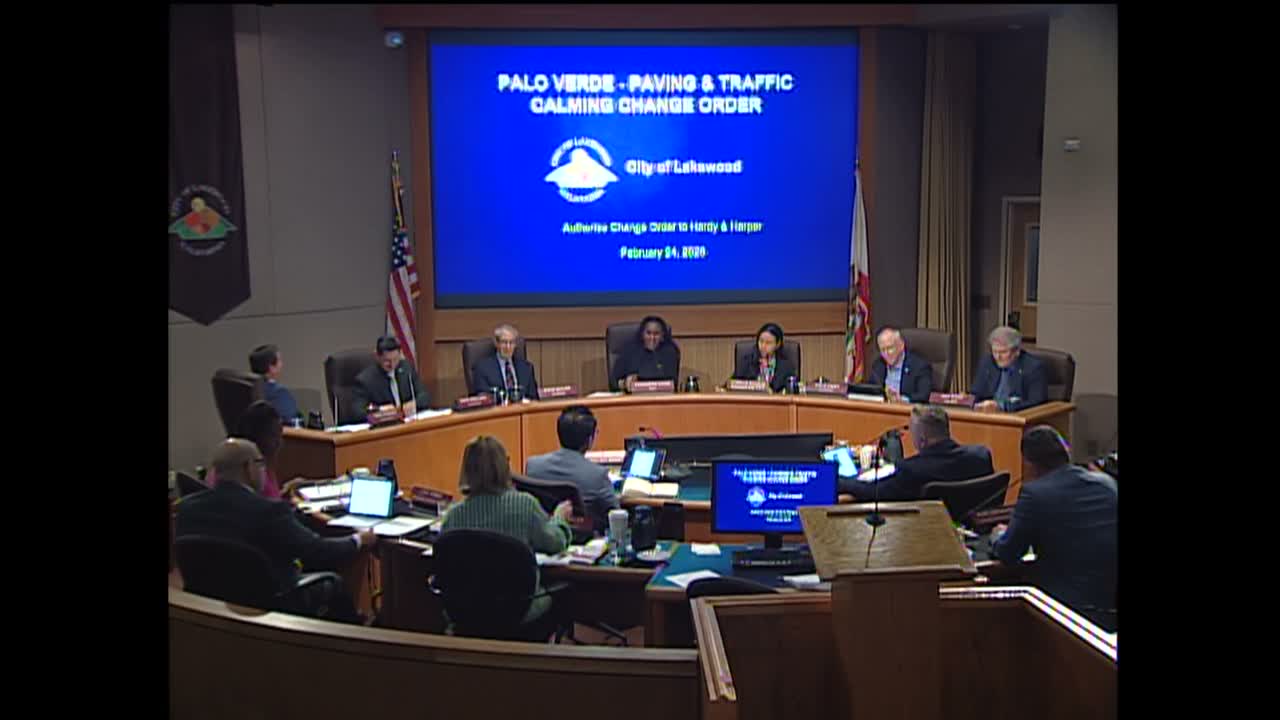
Council approved programming roughly $1.8M (Measure R) and $2.4M (Measure M) and authorized a $2.5M change order with Hardy & Harper to repave and install a pilot traffic‑calming corridor on Palo Verde, including a temporary roundabout at Candlewood and a 30‑day traffic monitoring evaluation.
The Lakewood City Council on March 7 approved staff recommendations to program additional funds and authorize a change order with contractor Hardy & Harper to repave a stretch of Palo Verde and install pilot traffic‑calming measures.
Kelly Pickler, director of public works, said the city identified nearly $4.3 million in unprogrammed funds after closing fiscal‑year accounts and proposed programming about $1.8 million from Measure R and $2.4 million from Measure M toward the Palo Verde pilot. Hardy & Harper proposed a $2,500,000 change order to complete paving and to install quick‑build traffic‑calming features, including a temporary roundabout at Candlewood.
Pickler described the pilot: repave the segment from Carson to South Street, restripe lanes to add an 8‑foot parking lane, a 5‑foot bike lane and an 11‑foot travel lane, and install a temporary, mountable roundabout at Candlewood with engineered curbs and high‑visibility bollards. ADA ramps at the corner would be temporarily blocked for the pilot and permanently revised only if the pilot proves successful.
Council members pressed staff on evaluation metrics. Pickler said the city will deploy a mobile traffic‑monitoring device to collect pre/post data over a roughly 30‑day monitoring period to measure vehicle speeds, non‑stops at pedestrian crossings and difficulty navigating the circle; staff will report results after the trial and will use recent collision data (Local Road Safety Plan update) to inform decisions. Councilmember Rogers noted the project follows several years of study and emphasized saving lives as a measure of success.
The council moved, seconded and voted unanimously to adopt staff recommendations, program the funds, and authorize the change order. Staff said if the pilot shows success they will return for permanent improvements; if not, temporary elements and striping will be removed and prior striping restored.