Get Full Government Meeting Transcripts, Videos, & Alerts Forever!
Get email alerts on the School Finance topic
No spam. Unsubscribe anytime.
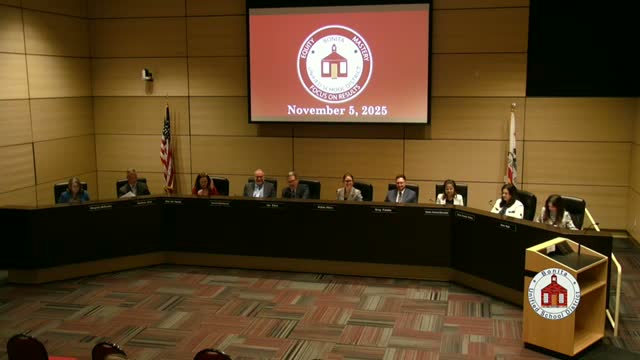
Bonita Unified hears detailed briefing on potential $260 million bond, tax-rate tradeoffs and legal limits
Summary
District consultants told trustees the district could access roughly $260 million under one illustrative bond structure but stressed tax-rate sensitivity, Proposition 39 compliance and strict limits on use of public funds for campaigning. Counsel outlined filing deadlines and project-list rules.
Bonita Unified trustees received a detailed presentation on the feasibility of a potential general obligation bond that consultants said could raise roughly $260 million under one illustrative schedule, and heard legal guidance on what voters would be asked to approve.
Chet Wang of Kegent Advisors framed general obligation bonds as the most common, lowest-cost method for districts to finance capital projects because repayment is through property taxes. "A GO bond is the most common method of debt financing utilized by school districts to finance capital projects," Wang said, explaining voters approve an authorization amount, a project list and an estimated tax rate.
Consultants told the board the district—urrent assessed value is about $13.7 billion and showed sensitivity scenarios: for example, a $60 per $100,000 tax-rate framing was used as an illustrative starting point that could produce roughly $260 million across multiple issuance series. Wang cautioned that slightly lower tax rates materially reduce proceeds and that polling is critical to decide which projects voters will support.
Bond counsel Nick Huer told trustees that any measure placed on the ballot under Proposition 39 would require a specific project list and a 75-word ballot statement that must include cost, tax rate and duration language, and that Prop. 39 lowered the approval threshold to a 55% supermajority. "Proposition 39... lowered the voter threshold ... to the 55% super majority requirement," Huer said. He also discussed the federal tax-exemption spend-down rule (typically 85% of proceeds within three years for each series) and urged the district to document a reasonable expectation to meet those timelines to avoid IRS challenge.
Huer reviewed campaign limitations and deadlines the board must follow if it moves forward: the board must adopt a resolution ordering the election and deliver it and required exhibits to the county registrar on the statutory filing timetable; counsel cited an 80th-day filing date in the presentation. He also cautioned that while the district may use public funds for impartial informational materials, it may not spend public funds to build a campaign or hire consultants to advocate for the measure.
District staff summarized core facility needs that motivate the exploration: districtwide HVAC replacement, plumbing upgrades, replacing portables and creating additional classroom space, safety and security upgrades, and new high-school science labs. Staff said project needs likely exceed $200 million and that the general fund (staff cited an unrestricted amount near $110 million) is largely committed to personnel costs and cannot absorb those capital needs.
Board members asked technical questions about polling methodology, which uses high-propensity voter lists from the county registrar, and about how the ballot language (dollars per $100,000 versus cents per $100) can affect voter comprehension and pass rates. Counsel offered to provide further written guidance and a memo on nonprofit/campaign contribution rules if the La Verne-San Dimas Educational Foundation or other community committees choose to support a campaign.
The board did not vote on placing a bond on the ballot at the meeting; members were presented with options and next steps to continue community engagement and further develop project lists for polling and legal review.