
Governor signs a package of bills covering tribal rights, public safety, health and labor
Get AI-powered insights, summaries, and transcripts
Subscribe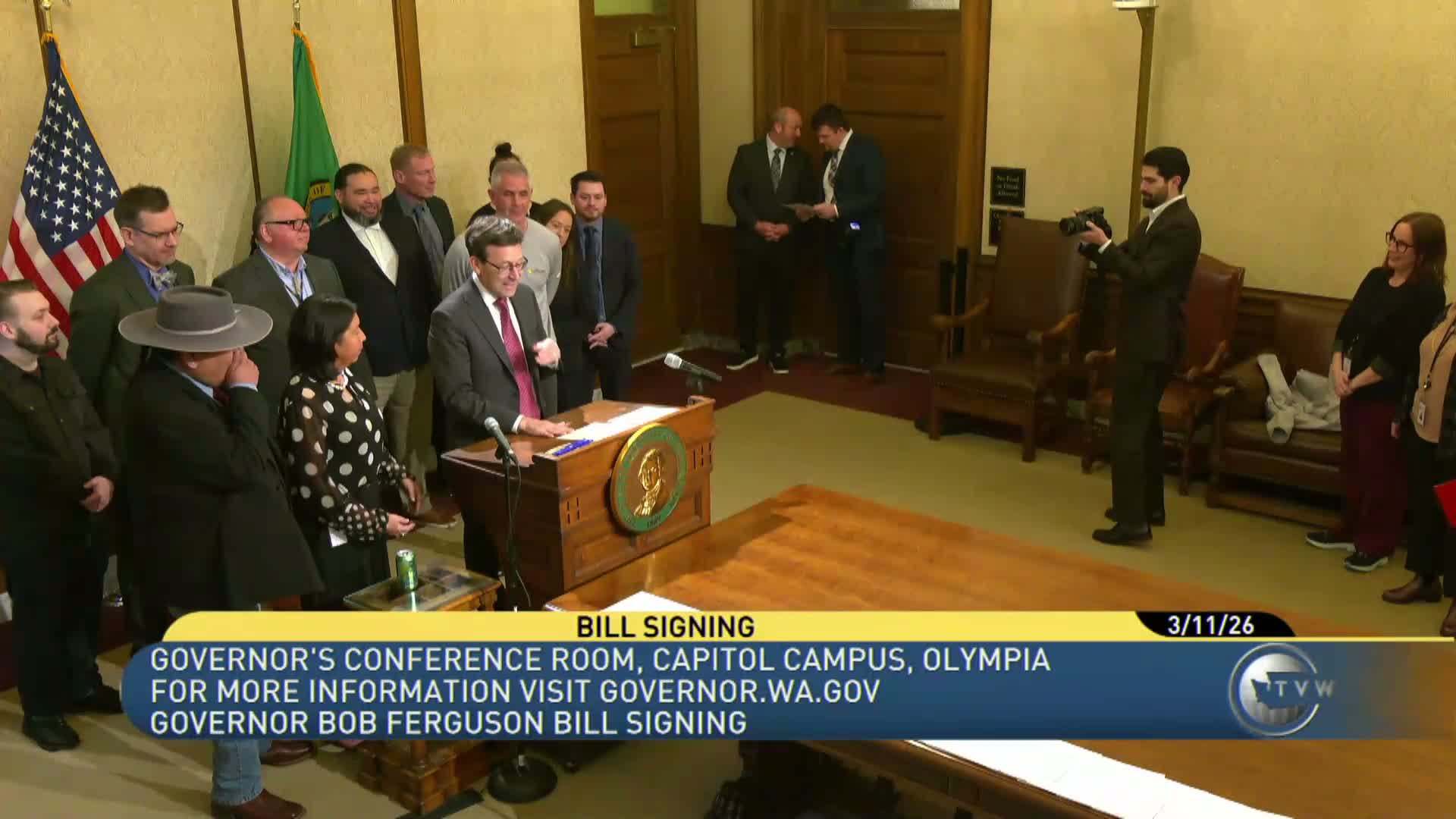
Summary
At a bill-signing ceremony at the Governor's Office, the governor signed more than a dozen bills into law, including a repeal of an anti‑tribal statute, a ban on employer-required microchipping, updates to ski-lift safety rules and measures to expand access to medical cannabis and licensure compacts.
The governor signed a package of bills at a ceremony at the Governor's Office on March 12, 2026, praising bipartisan cooperation and recognizing legislative sponsors. Among the measures signed was House Bill 2554, which repeals statutory language dating to initiative 456 that the governor said conflicted with treaty-reserved fishing rights and federal court rulings; the bill affirms tribes’ stewarding of Washington’s natural resources.
The ceremony covered a wide range of policy areas. The governor signed House Bill 1604, which updates guidance and training for jail officials performing strip searches to reflect current practices and better protect transgender and intersex individuals; House Bill 2088, which establishes an interstate licensure compact for dietitians; and House Bill 2107, which requires the Department of Labor and Industries to quickly notify construction sites when L&I identifies hazards that could cause worker injury.
House Bill 2152 was signed to allow qualifying terminally ill patients access to medical cannabis on hospital, nursing home and hospice premises; the governor said the change provides an alternative for managing pain and nausea in end-of-life care. Lawmakers also enacted House Bill 2158, expanding remote notary services so a physical document may be notarized remotely, an update the governor said improves access in rural areas.
Other measures the governor signed include House Bill 2230, reducing redundant DSHS oversight of community residential service providers for people with intellectual and developmental disabilities; House Bill 2272, updating ski-lift safety language to cover tramways, ski tows and conveyors; and House Bill 2294, which limits land-use covenants that could prevent grocery stores or pharmacies from reopening after a closure to help prevent food deserts.
The governor also signed House Bill 2345, prohibiting employers from requiring employees to implant microchips; House Bill 2363, permitting music therapy license applicants to practice under supervision for up to six months while exam results are verified; and House Bill 2476, which raises the maximum number of seats per screen at which theaters may sell alcohol from 120 to 200 without altering liquor control plans.
Financial and administrative bills included House Bill 2531, aligning the state's ambulance quality assurance fee program with federal rules and authorizing annual updates to reimbursement rates; House Bill 2534, allowing military families to establish residency in a new school district 90 days before moving; House Bill 2543, modernizing county clerk office electronic copies; House Bill 2557, requiring school districts to give parents evaluation reports at least five days before initial special-education eligibility meetings; and House Bill 2577, clarifying that the Department of Health should inspect acute care hospitals every 18 months and offering options to reduce duplicative inspections.
"It's my honor to sign this legislation into law," the governor said repeatedly during the ceremony, thanking sponsors and advocates and inviting photo opportunities after each signing. For each bill the governor publicly acknowledged the prime and companion sponsors and applauded bipartisan support. The event concluded after the signing of House Bill 2367, which removes certain regulatory exemptions and a sales-tax exemption for coal used at the TransAlta plant in Centralia and allows agencies to impose additional greenhouse‑gas requirements.
The signing ceremony was largely ceremonial and involved sponsor recognition, brief descriptions of each bill's purpose and photography; no floor votes or roll-call tallies were recorded in the ceremony transcript. Each bill will take effect on the dates prescribed in law or as otherwise specified.