
Department of Health seeks millions for dental access, Ryan White insurance coverage and rural health; committee forwards budget
Get AI-powered insights, summaries, and transcripts
Sign Up Free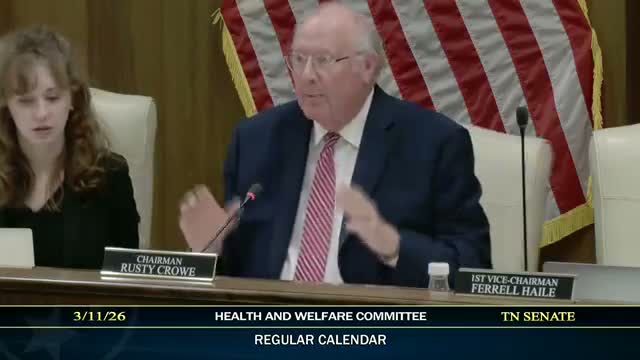
Summary
The Department of Health presented an FY27 request including $24M for the Healthy Smiles dental pilot, continued LMU dental support, an $18M increase for the Ryan White Insurance Assistance Program to cover premium spikes, naloxone purchases and rural health transformation projects; the committee voted to send the budget to Finance.
The Tennessee Department of Health (TDH) presented its FY27 budget priorities to the Senate Health and Welfare Committee, seeking investments to expand dental access, stabilize HIV care coverage, purchase naloxone for harm reduction and continue rural health transformation projects.
TDH requested $24 million in nonrecurring funds to sustain the Healthy Smiles Dental Pilot Program, which the department said has expanded student rotations and community visits through partnerships with the University of Tennessee and Meharry. TDH also highlighted Lincoln Memorial University’s dental services in East Tennessee and noted LMU will graduate its first dental class in May.
The department requested a little over $18 million in state funds to supplement the Ryan White Insurance Assistance Program so the program can continue to pay marketplace premiums for approximately 7,700 low-income Tennesseans living with HIV. John Webb, TDH deputy commissioner, said the total Ryan White insurance program currently runs about $58–$60 million and that the state increase reflects rising premiums. Webb told the committee TDH intends to screen people for Medicaid eligibility and move enrollees to Medicaid where appropriate.
TDH also requested funding to purchase 20,002 naloxone units targeted to high-need areas, to cover increased rent costs for a new state public health laboratory, and to support multiple rural health initiatives funded through shared savings tied to federal awards. The department said it manages roughly $712 million in approved federal projects (ARPA and other funding) and showed progress on local health department infrastructure and other ARPA projects.
Committee members asked for clarifications on program totals, the status of the Knox County forensic lab reimbursement and safety-net support for local primary care. TDH officials said Knox County had submitted invoices and the project remained on schedule. TDH deputy staff reported $31 million in recurring safety-net funds and noted the department has expanded services and increased reimbursement rates over recent years.
After the Q&A, the committee moved the TDH budget to the Finance Committee; the roll call produced nine ayes, and the chair announced the referral.
What happens next: The Finance Committee will undertake fiscal review of the requested appropriations and the department’s shared-savings projects.