
Committee approves Super‑Speeder bill allowing courts to require speed‑limiting devices
Get AI-powered insights, summaries, and transcripts
Subscribe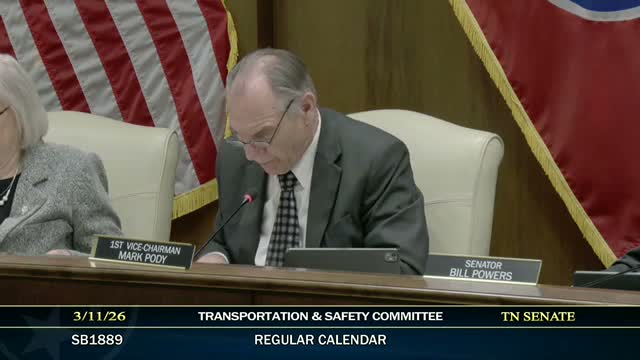
Summary
SB 19‑27 authorizes courts to require intelligent speed assistance (ISA) devices for repeat dangerous speed offenders; victims' family groups urged passage and a vendor described installation and ongoing costs. The committee passed the bill and sent it to calendar.
NASHVILLE — The Senate Transportation and Safety Committee voted to advance SB 19‑27, the Super Speeder Accountability Act, which would allow courts to require repeat serious speed offenders to use intelligent speed assistance (ISA) devices.
Chairman Massey said the bill targets ‘super speeders’ tied to a disproportionate share of fatal crashes and described the bill’s framework for judicial discretion and exceptions. Proponents included Patty Avery of Families for Safe Streets and Chuck Isbelle, who each described family tragedies and urged the committee to adopt corrective measures to reduce repeat speeding and its deadly consequences.
Brandon Ross, representing Speed Steer Safe, described how commercial ISA hardware operates: installation costs of roughly $150, removal at about $100, and a typical program fee cited as about $4 per day (committee testimony framed that as the vendor’s pricing). Ross said the devices use GPS to determine local speed limits and will limit acceleration accordingly; he emphasized the devices are not intended to provide continuous location tracking (the vendor characterized the devices as speed‑limit aware, not breadcrumb trackers used by fleet management).
Committee members asked about monthly costs to offenders and whether judges would set minimum terms; sponsor and witnesses said judges retain discretion and fees would generally fall to the offender. After discussion the committee approved the bill by voice vote (7 ayes, 2 no) and sent it to the calendar.
What happens next: If the bill clears the Senate, implementation details (vendor standards, court guidance and protections for device use) will require rulemaking or administrative guidance.