
Committee advances driver‑licensing language measure with 3‑year pathway for non‑English exams
Get AI-powered insights, summaries, and transcripts
Subscribe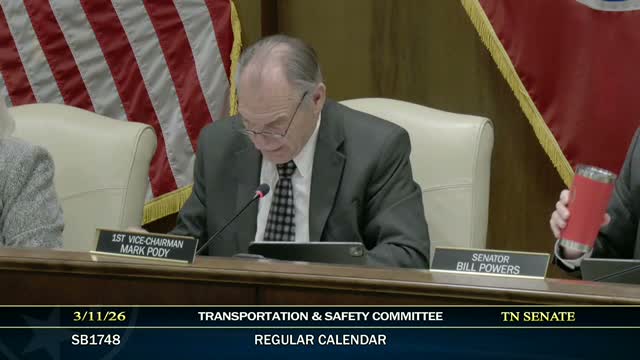
Summary
The committee approved an amended bill that allows initial driver written exams in the applicant's native language with a nonrenewable three‑year license; after three years applicants must pass the written test in English. Testimony urged interpreter access for road tests and warned of workforce impacts.
NASHVILLE — The Senate Transportation and Safety Committee on Monday advanced SB 18‑89, an amended bill that changes how Tennessee issues driver's licenses to applicants unable to read or speak English.
Under the amendment adopted in committee, applicants may take the initial written exam in their native language and receive an unrestricted three‑year license. When that license expires, the applicant must pass the written exam in English for renewal. The bill also includes registration language requiring proof of U.S. citizenship, lawful permanent residency, or federally authorized temporary stay for vehicle registration.
Opponents and public commenters said the renewal requirement could penalize lawful residents and workers who rely on driving to reach jobs, school and medical care. Rick Colbert told the committee a family history illustrating the policy’s potential to harm U.S. citizens who are functionally non‑English speakers; Diana Sanchez (representing the Our State, Our Languages coalition) and Sumner County resident Rachel Jackson urged the committee to add explicit interpreter access for the road test and warned the three‑year timeline for English fluency is unrealistic for working adults.
Graham Tudor, director of legislation for the Tennessee Department of Safety, clarified that state law already requires applicants to be in the country lawfully (citizen, lawful permanent resident, or lawful temporary resident).
Sen. Taylor, sponsor of the bill, said the changes strike a balance between safety and workforce needs by allowing a three‑year initial period while incentivizing applicants to learn English. After discussion and amendment, the committee voted to pass the bill to the finance and ways‑and‑means committees.
What happens next: The measure will receive fiscal review in finance; opponents urged explicit rules for language assistance on the road test if the bill advances.