
Senate committee advances bill to create state authority for subterranean transit
Get AI-powered insights, summaries, and transcripts
Subscribe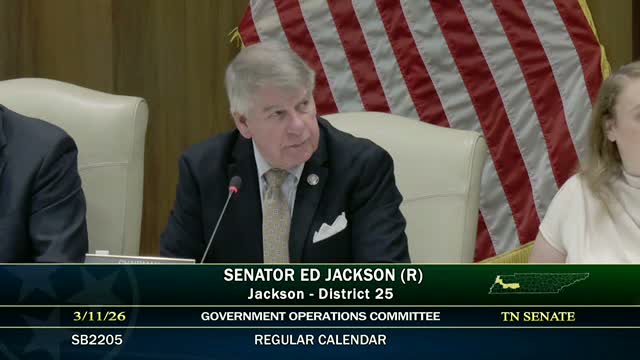
Summary
The Government Operations Committee voted to send Senate Bill 2205 to State and Local with a positive recommendation after the sponsor said the measure would create an 11-member authority to oversee qualifying subterranean transportation projects, including the Nashville tunnel project referenced in committee remarks.
Leader Johnson told the Tennessee Senate Government Operations Committee that Senate Bill 2205 would create a Subterranean Transportation Infrastructure Coordination Authority, an 11-member board tasked with governing qualifying subterranean transit projects and coordinating state oversight.
"This bill ... would create the subterranean transportation infrastructure coordination authority," Leader Johnson said, outlining appointments by the governor and legislative leaders and ex officio membership for the State Fire Marshal and several commissioners. He told members the authority would come into existence only upon execution of a qualifying state lease or by July 31 and would be subject to a two-year sunset review by this committee and a House committee.
Senator Oliver pressed whether the authority was necessary for the Nashville project now under construction and asked who would pay to remediate a partially completed tunnel if a private operator abandoned the work. Leader Johnson said the authority is not needed to authorize the existing tunnel and said permitting for the Nashville airport-to-downtown project has already been completed. He added that, in his view, the operator would be responsible for remediation if it abandoned a project and that the authority is intended to provide consistent regulatory oversight in future projects.
The committee recorded a roll-call vote with seven ayes and two noes. The chair announced the bill will travel to the State and Local committee with a positive recommendation.
What it means: The measure establishes a state-level board to provide centralized oversight for future subterranean transportation projects and aligns legislative and executive appointments; proponents say the structure will streamline approvals and safety oversight, while critics raised local-control and fiscal questions that will be vetted in Finance.