
Virginia Senate advances wide range of House bills on education, housing, public safety and energy; several close party-line votes
Get AI-powered insights, summaries, and transcripts
Subscribe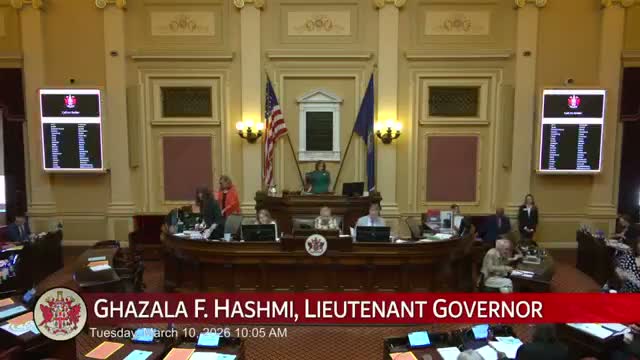
Summary
The Senate of Virginia spent its March 10 session moving dozens of House bills — approving measures on student discipline, housing protections, elections and energy rules — and establishing conference committees for unresolved items. Several bills passed on narrow, often party-line margins.
The Virginia Senate met in Richmond on March 10 and cleared a broad slate of House measures while appointing conferees to resolve outstanding differences with the House.
In early business the Senate voted to suspend a special joint order on judicial elections until March 11, 2026, after senators said bills creating new judgeships had not finished the enactment process. The motion, offered by the senator from Eastern Fairfax, passed unanimously.
The Senate took up blocks of unfinished business and dealt with hundreds of House and Senate bill cognates, alternately concurring with House substitutes, rejecting amendments and sending items to conference. Notable outcomes included:
- Student discipline (House Bill 2 98): After lengthy debate, the Senate approved a measure requiring schools to consider at least one evidence‑based restorative disciplinary practice before suspending or expelling a student, with exceptions for serious felonies. Senator from Arlington said the bill “teaches kids how to resolve things in a restorative way,” while critics warned it could limit traditional disciplinary tools. The bill passed 21–19.
- Red-flag reporting (House Bill 10 96): The bill directing the Virginia State Police to publish monthly reports about substantial‑risk (red‑flag) orders passed 21–19; supporters called it a transparency measure to make data readily available online.
- Housing and landlord-tenant reforms: A package of bills addressing eviction diversion, notice of rent increases, payment-plan options for short rent arrears, manufactured‑home park protections and other tenant protections passed in various forms. Sponsors emphasized tenant stability and clearer notice requirements; opponents raised concerns about implementation details. For example, House Bill 95 (payment-plan protections) passed on a close vote (ayes 20, noes 19).
- Public safety and crime policy: The Senate passed a measure broadening when ignition‑interlock devices can substitute for hard license suspensions in DUI cases, arguing interlocks reduce impaired driving while preserving mobility; that vote carried 35–5. The Senate also approved a bill to require the Department of Criminal Justice Services to convene a work group on firearm‑violence policy (House Bill 9 69).
- Energy and environment: Multiple energy‑sector measures were debated and passed, including bills directing agencies to prepare models for distributed energy resource siting, creating pilot programs related to offshore wind workforce training, and requirements tied to data‑center permitting. House Bill 5 07 (data‑center engine emission limits) passed 25–15.
On many items the Senate recorded narrow margins. Sponsors on both sides repeatedly said agreement would be better reached in conference committees; the chamber named conferees for many bills by committee leaders. The Senate concluded the day's business by adopting memorial and commending resolutions and adjourning until 10:00 a.m. the next day.
Votes at a glance (selected): - HB 2 98 (restorative disciplinary practices) — Passed 21–19 - HB 10 96 (red-flag reporting) — Passed 21–19 - HB 5 07 (data-center emissions limits) — Passed 25–15 - HB 95 (tenant payment-plan protections) — Passed 20–19 - HB 5 61 (DUI/ignition interlock) — Passed 35–5
What’s next: Several bills were sent to conference committees for final negotiation; sponsors said they expect additional floor action and possible rollbacks in subsequent days as conference reports arrive.