Get Full Government Meeting Transcripts, Videos, & Alerts Forever!
Get email alerts on the Resiliency Action Plan topic
No spam. Unsubscribe anytime.
Edmond unveils draft Resiliency Action Plan and public dashboard; staff say plan will help unlock federal grants
Summary
At a special City of Edmond meeting, city staff and consultants previewed a draft Resiliency Action Plan that sets six sector goals, will be supported by a public dashboard and is tied to a $146,000 EECBG (DOE) contract with Lotus. Council members pressed for more on air-quality monitoring, school collaboration on idling, and a nearby plant’s odor and noise.
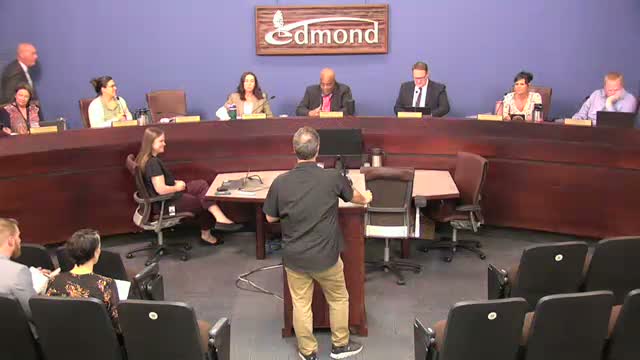
City staff and consultants presented a draft Edmond Resiliency Action Plan at a special City of Edmond meeting, outlining six sector goals — green building and energy efficiency, land use and urban design, air quality and transportation, water quality and conservation, waste reduction, and economic development — and a public dashboard to track metrics and progress.
Phil, a city grant manager, told council the contract with consulting firm Lotus includes creation of an interactive public dashboard and was funded through an EECBG (DOE) award of $146,000 to produce a comprehensive set of strategies and metrics. “This contract with Lotus will include a public dashboard, which will display various metrics and provide better community engagement,” Phil said.
Hillary Dobos, president and owner of Lotus, described the plan as the result of broad stakeholder engagement — eight focus groups, surveys and dozens of interviews — and said the team identified more than 100 strategies that the city can adopt, act on, or advocate for. “The goal of the Edmond Resilience Action Plan is to build a stable, resilient, and healthy community for generations to come,” Dobos said. She said the plan’s timeframe is focused on achievable targets through 2030.
Why it matters: staff said the plan will position Edmond to compete for federal and state funds that usually require a documented strategy before awarding implementation grants. Phil told council the dashboard and plan are intended to support future grant applications and improve public transparency.
Key details and council questions: - Metrics and funding: The dashboard will track metrics such as local renewable energy production, EV counts and charging infrastructure, mode share, tree‑canopy percentage, water‑use intensity for city buildings, asthma and ozone alert days, recycling and composting tons, and grant dollars pursued. - EECBG funding: Phil stated that the current contract was taken from EECBG (DOE) for $146,000 and that the plan is intended to be used to pursue additional funding. - Waste contract timing: Dobos told council the city’s current waste contract was reviewed and noted it expires in 2028, creating a possible opportunity to revisit service language or models.
Air quality and school collaboration: Council members pressed the presenters on air-quality monitoring and opportunities to partner with the Edmond Public School system to reduce vehicle idling. Dobos said the dashboard will include air-quality metrics (ozone alert days, asthma rates) and that the plan contains strategies to partner with the school district; she noted examples where school systems obtained grants to convert fleets to electric buses.
Local concerns: Council members raised constituent concerns about odor and nighttime noise from a nearby dog-food plant (Purina). A council member described a drying machine that runs around 3:00 a.m. and said residents hear and smell activity near the southwest side of town. Dobos acknowledged the concern and said the team would research it and follow up with more information.
Hazards and projections: Presenters flagged climate‑related hazards for Edmond: a projection cited in the briefing estimated about 113 days per year over 90°F by 2050 and repeated multi‑week dry spells, along with the potential for heavier rainfall and stormwater events. Staff recommended actions to speed FEMA reimbursement after storms and to consider cooling centers and other community supports.
Dashboard and living document: Dobos showed an example dashboard (based on work for Fort Collins) intended to be a living, automatically updated online tool for tracking tactics, partners and progress. Phil said staff will maintain the dashboard and that the full strategy list will be provided to council in the coming weeks for review.
Next steps: Staff said they will deliver the complete set of strategies to council for review in the coming weeks and will return with follow-up research on air-quality monitoring, the Purina-related concerns, and EV‑charging usage data. The special meeting adjourned after a brief closing.
The council moved to adjourn and the meeting was closed without additional formal actions on the plan; staff said follow-up deliverables will be provided for council review.