Get Full Government Meeting Transcripts, Videos, & Alerts Forever!
Get email alerts on the Rezoning topic
No spam. Unsubscribe anytime.
Neighbors press council to delay East Edmond rezoning; council schedules another meeting
Summary
The council heard hours of public comment on a rezoning and PUD application for roughly 150 acres east of I‑35; residents cited traffic, tree loss, schools and density concerns. Applicant and staff described planned infrastructure and mitigation; council agreed to a staff‑facilitated meeting with residents and the developer and continued the item to Oct. 28.
The Edmond City Council's public hearing on a proposed rezoning and Planned Unit Development for about 150 acres east of I‑35 drew repeated objections from nearby residents and a detailed staff and applicant response on Oct. 14.
Planning staff described the property's history in Edmond's long‑range plans and explained the PUD's four "tracks": mixed‑use tracks 1 and 2 with a combined residential cap of about 120 units, a single‑family track (track 3) described with a maximum of 569 units and a small track 4 for limited uses. Applicant representatives with the Orion Group said they held three public meetings and that the plan includes tree preservation, trail easements for the Coffee Creek Trail and detention basins to control post‑development flow into Coffee Creek.
Residents from multiple nearby neighborhoods — including Mark Herkert, Larry Purdue, Boyd Elliott, Lloyd McAllister and others — urged delay or rejection, citing limited road capacity at key intersections (Covell and Air Depot), the need for completed traffic and economic feasibility studies, school capacity and the loss of a remnant cross‑timbers forest. "The infrastructure should have been done before this started," resident Mark Herkert said. Several speakers asked the council to ensure fire and emergency access, and others feared high density would alter longstanding neighborhood character.
City staff including Steve Lawrence (city engineer) said the municipal process typically requires traffic and floodplain studies during plat/site plan review after zoning; ordinances require developers to provide road widening, detention and other infrastructure or pay fees in lieu where allowed. Lawrence said ODOT and long‑range plans cover some regional elements and that the city has projects for road improvements on its capital list, and that several intersections are on a proposed general obligation bond ballot.
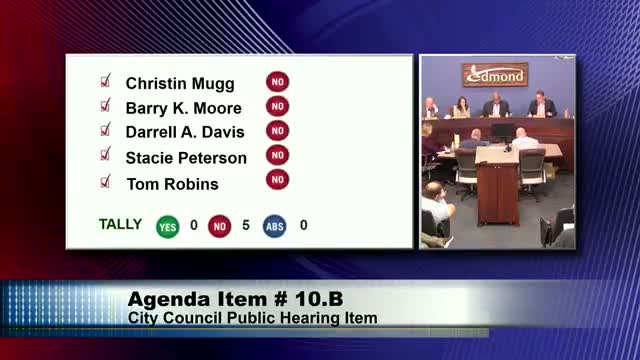
After extended public comment and applicant reply, council members asked staff and the developer to meet with neighborhood representatives and senior staff in a city‑facilitated session to attempt additional concessions and to clarify outstanding technical documents. The council then continued the rezoning decision to its Oct. 28 meeting.