
Senate committee debates replacing truancy with ‘chronic absenteeism’ model in House Bill 4656; witnesses warn of capacity risks
Get AI-powered insights, summaries, and transcripts
Subscribe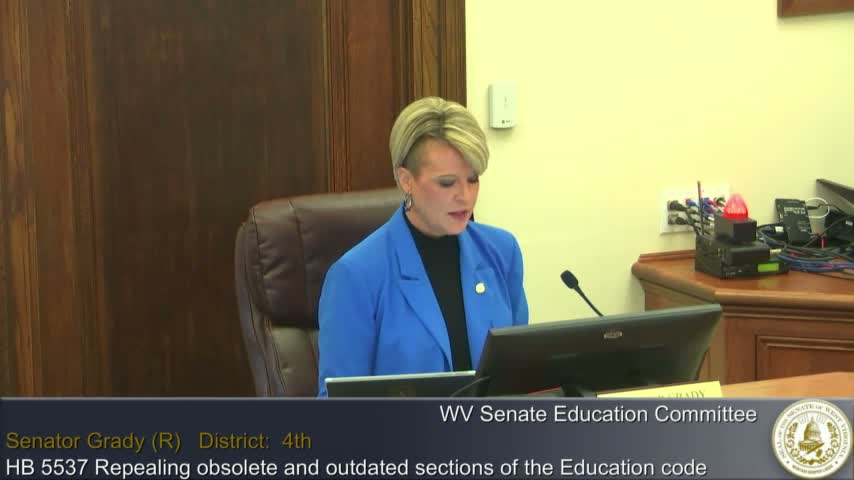
Summary
House Bill 4656’s committee substitute would end truancy as a status offense and promote earlier, preventative interventions — including DHS-supported wraparound services triggered at the fifth absence and a 10% instructional-day threshold — but county attendance directors, probation officers and prosecutors warned about lost enforcement tools and strained capacity; the committee reported the bill without recommendation and re-referred it.
The West Virginia Senate Education Committee on March 10 debated House Bill 4656, a committee substitute that would remove truancy as a status offense and instead define and respond to chronic absenteeism through earlier, prevention-focused interventions. After extended questioning and three invited witnesses, the committee voted to report the bill to the full Senate without recommendation and requested re-referral to the Education Committee.
Counsel explained that the substitute shifts focus away from punitive measures against students and toward earlier intervention, including wraparound services provided by the Department of Human Services (in partnership with the Department of Education) and initiation of supports at a student’s fifth unexcused absence. The substitute sets four alternative “prongs” any one of which may trigger court jurisdiction or earlier intervention — for example, failure of meaningful contact with a parent, failed intervention under the system-of-support plan, evidence that absences are impairing grade-level progress, or absences that meet or exceed 10% of instructional days.
The committee’s questions focused on who would perform the student-support role, how the new thresholds would work in practice, where funding for diversion specialists would come from and whether removing a status offense would strip courts and probation officers of the ability to secure compliance. Counsel said the bill is permissive about who counties designate as a student-support specialist (attendance directors, probation officers or diversion specialists) and that approximately 33 counties currently use diversion specialists. Counsel also said the committee substitute contains staged effective dates and that administrative language for juvenile jurisdiction was provided by the Administrative Office of the Supreme Court.
Three invited witnesses testified about practical consequences:
- Cynthia Hedrick, Fayette County attendance director, said Fayette uses meaningful-contact notices and a system-of-support at 3, 5 and 10 unexcused absences and relies on school-based probation officers and court-ordered participation to secure services. She warned that wraparound services are not court-ordered and staff capacity at DHS and partner agencies is limited; she told the committee that Fayette County’s last-year data show "over chronically absent, over 1,000 students" who could be affected if the model expands without additional capacity or mandatory participation.
- Zach Trainham, a school-based juvenile probation officer in Greenbrier County, described the local diversion process that typically triggers at 10 unexcused absences: the attendance director notifies probation, a diversion meeting produces a plan, and the student is monitored through the school year. He reported that in the 2024–25 school year Greenbrier County held 211 secondary-school diversions and only 10 resulted in petitions (about 5%), and that 42 elementary diversions led to 3 referrals for educational-neglect services — evidence, he said, that diversion can reduce petitions while court involvement remains a tool when diversions fail.
- Allison Apellucci, juvenile prosecutor for Taylor County, argued that removing truancy as a status offense would remove a key enforcement tool and the court’s ability to ensure services are implemented; she cited local practice (62 filings in Taylor County last year) and urged preserving the ability to use status-offense proceedings or a local compromise so counties may maintain the effective tools they currently use.
Committee members raised implementation questions about staged effective dates, how juvenile drug courts fit under the new definition, and whether the bill’s permissive language would produce uneven practices across counties. Several members expressed support for early intervention while also seeking protections for counties that rely on status-offense tools. Following testimony and debate, the vice chair moved to report the bill without recommendation and to re-refer it to the education committee; the motion carried on a voice vote.