
Commissioners approve $600 million contingency increase and $1 billion WIFIA loan for Walnut Creek expansion
Get AI-powered insights, summaries, and transcripts
Subscribe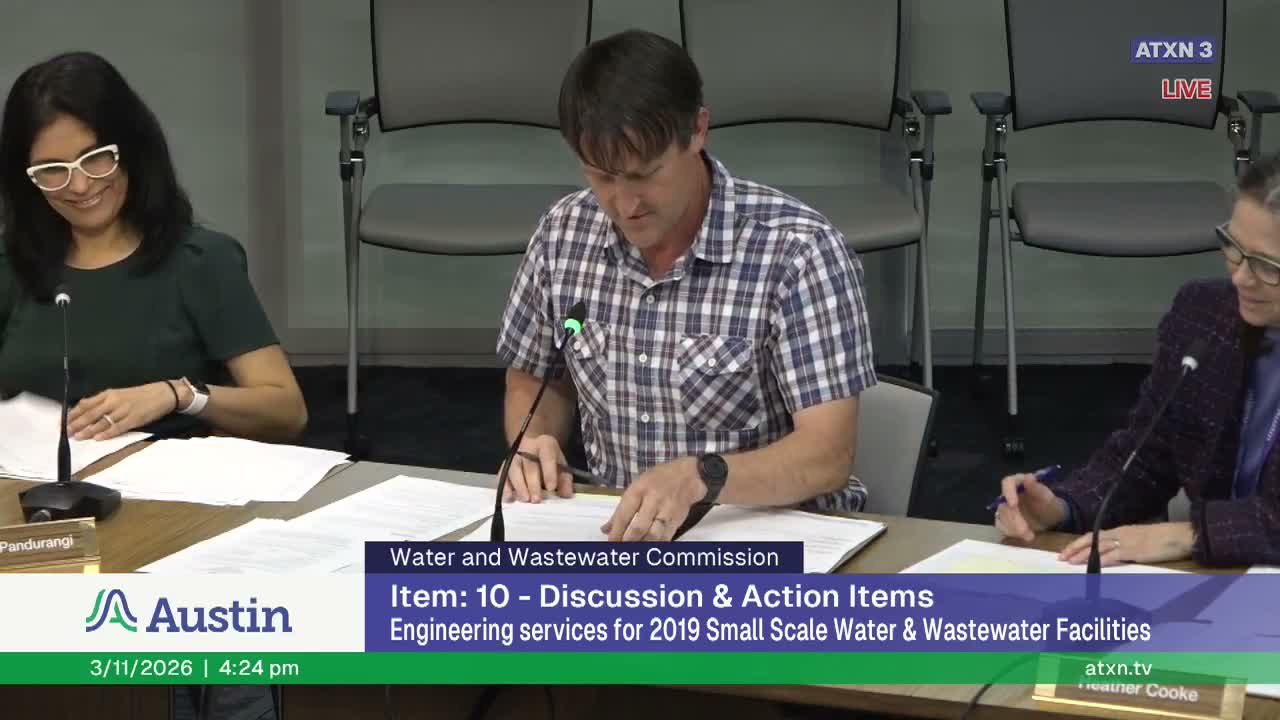
Summary
Austin Water told the commission its Walnut Creek Wastewater Treatment Plant expansion needs more funding because of higher construction costs; commissioners unanimously approved a $600 million contingency increase to bring the MWH contract ceiling to $1.5 billion and authorized seeking up to $1 billion in EPA WIFIA loan proceeds.
Austin Water staff told the Water and Wastewater Commission on March 11 that the Walnut Creek Wastewater Treatment Plant expansion has reached a new funding milestone and that rising construction costs require an increase in the project's contingency and borrowing authority. Commissioners voted unanimously to increase the construction contract ceiling by $600 million, to a revised maximum of $1.5 billion, and to authorize the City Manager to seek up to $1 billion in EPA WIFIA loan funds.
In a briefing, Assistant Director of Engineering and Technical Services Charles Solaros said the project combines a 25 million-gallon-per-day expansion with extensive modernization: a biological nutrient removal treatment process, ultraviolet disinfection to replace chemical disinfectants, advanced odor control, and a floodwall to protect the plant in the 100-year floodplain. "We're at a milestone now of being ready to move forward with the remaining funding for this project," Solaros said, summarizing why updated authorizations are before council and the commission.
Solaros outlined the project's delivery approach and schedule. City staff selected a construction-manager-at-risk (CMAR) delivery and divided the work into multiple GMP (guaranteed maximum price) packages; several packages are already under construction, two are in bid, and others remain in design. Solaros said the team has used CMAR preconstruction collaboration to refine constructability, sequencing and cost estimates and that the project is being phased to maintain continuous treatment operations through construction.
Commissioners pressed staff about rising costs and procurement checks. One commissioner asked whether the original cost baseline accounted for post‑COVID inflation; Solaros responded that early estimates used 2022-era cost assumptions and that the CMAR process and updated design work have since produced more detailed, current price information. "As we get more accurate design and detailed pricing from the contractor, that's when we update our projections and bring them back to Council and the commission," Solaros said.
Deputy Director Joseph Gonzalez described the finance plan and how the request fits within the utility's rate and capital policies. Gonzalez said the utility uses a mix of cash funding and debt and that the financing plan for Walnut Creek was considered in the utility's 2024 cost-of-service discussions. "We have a financial policy that says we should finance roughly 35% or cash fund 35% to 50% of our capital projects," Gonzalez said. He added that the planned approach — including the WIFIA loan and a $59 million Texas Water Development Board Clean Water SRF loan approved in January — leaves the remainder to be financed with Austin Water revenue bonds, and that staff do not expect a significant change to the rate plan submitted in 2025.
Commissioners also asked about alternative delivery and competition. Solaros said each GMP package is competitively bid under the CMAR process, the CMAR provides an initial IGMP (initial guaranteed maximum price) that the owner's engineer validates, and then the CMAR completes sealed proposals for each package. He said several bid packages to date came in below the CMAR's IGMP estimates.
After discussion the commission moved and unanimously approved two actions: (1) an amendment to the MWH Constructors construction contract increasing contingency by $600 million to a not-to-exceed $1.5 billion, and (2) a resolution authorizing the City Manager to increase the EPA WIFIA loan application from up to $446,842,000 to up to $1,000,000,000, with funding contingent on future operating budgets. The commission's approval will be forwarded to City Council for final action.
What happens next: staff said the item is on the City Council agenda the following day and that work on GMP packages, bidding and financing will continue as the project advances toward construction of the new and converted facilities through the early 2030s. The staff schedule projects phased completion and expected delivery of the final conversion work around 2032.
Sources and attribution: quotes and technical descriptions are from the March 11 Water and Wastewater Commission meeting briefing by Charles Solaros and finance remarks by Joseph Gonzalez.