
Junior council presentation spotlights housing insecurity and county housing programs
Get AI-powered insights, summaries, and transcripts
Subscribe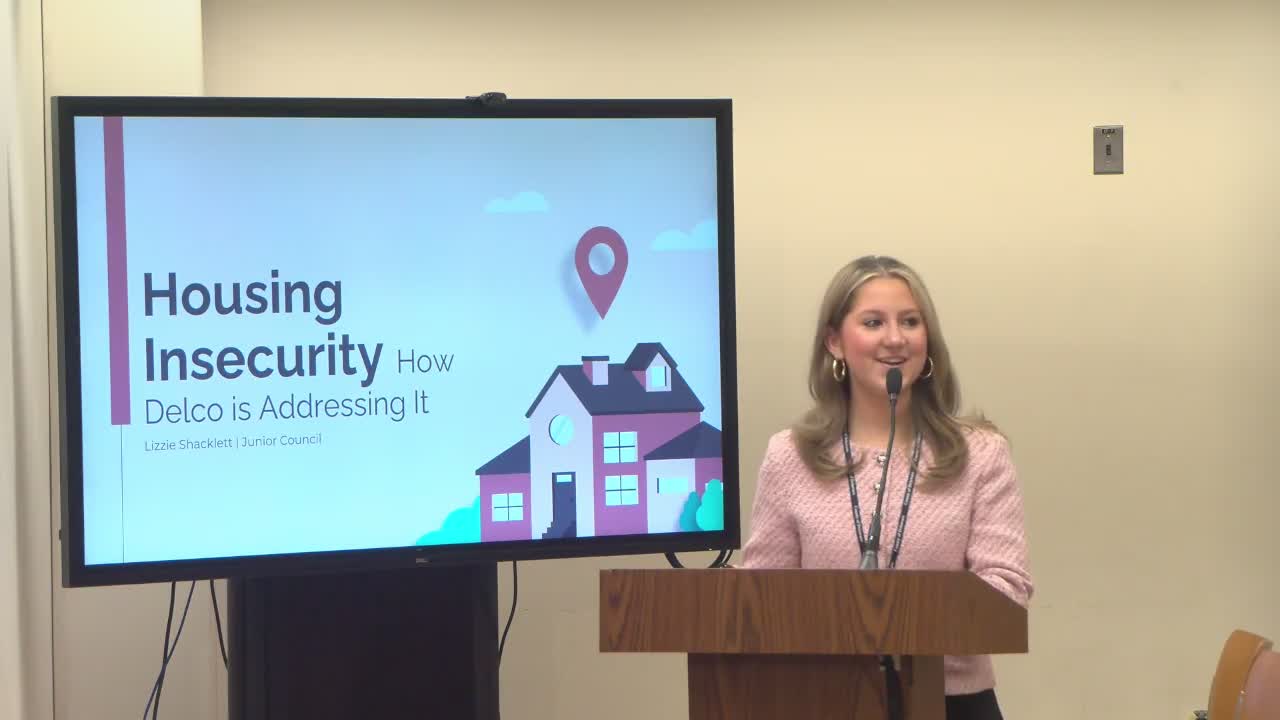
Summary
A junior council member outlined local housing pressures — high rents, aging housing stock and daily eviction pressures — and reviewed county programs (CDBG, HOME, ESG, Housing Choice Vouchers) and the county’s 2026 priorities to expand shelter-to‑permanent options.
A junior member of the county’s Junior Council urged Delaware County officials on March 4 to treat housing insecurity as a broad, chronic problem requiring coordinated programs, while county staff outlined federal programs and local efforts to increase housing capacity.
Lizzie Schacklett (a senior at Agnes Irwin School and a Junior Council member) told the council that housing shapes access to health care, education and jobs and cited state and local indicators: "In Delaware County, where one‑third of residents are renters, approximately 20 renters face eviction every day," she said, summarizing a county overview of housing demand and the county’s inventory challenges.
Nut graf: Schacklett’s presentation reviewed programs administered by the Delaware County Office of Housing and Community Development — the Community Development Block Grant, the HOME Investment Partnerships program and the Emergency Solutions Grant — and described the county’s 2024–25 efforts to place households in rental assistance and permanent housing. The presentation also described the county‑formed Delaware County Housing Coalition (2023) and its working groups on homelessness, rental housing and homeownership.
County context: the presentation said the County Housing Authority owns more than 1,000 affordable units and supports more than 3,000 families through Housing Choice Vouchers; presenters and council members discussed capacity challenges, long voucher wait lists and the need to repurpose unused buildings for transitional housing.
Public response and follow up: council members thanked the presenter and asked staff to continue coordinating training for shelter providers, expand permanent housing options and standardize continuum‑of‑care practices in the 2026 budget year. Executive Director Ms. O’Malley later highlighted county programs including the Lead Free 123 outreach campaign and invited residents to contact county staff for services and assessments.
Quotable: "Housing is one of the most important aspects of our lives," Schacklett said during her remarks, urging that "everyone deserves access to a safe and stable place to call home."
Ending: The presentation did not prompt a formal vote; council members requested continued reporting and staff said they would pursue coalition goals, shelter expectation standards and training for new continuum‑of‑care providers.