Get Full Government Meeting Transcripts, Videos, & Alerts Forever!
Get email alerts on the Budget Finance topic
No spam. Unsubscribe anytime.
Delaware County executive presents nearly $1 billion 2026 budget; council approves $55 million tax anticipation note
Summary
Executive Director Barbara O'Malley presented a proposed 2026 county budget totaling nearly $1 billion, including a $340 million operating plan and $137.9 million in capital projects. Council voted to authorize up to $55 million in tax revenue anticipation notes to manage cash flow and scheduled public budget hearings for Dec. 8.
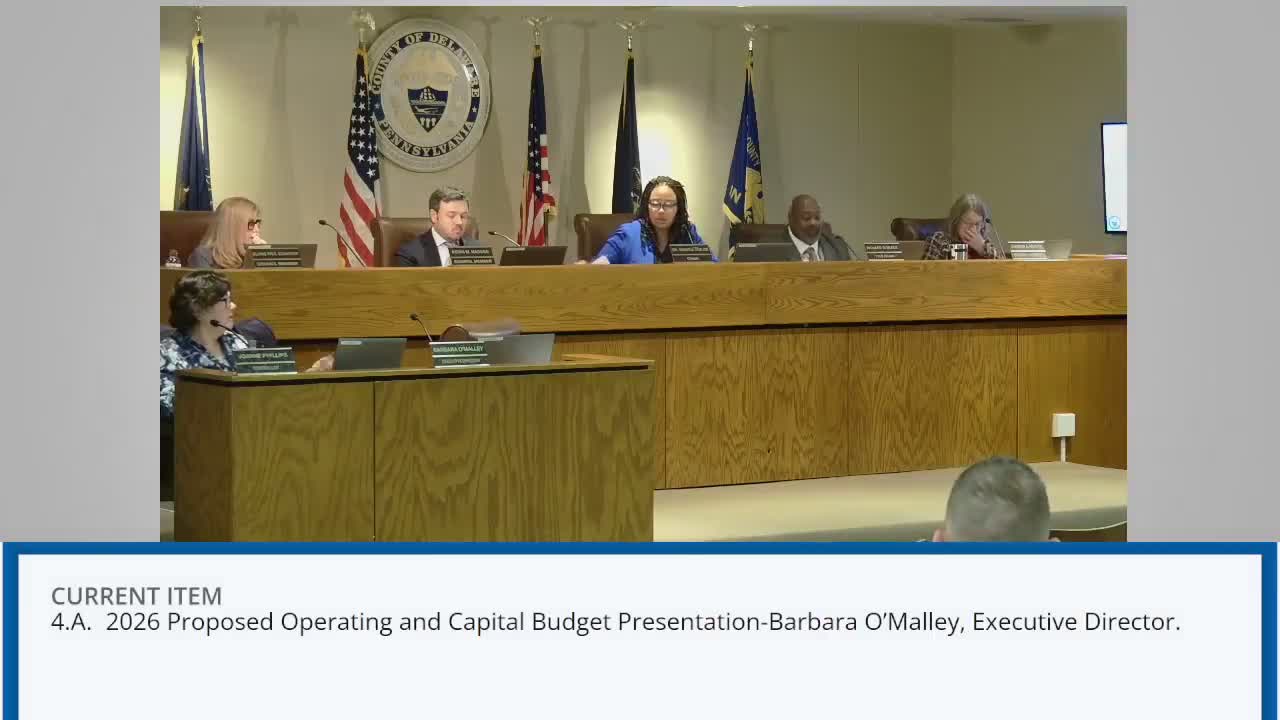
Executive Director Barbara O'Malley presented Delaware County's proposed 2026 operating and capital budgets Wednesday, saying the county's overall plan totals "nearly $1,000,000,000," with an operating budget of about $340,000,000 and a capital program of $137,900,000.
The proposal, presented at first reading, includes a county tax increase that the executive team estimated would average $188 a year on the typical assessed home. "When we look at the millage, the increase is about $188 on the average home value," O'Malley said, placing the change as roughly $15 a month per homeowner while acknowledging the burden on residents.
Why it matters: County leaders said the increase is intended to close a structural deficit that officials say arose over years and was partly masked by one-time federal ARPA funds. The presentation detailed where dollars are spent — courts and corrections, county services, employee benefits and debt service — and described cost-containment steps such as central purchasing, benefit reforms and a hiring freeze for nonessential positions.
O'Malley emphasized the role of grants and reimbursements in capital accounting and said the county will not rely on fund balance to pay operating costs in 2026. She also reported continued improvements at Fair Acres, the county nursing facility, and highlighted a nearly $40 million radio upgrade and a multi‑project capital list of 142 projects.
Council members raised questions about cash flow and timing. Council Member Reuther, who spoke during the Q&A, said the budget work and cash‑management changes since the state and federal funding interruptions were an important learning moment. Council Member Schaeffer indicated philosophical differences about how aggressively to raise revenue but thanked staff for the presentation.
To preserve flexibility while revenues are finalized, council voted to adopt Ordinance 2025-08 authorizing the county to issue tax revenue anticipation notes in a maximum principal amount of $55,000,000. CFO Kelly Diaz, who presented the debt item, described the notes as a short-term liquidity tool to bridge timing gaps in receipts and said competitive bids produced a low cost for the facility fee and interest. The ordinance passed on a roll call vote, with the five councilmembers present voting aye.
Public response at the meeting focused heavily on the proposed tax increase. Dozens of residents urged greater spending reductions, questioned capital accounting choices (for example, showing gross capital costs and later grant reimbursements), and asked for clearer line items ahead of the Dec. 8 public budget hearing. The county announced two hearings on Monday, Dec. 8 at 2 p.m. and 6 p.m. to give residents another opportunity for questions and for staff to provide more apples‑to‑apples comparisons.
What happens next: The budget will return for a second reading after the public hearings and any adjustments. The tax anticipation note ordinance gives the county short‑term borrowing authority it can use if necessary to manage timing-related cash shortfalls; officials said they hope not to draw it down before January.