Get Full Government Meeting Transcripts, Videos, & Alerts Forever!
Get email alerts on the Land Use Pud topic
No spam. Unsubscribe anytime.
Commission narrowly recommends approval of Kelly Corner PUD amendment amid traffic and oil‑rights concerns
Summary
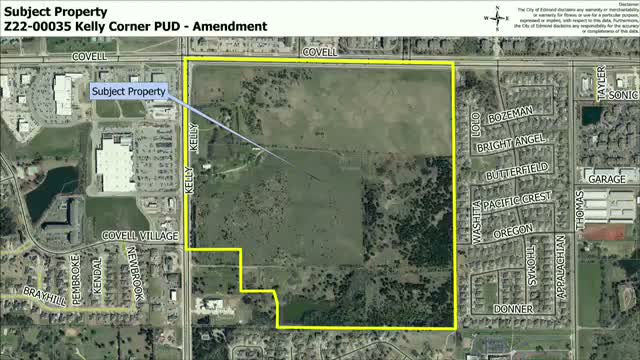
The Edmond Planning Commission voted 3-2 to recommend approval of an amended 150‑acre Kelly Corner PUD, advancing the proposal to City Council despite neighborhood concerns about street widths, traffic and an oil‑lease dispute raised by Harland Oil Company.
The Edmond Planning Commission voted 3-2 to recommend approval of an amended Kelly Corner planned unit development, forwarding the item to the City Council agenda on Jan. 26, 2026.
Staff presented the amendment as an update to a previously approved PUD covering roughly 150 acres, noting no change to the development concept. Key changes include increasing the allowed senior‑living unit cap from 120 to 130, a unit cap of 300 for Parcel Area 6 with office uses allowed in townhomes, and an increase in dedicated common area from 15.8 to 18.4 acres. Todd McInnis, representing the developer, said the project follows a new‑urbanism approach and defended narrower local street widths as appropriate for pedestrian‑focused design.
"The city standards are based on suburban sprawl and we have a new urbanism development that calls for smaller streets that are more pedestrian dominant," Todd McInnis said. He and staff said traffic infrastructure improvements and any required site‑planning mitigation would be addressed later during the planning and site plan reviews.
Neighborhood residents urged deeper scrutiny. Jim Lee asked whether the PUD included traffic controls to address growing traffic on Covell. "We have a traffic issue right now at Short Grass Road in Covell," Lee said, asking if the plan required additional safety controls.
A central point of contention was raised by Mark McCann of Harland Oil Company, who said the PUD did not acknowledge existing oil and gas rights on the land and pointed to ongoing litigation and unitization orders. McCann told commissioners that oil‑and‑gas operations and the rights granted under an Oklahoma Corporation Commission order affect surface‑use and setback considerations and should be addressed in the PUD's special conditions.
"Our rights to produce this are the predominant rights and the rights of the surface owner are subservient under Oklahoma law," Mark McCann said, urging the commission to include a statement that the project will comply with Harland Oil Company’s private rights.
Developer and staff responses stressed that litigation and unit rights are separate from the zoning question and that the PUD's general conditions require compliance with city standards and other applicable permitting processes. McInnis said traffic impact analyses and the timing of infrastructure improvements will be handled as the project advances through site planning.
The commission’s split vote reflected the mix of planning arguments and community opposition: supporters emphasized the PUD’s conformity with the city’s planned‑use framework and design intent; opponents cited street‑width, traffic, safety and compatibility concerns. The commission’s recommendation now goes to the City Council for final action on Jan. 26, 2026.