Get Full Government Meeting Transcripts, Videos, & Alerts Forever!
Get email alerts on the Budget Task Force topic
No spam. Unsubscribe anytime.
Delaware County task force offers cost‑containment recommendations including audits, asset monetization and telecom cuts
Summary
Deputy Executive Director Mark Wooley summarized a budget task force report that recommends immediate and longer‑term steps to stabilize county finances: dependent‑eligibility audits, centralized grants, copier consolidation, fleet leasing options, telecom audits (cited $770,000/month savings), and a capital improvement campaign.
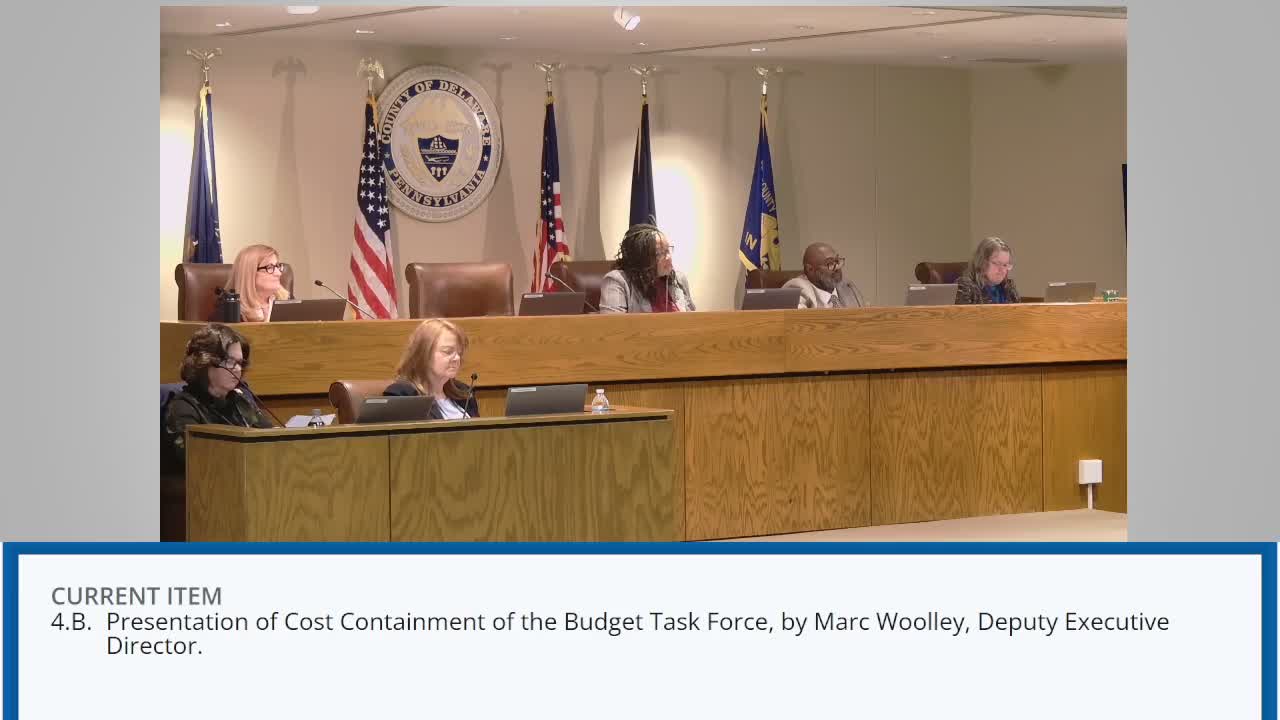
Deputy Executive Director Mark Wooley presented the cost‑containment subcommittee’s final public report and told council the group organized recommendations by feasibility and timeframe (immediate, short‑term 1–2 years, long‑term 2+ years).
Wooley said the committee found some commonly proposed “low‑hanging fruit” already underway—centralized purchasing and benefits audits—but identified additional steps, including centralizing grants management, auditing dependent eligibility, consolidating copier contracts and instituting a print accountability system. He said the county currently spends about $1,000,000 on copiers and $100,000 on paper; the committee set a mandate to reduce copier costs by 20%.
On telecom, Wooley said a review reduced county telecom spend from about $5,000,000 to $2,000,000 and that continued work aims to push the spend below $1,000,000; he said such line‑verifications and consultant engagement have yielded significant savings and, in one phase, reduced monthly spend by about $770,000.
The subcommittee discussed fleet management (about 400 vehicles); Wooley said wholesale replacement would be a roughly $3,000,000 capital cost, while a leasing option could shift capital to operating costs and reduce upfront capital needs to an estimated $300,000–$500,000. He noted telematics and other tools could reduce liability and maintenance costs.
Wooley said the report includes recommendations to monetize county assets (for example, potential improvements and wider use of the George W. Hill range) and an RFP for a campus‑space study. He described the draft report as about 11 pages with a roadmap for quick wins (0–90 days), a build phase (90–180 days) and institutionalization (180–365 days). The document is scheduled for finalization in December.
Council members applauded the task force’s work and emphasized careful implementation and cost controls as recommendations are moved to department heads for potential action.