Get Full Government Meeting Transcripts, Videos, & Alerts Forever!
Get email alerts on the Transportation topic
No spam. Unsubscribe anytime.
Council hears updates on Danforth & Kelly, I‑35 corridor, signals and CityLink
Summary
Engineering and transit staff updated the council on federal-funded road projects, ITS intersection upgrades, interim signals at Danforth & Sooner, and CityLink route planning and funding constraints; staff urged continued data publication to show safety and performance gains.
Council and staff spent a substantive block of the workshop on transportation and transit projects affecting Edmond’s corridors.
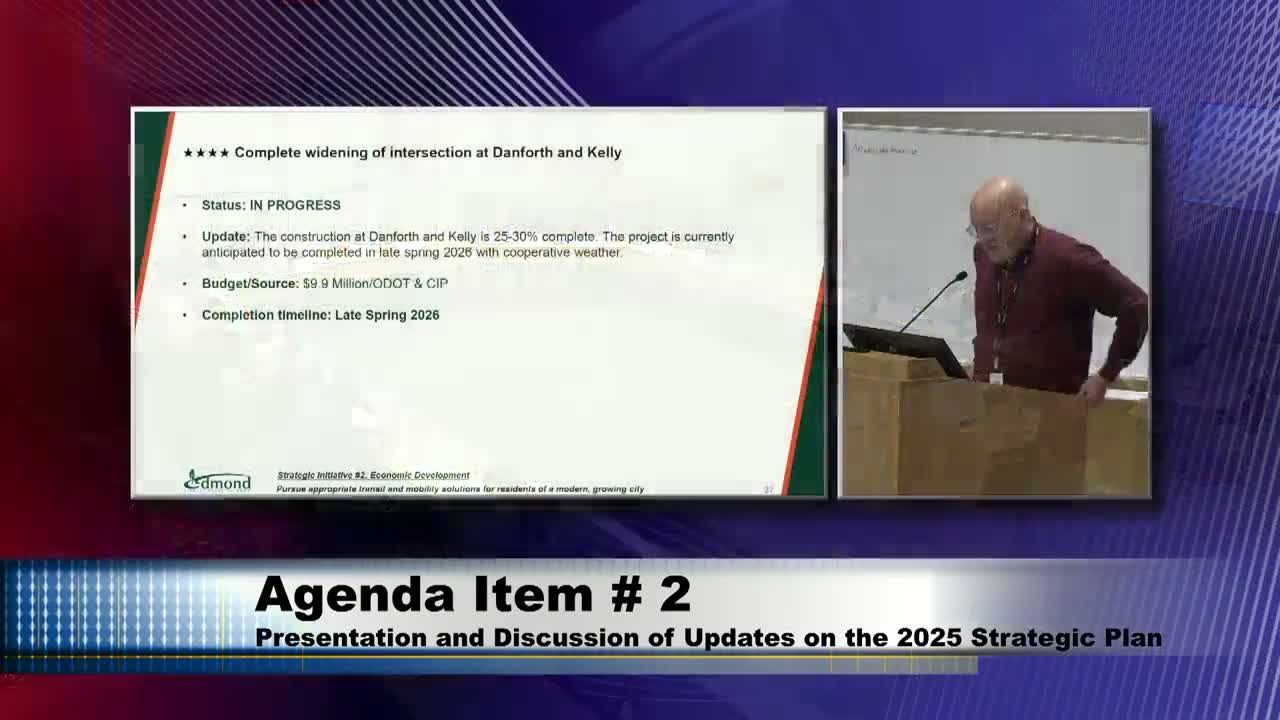
Danforth & Kelly, I‑35 Corridor: Steve Lawrence (Director of Engineering) said the Danforth & Kelly project is under construction but about a month behind schedule; he emphasized that several corridor projects rely on significant federal funding and ODOT processes. "That is also another project where we received significant federal funding, so it is being managed through ODOT," Lawrence said.
ITS and interim signals: Lawrence outlined an ITS Phase 4 rollout that will modernize signal equipment and provide live connectivity to manage incidents and improve safety; interim span‑wire signals are being installed at Danforth & Sooner to relieve I‑35 congestion. Council members asked for publicized before/after safety and throughput data; Lawrence said staff publishes results where available.
Covell, Boulevard and other intersections: Staff described preliminary plans and grant applications (Surface Transportation Block Grant, safety grants) for reconfiguring downtown bottlenecks and pursuing interim improvements where full utility relocation would be costly.
CityLink and transit funding: Kristy Batterson explained CityLink’s funding structure as a subrecipient of Embark: the program covers roughly 50% of operations and 80% of maintenance, with capital grants typically requiring local matching funds (often an 80/20 capital split). She said CityLink will use ACOG and FTA planning funds to evaluate routes (including a proposed Route 7 to the conference center) and that capital and operating sustainability remain key constraints.
Council direction and next steps: Council members asked staff to continue publishing ITS safety and performance metrics to illustrate impacts, to keep pursuing grants to leverage local dollars, and to integrate the transportation priorities into the five‑year pavement and capital plan.