
Senate advances documentary stamp tax increase to fund rural and middle-income workforce housing
Get AI-powered insights, summaries, and transcripts
Subscribe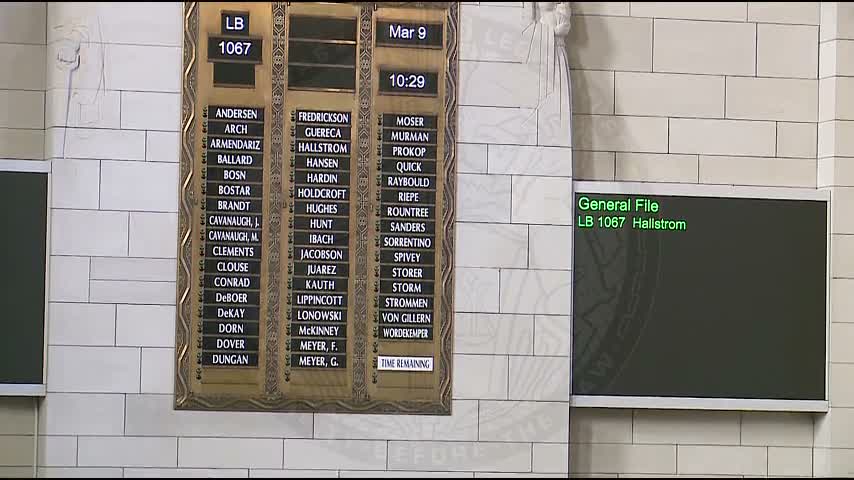
Summary
The Nebraska Legislature advanced LB10-67, amended by AM22-13, to E & R initial after debate. The amendment lowers the proposed documentary stamp tax increase to $1 per $1,000 of sales price, splitting 50¢ to rural workforce housing and 50¢ to middle-income workforce housing, and includes a five-year sunset.
LINCOLN — The Nebraska Legislature advanced LB10-67 on a 32–8 vote, clearing a procedural hurdle for a bill that would raise the documentary stamp tax to provide ongoing revenue for the state’s workforce housing programs.
Senator Hallstrom, the bill’s sponsor, said the proposal responds to a statewide housing shortage and would direct new revenue to two targeted funds. “We have a housing crisis in Nebraska and a reliable funding source is needed,” Hallstrom said, urging colleagues to support the committee amendment that narrows the increase and adds a five-year sunset.
The committee amendment, AM22-13, reduces the original proposed increase and sets a $1-per-$1,000 rise in the documentary stamp tax, allocating 50¢ to the Rural Workforce Housing Investment Fund and 50¢ to the Middle Income Workforce Housing Investment Fund. Von Gillard, who introduced the amendment on behalf of the revenue committee, said it also ends the increase on Jan. 1, 2032.
Supporters framed the bill as a modest, targeted revenue source to unlock local housing projects. Senator Dover described local examples where workforce housing dollars paired with tools like tax-increment financing produced hundreds of new housing units, saying the availability of housing is essential to bringing and retaining jobs. “We have to build the houses,” Dover said. Senator Fred Meyer called the increase “a very small thing” compared with housing costs and urged colleagues to back the amendment and the bill.
Opponents warned of cumulative fee increases and the effect on housing affordability. Senator Anderson said the amended proposal represents a substantial percentage increase in the documentary stamp tax (she described it as roughly a 43% increase at the amended level) and criticized using a transaction tax as the funding vehicle. “We keep piling small increases on top of small increases that eventually become big increases,” Anderson said.
Hallstrom directly addressed industry pushback from some realtors, arguing that closing costs such as broker administrative fees are already larger and that sellers routinely absorb documentary stamp taxes. “I have not once had anybody … suggest that the level or even the existence of the documentary stamp tax has anything to do with their ultimate determination to close the transaction,” Hallstrom said, adding that the bill prohibits transfers or sweeps of the designated funds into the general fund.
According to Hallstrom’s floor remarks, the amendment is expected to raise approximately $8 million annually for each of the two programs, although the bill text includes a sunset provision and language intended to prevent the sweeping of those receipts to other uses. The clerk read the bill onto the general file earlier in the day, and after debate the Legislature voted 32 ayes, 8 nays to advance LB10-67 to E & R initial.
The bill’s next steps will include technical review by the Engrossment and Review (E & R) Committee and future floor scheduling for further debate on engrossment and any additional amendments.
Votes at a glance: LB10-67 (AM22-13 adopted) — advancement to E & R initial: 32 ayes, 8 nays.