
Appropriations chair outlines $125.6M shortfall as committee unveils LB10‑71 amendment
Get AI-powered insights, summaries, and transcripts
Sign Up Free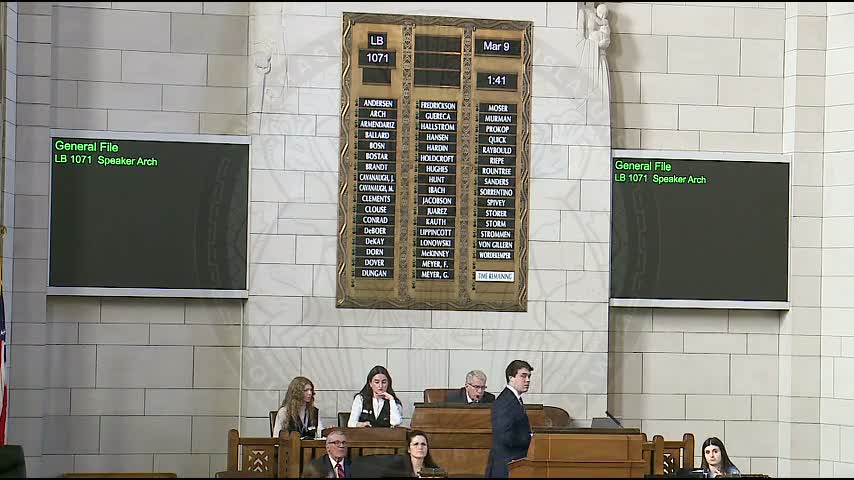
Summary
Senator Clemens, chair of the Appropriations Committee, told the Legislature that LB10‑71 is the main budget adjustment bill and that committee work and transfers have reduced a $646 million projected shortfall to about $125.6 million; he said the committee will use select‑file amendments and possible revenue measures to close the gap.
Senator Clemens, chair of the Appropriations Committee, opened floor debate on LB10‑71 by describing it as the main budget adjustment bill for the year and laying out the process the committee used to address a large revenue shortfall.
Clemens said the economic forecasting board reduced revenue estimates in October, producing a roughly $471 million shortfall that later increased after a February revision; the combined reductions total about $646 million. He told senators the committee has identified about $520 million in savings and transfers, leaving roughly a $125.6 million gap in the current projection.
Why it matters: the Appropriations Committee is constitutionally required to present a balanced budget, and members must reconcile program priorities with limited receipts. Clemens walked members through the Goldenrod budget book, pointing to page 4 (general fund financial status) and specific lines for net receipts, transfers out and in, and session budget adjustments.
Key details: Clemens said transfers out (primarily property tax credits) total in the billions on the gross revenue line, while transfers in accounted for roughly $70 million. He noted session budget adjustments show a negative $52 million in FY26 and $182 million in FY27 on a single line, and that state spending is projected to rise 0.3% in the first fiscal year and fall 1.7% in the second, averaging a negative 0.7% overall.
Clemens emphasized that the committee released a preliminary report in February, held public hearings with agencies and fiscal staff, and is preparing daily green sheets to show how adopted items affect the current status. He said the committee will convene each day, and that some of the remaining shortfall could be covered with additional budget adjustments while other portions might require revenue bills still under consideration.
Next steps: Clemens said select‑file amendments and possible revenue measures will be debated starting the next day, and he invited senators to consult fiscal analysts for item‑level questions. The committee amendment (white copy) presented on the floor replaces the governor's proposal in many parts and contains items adopted and changed by the Appropriations Committee.
The body then moved into debate on specific floor amendments and policy tradeoffs embedded in the committee package.