Get Full Government Meeting Transcripts, Videos, & Alerts Forever!
Get email alerts on the Employee Health Clinic topic
No spam. Unsubscribe anytime.
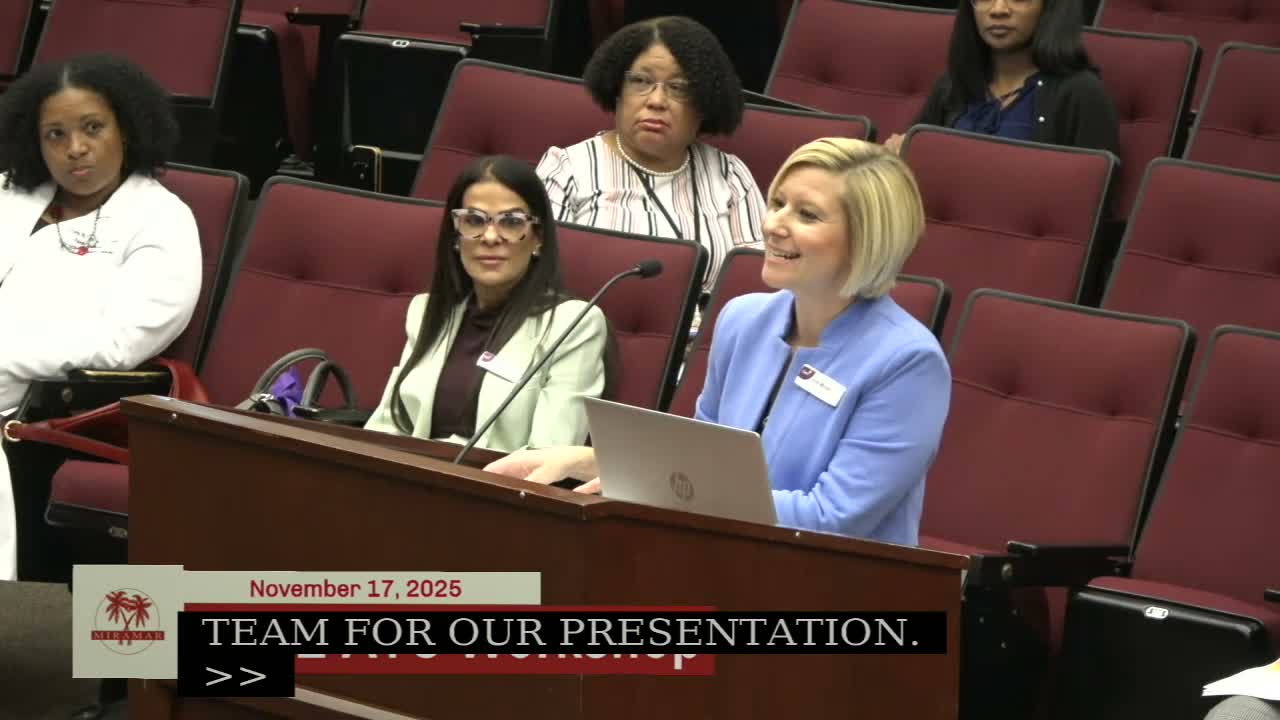
Miramar workshop: city'run employee clinic shows strong outcomes but is near capacity; staff to request more providers
Summary
CareATC reported strong clinical outcomes at Miramar's employee health clinic (high patient satisfaction, A1C improvements and an estimated ROI of ~1.1'1.2), but commissioners pressed staff over appointment availability as provider schedule reached about 91% utilization. City staff said they will return with a formal request to add clinicians and follow'up data.
The Miramar City Commission heard an annual review of the city's employee health and wellness clinic at a workshop, where CareATC staff highlighted clinical results and financial metrics while commissioners raised access and capacity concerns.
Erin McDill, vice president of client success for CareATC, told commissioners the clinic produced a 95 net promoter score in 2024, 41% employee engagement for the year and had been operating at roughly 80% capacity in 2024. Using a 12'month window for calculation, CareATC reported clinic costs of a little over $1,100,000 and an associated clinic value a little over $1,200,000, yielding a reported return on investment of about 1.1 for 2024; an updated 12'month rolling figure covering Oct. 2024'Sept. 2025 produced a reported ROI of about 1.2.
CareATC emphasized the clinic's diabetes management program: in 2024 there were 45 enrolled members (43 with type 2 diabetes), with average A1C improving from 8.3 to 7.5 and an estimated program cost savings of about $355,000 (roughly under $9,000 per participating patient). Year'to'date through Sept. 30, 2025 the program showed further improvement (average A1C from 8.5 to 7.0) and an estimated savings of roughly $414,000 (about $11,000 per participating patient), and CareATC said medical claims for enrolled diabetics were about 53% lower than for non'enrolled peers.
"This is why we do what we do," Erin McDill said, recounting a case in which clinic screening and care coordination led to timely cancer diagnoses and specialist referrals for a patient who otherwise faced long waits. Dr. Tiffany Sales, the clinic physician, said visits at the site are longer than typical office visits (about 30 minutes) and include prevention, education and medication management.
Commissioners praised those outcomes but pressed on access. Commissioner Chambers said employees were telling her they cannot get appointments and "are staying away from the clinic," noting long waits and urging staff to address the problem or consider closure if access could not be restored. CareATC responded that limited availability is capacity'driven: Dr. Sales is the sole full'time provider in the current model and CareATC reported approximately 91% utilized capacity for the physician'led schedule, with double and triple bookings that constrain same'day and next'day appointments.
City Manager Mr. Virgin told the commission the workshop was an update and staff will return with a formal request for additional clinical staff (part'time or full'time nurse practitioner options were discussed) and potential space needs. Commissioners also asked for targeted outreach to low'utilization departments (for example, social services and some utilities) and for follow'up data showing busiest days and times, productivity metrics tied to attendance and information on how clinic eligibility and utilization rates relate to total eligible staff.
A city staff member explained that some units, notably social services programs that are ratio driven (child care, adult day care, senior services), have limited flexibility to leave client duties and that targeted outreach or schedule adjustments may be required to raise participation in those groups.
Vice Mayor (chairing the meeting) and other commissioners asked CareATC and HR for additional operational details, including weekday/time utilization graphs and a plan to boost survey response rates (currently around 9.6%) so staff can gather more direct feedback from employees who say they could not get appointments. The city manager said he had appointed Dr. McSwain from the city staff to the clinic team for added public health expertise during expansion planning.
The workshop ended with commissioners asking staff to return with the formal funding/position request and with metrics linking clinic usage to productivity (employee attendance and reduced callouts). The meeting adjourned without formal votes on staffing or budget; those items will return as future agenda items.