
Council advances large Fair Oaks master plan after amendment tying MPD uses to future zoning rules
Get AI-powered insights, summaries, and transcripts
Subscribe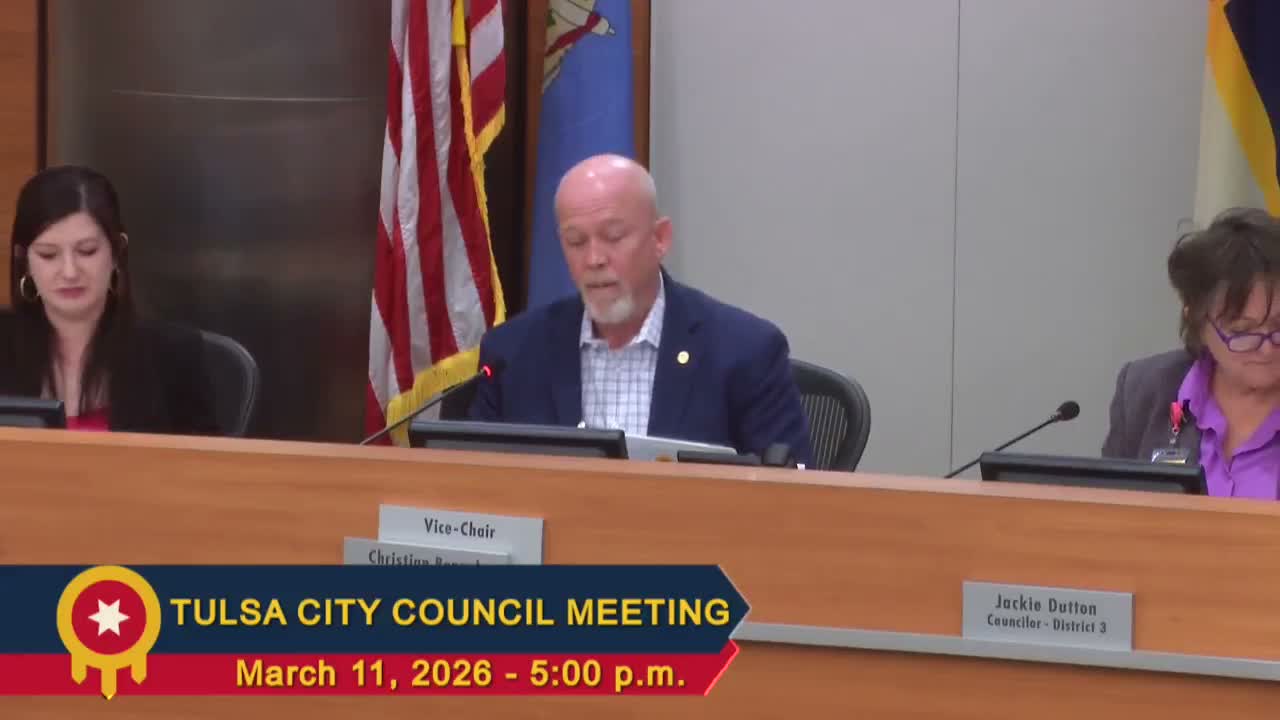
Summary
After extended public comment and council scrutiny over data centers, infrastructure and environmental review, the Tulsa City Council approved the first-reading rezoning of MPD 6 (Fair Oaks) with an amendment that makes MPD use categories subject to future zoning-code revisions. Dissenters cited missing traffic, utility and species studies.
Tulsa City Council approved, by roll call, the first-reading rezoning of the proposed Fair Oaks master-planned development (MPD 6) after adding a friendly amendment that makes the MPD's use categories and definitions subject to any future revisions of the city zoning code.
The MPD 6 application, presented by developer Lou Reynolds, proposes a mixed-use community with neighborhood, town and regional centers, about 1,200 acres of preserved open space and an illustrative street system. Reynolds told the council the developers and the city have already invested in infrastructure in the corridor and said the proposal could yield tens of thousands of dwelling units over time and catalyze economic activity.
Why it matters: Speakers who live near the proposed area pressed the council for more information before rezoning, citing potential noise and environmental harms if data centers or other industrial uses expand near existing neighborhoods. Planning staff and the applicant said many project-level studies (traffic impact analyses, stormwater and utility engineering, and endangered-species reviews) are typically completed at the later subdivision and permitting stages, not at rezoning.
During the public hearing and subsequent council discussion, residents and technical witnesses raised several recurring concerns: the absence of a binding street and utility plan and the lack of traffic and water/wastewater demand studies in the MPD application; potential contamination from remediated mines on portions of the land; and uncertainty about whether and where large data centers might be sited. Buchanan Dowling, an electrical engineer, urged a moratorium on data-center expansion into the MPD, saying "there's gonna be loud noises, there's gonna be generators" that could affect nearby households. Kaleelani Balu, who focused on ordinance requirements, argued the record lacked the mandatory findings of infrastructure adequacy and compatibility and recommended denying the rezoning until studies are provided.
The applicant, represented by Lou Reynolds, said the MPD includes design standards (setbacks, landscaping, active storefront requirements) and that he would provide language on data centers before the second reading. Council members asked detailed questions about the plan's maps, the added 250-foot setback for data centers the applicants proposed, the feasibility of the street sections, and how long-term maintenance or public costs for enhanced boulevards would be handled. Planning staff said roughly 2,400 acres in the MPD map could be classified for business and industrial uses and estimated—using the scale of a comparable, roughly 400-acre tract—that the site could accommodate several large employment sites if geometry and other constraints align.
Councilor Doctor Wright moved to approve item 5a with an amendment to section 5.3 providing that the MPD's use categories and definitions are subject to future zoning-code revisions; the motion passed on roll call. Councilor Dutton and Councilor Bellas recorded no votes on the motion; remaining councilors voted yes.
What remains: The approval advances the MPD to its next step; second-reading materials will include the applicant's promised language on data centers and any additional clarifications the council requests. Project-level environmental reviews, traffic modeling and utility engineering were described by staff as deliverables during subsequent subdivision and permitting phases, not conditions of rezoning. Residents and some council members signaled they will continue to press for explicit studies and binding standards before later approvals.
Action taken: Council approved item 5a (rezoning for MPD 6) with the section 5.3 amendment to tie MPD uses and definitions to future zoning-code revisions. The vote passed (majority yes; two recorded no votes).