Get Full Government Meeting Transcripts, Videos, & Alerts Forever!
Get email alerts on the Mail In Ballot Concerns topic
No spam. Unsubscribe anytime.
Observers present calculations alleging mail‑in ballot count contradictions; county officials describe procedures and legal limits
Summary
Public commenters presented a mathematical contradiction they say shows mail‑in ballot physical counts and electronic totals cannot both be correct; county officials and the return board described statutory cure procedures, recount outcomes, and testing protocols but did not reconcile the calculations during the meeting.
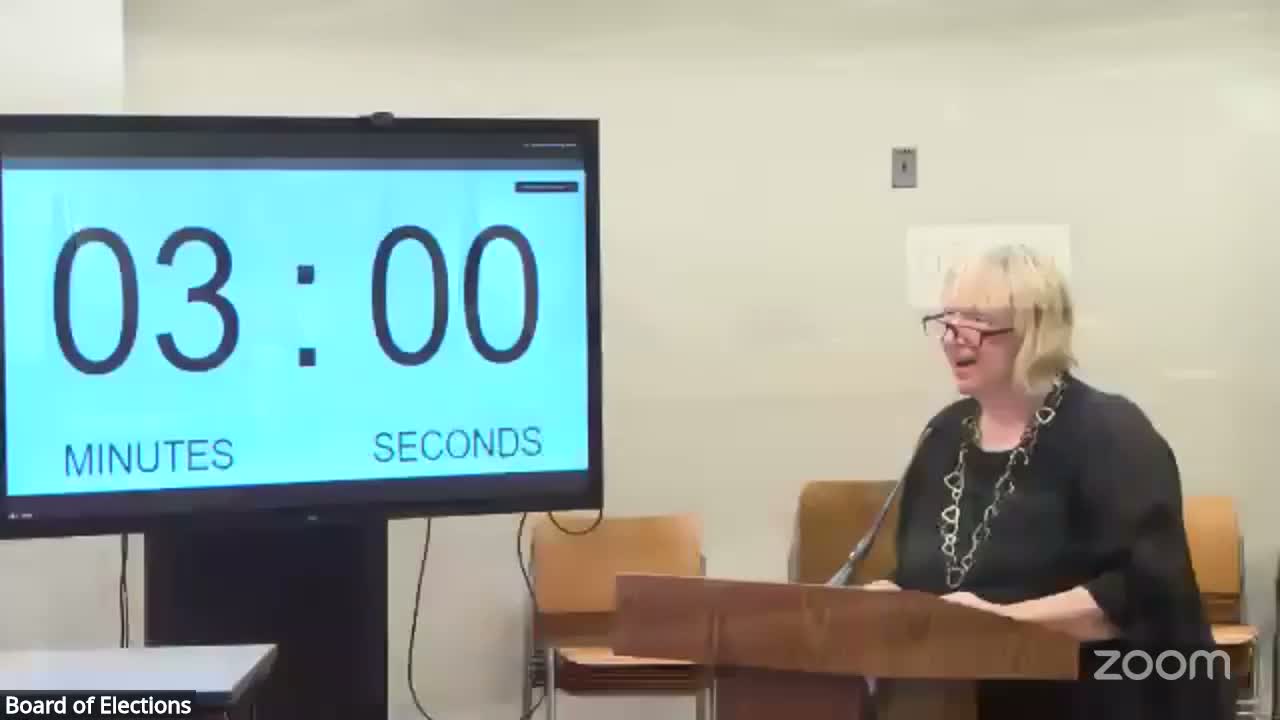
At the Nov. 18 Delaware County Board of Elections meeting, two public commenters presented detailed criticisms of county mail‑in ballot accounting and testing procedures and asked the board to address them before certifying results.
Laura Lewis of Radnor Township told the board she and observers intentionally separated two groups of mail‑in ballots — those received before election day and those arriving on election day — and said the two observed physical sets cannot both be reconciled with the county’s electronic totals under any reasonable assumption. “The physical evidence and the digital records cannot both be correct,” Lewis said, and submitted a copy of her calculations to the board.
Ms. Schwartz, who identified herself as part of a watchdog group, raised four specific concerns: verification of voter ID before mail‑in ballots are approved; thousands of registrants listed with nonresidential or incomplete addresses; lack of pre‑certification verification of mail‑in ballot applications; and reliance in some testing on boot‑ups and 0 tapes rather than configuration and hash validation. She said these process issues threaten public trust and asked the board to address them prior to certification.
Mr. Allen and the county solicitor responded in turn. Mr. Allen noted statutory procedures for voters who did not include ID with a ballot: the county issues a notice and the voter has six calendar days after the election to provide proof of identification, and ballots without a subsequent cure are not opened. He described how the county segregates unverified ballots in a red tray near the observation area.
The solicitor cited prior litigation on verification claims, noting a judge previously dismissed similar claims and explained that the county conducts random hash testing and other checks that go above Commonwealth minimums. He also said an injunction request concerning testing was denied; the underlying claim may be litigated further, but current law and court rulings permit the board to proceed with certification.
Lewis’s and Schwartz’s submissions were not reconciled at the meeting; instead, the board questioned return‑board leaders about the return‑board hand counts and other processes before proceeding to certification. The transcript shows the board welcomed public scrutiny and described legal and procedural limits on additional pre‑certification examinations without statutory or court‑ordered changes.
The public comments recorded specific requests for post‑certification transparency and suggested procedural reforms such as pre‑certification verification of mail‑in ballot applications and expanded testing protocols.