Get Full Government Meeting Transcripts, Videos, & Alerts Forever!
Get email alerts on the Re16 topic
No spam. Unsubscribe anytime.
Miami adopts county-coordination measure to scrutinize businesses tied to Cuba and urges federal enforcement
Summary
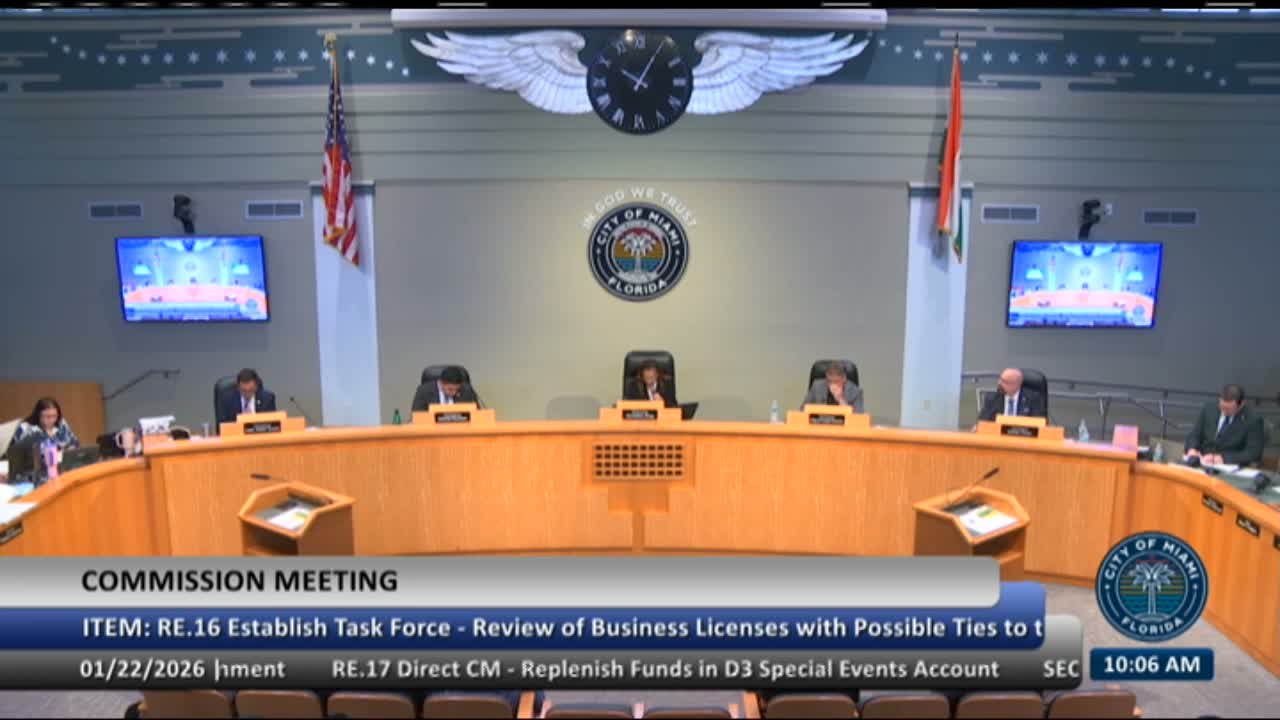
The commission approved RE16 as amended, authorizing the city manager to work with the Miami-Dade County tax collector to help enforce state and federal restrictions on businesses doing business with Cuba, and separately approved a resolution urging federal authorities to act.
On Jan. 22 the Miami City Commission adopted RE16, a resolution directing the city manager to coordinate with the Miami-Dade County tax collector to ensure compliance with applicable federal, state and local laws governing business tax receipts and related enforcement regarding business ties to Cuba. The commission also approved a follow-up resolution urging federal enforcement.
Several commissioners and members of the public voiced strong anti-communist sentiments and support for the measure. "This is about coordinating on a regular basis with the county and implementing what is already on the books," Commissioner Rafael Rosado said after a substitution memo limited the city role to coordination with the county tax collector.
City Attorney George Weisong explained the local legal hook is Florida Statute Section 205.0532, which permits a local governing authority to revoke or refuse to renew a business tax receipt if a business engages in activities prohibited under state or federal law related to Cuba, but he warned of potential litigation and said the city would be relying on federal determinations in many cases.
Several commissioners urged caution because a federal lawsuit challenging the statute is pending; some asked the city to defer action until court resolution or to supplement the measure with a resolution asking federal authorities to investigate and enforce sanctions. The commission approved the amended resolution and later voted to urge federal agencies to vigorously enforce sanctions and related laws.
The action authorizes coordination and cooperation with county enforcement activity rather than creating an independent city enforcement apparatus; commissioners sought to balance community concerns about exploitation of sanctions with legal and fiduciary risk.