Get Full Government Meeting Transcripts, Videos, & Alerts Forever!
Get email alerts on the Land Use Planning topic
No spam. Unsubscribe anytime.
Belgrade commission hears overview of Montana Land Use Planning Act, sets schedule toward 2026 adoption
Summary
City consultant Charles Frowell told the Belgrade Interim Planning Commission that the Montana Land Use Planning Act consolidates local planning boards, requires 20-year population projections linked to housing needs, and sets an adoption timeline that aims for a land use plan by spring 2026.
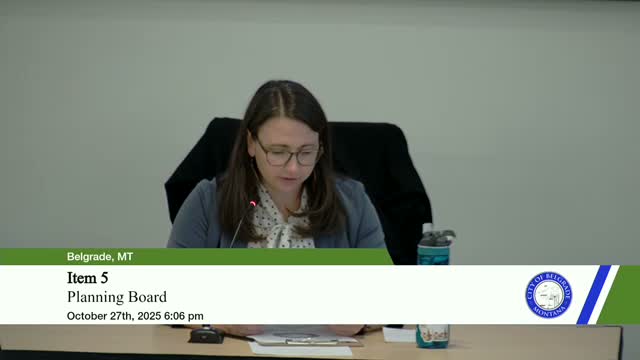
Belgrade’s Interim Planning Commission on Oct. 27 heard an overview of the Montana Land Use Planning Act and how the city’s Clearly Belgrade master planning work will be used to meet the law’s new requirements.
Charles Frowell, an urban planner with Cushing Terrell, told commissioners the state law consolidates some local boards and updates planning processes. “It consolidates existing boards and commissions to one body, the Planning Commission,” Frowell said, describing the statute’s intent to streamline review of zoning, subdivision and land-use issues.
Why it matters: the act ties 20-year population projections to housing estimates, requires a public participation plan and directs jurisdictions to align zoning and subdivision regulations with an adopted land use plan. Frowell said Belgrade must adopt the plan portion by May 2026 and follow that with an implementation plan that reconciles zoning and subdivision rules.
Frowell reviewed the Clearly Belgrade master planning effort — a collection of plans including a utilities master plan, transportation update and parks district plan — that feed into the city’s land use plan. He said the city’s recent 2020 growth policy and a 2022 SWOT analysis set the foundation for the current effort and that many linked documents will be updated and consolidated in one place.
The presenter described several specific requirements: jurisdictions must produce 20-year population projections and related housing needs; local zoning will need to meet at least five of 14 state-identified housing strategies; and certain administrative processes, such as subdivision reviews and appeals, will be handled under the consolidated Planning Commission framework. Frowell also noted a required 15-day written comment period for reviewers during some stages of administrative review.
Commission discussion focused on how standards and permitting will be drafted and who implements them. The Chair asked whether staff prepare draft ordinances and standards and the Planning Commission then reviews them; Frowell said, “Ultimately, the Planning Commission will ultimately make a recommendation to Council for adoption of those,” and described a development coordinator role to manage review workflows between staff and the commission.
Commissioner (speaker 4) reminded the group that the Board of Adjustment — which handles variances and appeals — will be absorbed into the Planning Commission under the new structure. Frowell said the state has resources to help jurisdictions implement the changes, and he described an outreach schedule of open houses, virtual meetings and focus groups from October into February to inform the community.
Procedural notes: the Commission approved the meeting agenda and the Sept. 29, 2025 minutes by voice vote. No public comments were offered during the public comment period. The Commission will continue to receive updates as the land use plan moves toward adoption and the meeting adjourned at 6:47 p.m.
Next steps: public engagement and targeted outreach through the winter, anticipated land use plan adoption in March 2026, and adoption of the implementation plan in April–May 2026, after which the interim commission will recommend a permanent Planning Commission.