Get Full Government Meeting Transcripts, Videos, & Alerts Forever!
Get email alerts on the Urban Forestry topic
No spam. Unsubscribe anytime.
Belgrade council leans toward lot-size fee as staff refines urban-forestry assessment
Summary
City staff presented two options for funding a new urban-forestry program; after questions about equity and downtown impacts, council members signaled support for a refined lot-size (bracketed) assessment and asked staff to test alternate weightings and caps before a formal proposal.
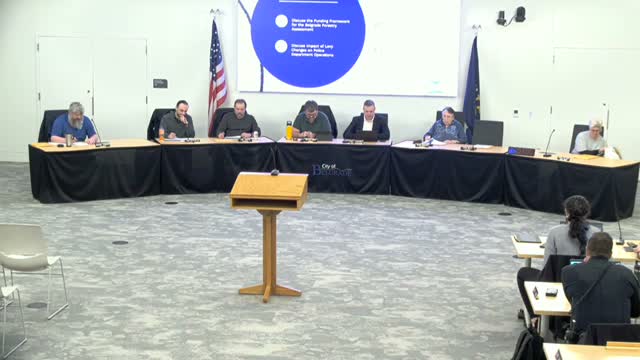
Jordan Green, Belgrade’s director of Parks, Trails and Recreation, presented options for funding a proposed urban-forestry program and assessment fee, telling the council the city is in its second year of a flat-fee charge and consultants (Cushing Terrell) examined equitable alternatives.
Green said the consultants modeled two primary approaches: a bracketed lot-size method that scales fees by parcel area, and a land-use (zoning) approach that assigns weights to residential, commercial and industrial parcels. “This is purely representative of how this approach would be done,” Green said, noting the examples used a $200,000 benchmark and that formulas and weights remain adjustable.
Council members pressed on specifics. One councilor flagged a numerical discrepancy in a bracketed entry; Green agreed to verify the consultant’s formulas. Members debated whether the fee should fund maintenance only or also program growth; Green said the benchmark illustration would cover staffing, equipment and tree purchases, with final amounts set via the regular budgeting process.
Business owners and downtown representatives questioned the fairness of making dense commercial downtown parcels pay a relatively large share when they currently host few street trees. City Manager Carnivale and other staff argued the zoning approach offsets hardscape impacts (heat island, air quality) by funding tree work elsewhere in the community, but several council members said lot size was easier to explain and administer.
By the end of the workshop, the council’s informal direction was to pursue Alternative A (a lot-size, bracketed model) with refinements: split the large “1/8 to 1/2 acre” bracket into smaller bands, consider minimum and maximum caps (suggested examples included keeping most fees under $90–$100 at the $200,000 benchmark), and explicitly exclude exempt parcels (schools, certain public facilities) from assessments. Green said staff would return with refined weighting options and verify the consultant’s calculations.
Next steps: staff will refine the lot-size brackets and weights, confirm exclusions and exemptions, test cap scenarios, and bring back a more detailed proposal for council direction and eventual inclusion in the annual budget process.