
House resources committee hears first testimony on bill to modernize state land rules and create commercial parks
Get AI-powered insights, summaries, and transcripts
Subscribe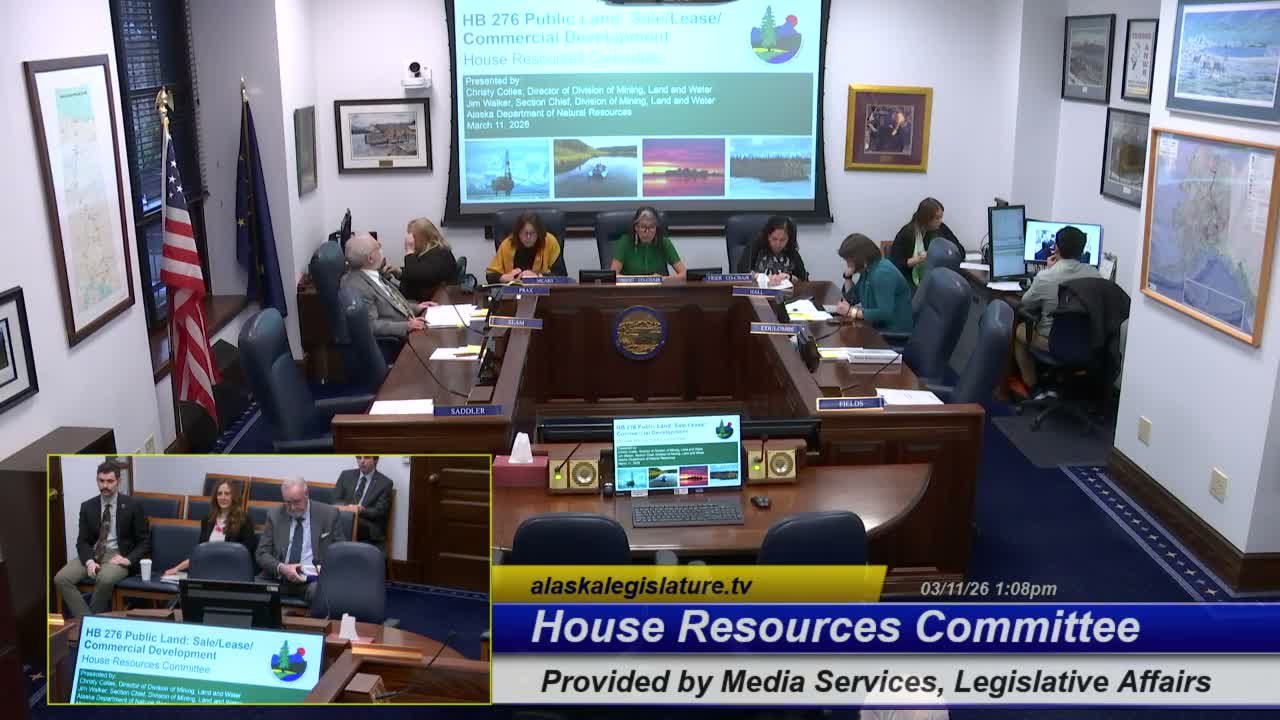
Summary
At a March 11 hearing in Juneau, DNR officials described House Bill 276's packages of changes to state land sale and lease rules, including extending some purchase terms, allowing discretion on cadastral surveys, realigning state refuge boundaries with federal refuges, and creating a mechanism for commercial development parks; members pressed officials on homeless encampment cleanup and the public designation process.
Juneau ' At a first hearing March 11, 2026, the Alaska House Resources Committee heard Department of Natural Resources officials present House Bill 276, legislation the department says would modernize state land-sale and lease procedures, help attract employers by pre-clearing "commercial development parks," and repeal or align certain outdated state land designations.
The presentation, led by Christy Collis, director of the Division of Mining, Land and Water, and Jim Walker of the Department of Natural Resources, described three central aims: streamline DNR's administrative processes, stimulate economic development through designated commercial parks, and remove or conform obsolete land-boundary designations.
"The three main purposes of this legislation are to modernize state land lease and sale processes, to stimulate economic development through commercial parks, and lastly, to repeal some outdated land boundaries and obligations," Jim Walker told the committee. He said one practical change would be to extend certain state land contract payoff periods from 20 to 30 years "so that the folks have a little bit more time to pay."
Walker and Collis described a proposed change to the compulsory cadastral-survey requirement for leases over 10 years: the bill would give the DNR commissioner discretion to waive surveys for low-infrastructure leases (for example, some agricultural uses) while preserving the survey requirement before any sale. Walker said that in one example a would-be peony farmer faced a roughly "$40,000" cadastral survey bill under current rules.
The presenters also described boundary changes affecting the Kenai National Moose Range and the Kodiak National Wildlife Refuge. Walker said the bill would remove overlapping state-game-refuge designations where federal boundaries have contracted so that fringe lands would become general state lands and could be treated for subdivision or other beneficial uses.
A distinct portion of the presentation focused on the Business Park Wetlands in midtown Anchorage, a three-acre parcel conveyed to the state after private stewardship lapsed. "Although it is still legally classified as wetlands, its wetlands character is much less," Walker said, adding that the division has borne recurring cleanup costs tied to debris and drug paraphernalia. He said the division has spent about "$80,000" to date on cleanups and forecasted an additional "$105,000" over the next five years to keep pace with recurring problems. The bill would remove the special legislative designation so the state could consider conveyance to the Municipality of Anchorage or other beneficial uses, Collis said.
Representative Hall pressed officials on whether a homeless encampment currently existed and its size; Walker said encampments "get cleaned up and they return" and that the division sees recurring problems. Collis said the division does not have a precise current size estimate and noted municipal counts may not include state-owned parcels. Officials also said they have reduced staff field visits for safety and now rely on contractors who visit the site regularly.
On the commercial-parks proposal, Walker said HB 276 would let the state identify lands already classified for settlement, front-load planning and best-interest findings, and thereby make some parcels more attractive to employers. He said regulations would follow the statute to work out details and that incentives could allow DNR to consider economic factors such as local employment rather than charging full fair-market value.
Representative Prox asked whether the bill itself designates specific parcels; Collis replied it does not and that any designation process would include additional public hearings and an appealable decision. On a question about adverse-possession scenarios, Walker said the bill addresses leasing of state lands and does not change the separate legal processes required to convert occupancy into formal title.
The committee took no formal action at the hearing; members did not vote on the bill. Co-chair Representative Divert closed the session and reminded the committee it will reconvene March 16 to take up a committee substitute to House Bill 321 and later hear other presenters.
What happens next: HB 276 will proceed through the committee process; officials said designations of commercial parks would be subject to separate public processes and rulemaking under the statute.