Lifetime Citizen Portal Access — AI Briefings, Alerts & Unlimited Follows
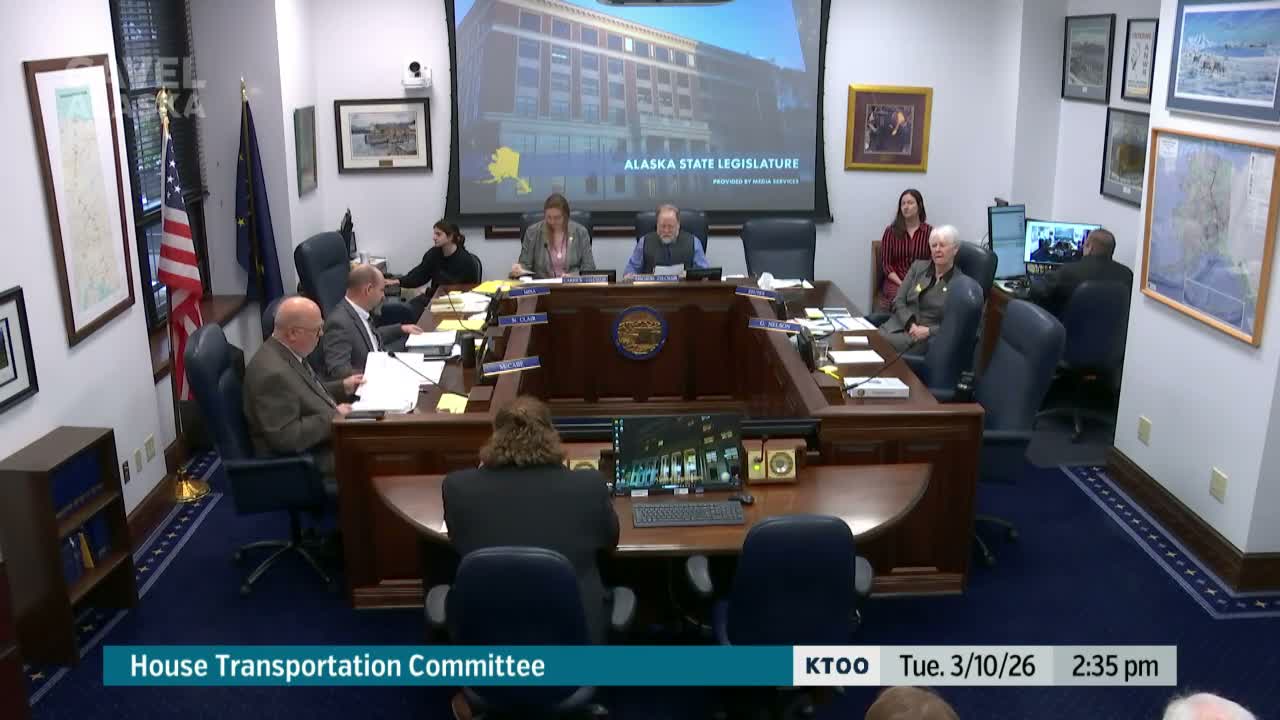
House Transportation committee hears testimony supporting Northern Continental Corridor resolution urging DoD engagement
Loading...
Summary
Representative Garrett Nelson introduced HJR 42 supporting the Northern Continental Corridor; invited witnesses from e4m and Dewberry described defense, supply‑chain and economic rationales, and the committee set an amendment deadline for a related resolution item.
Representative Garrett Nelson (District 29) introduced House Joint Resolution 42 on March 10, asking the House Transportation Committee to endorse the concept of the Northern Continental Corridor (NCC), a proposed rail connection that would link Alaska through Canada to the Lower 48. Nelson described the resolution as a signal of support aimed at the U.S. delegation and federal agencies and said he would send the resolution to the Department of Defense.
Invited witnesses presented the project case. Kevin Thompson, principal partner at e4m, described an EPCM (engineering, procurement, construction, management) approach to de‑risk the corridor and said early Department of Defense engagement could validate strategic value and unlock private capital. "This resolution would be sent to the Department of Defense," Thompson said when asked how the sponsor intended to use the committee's endorsement.
Greg Maddalina, e4m's chief engineer and a Coast Guard veteran, outlined routing progress and a costing validation exercise; he asserted the corridor's potential economic impact as "420,000 job years." The committee sought clarification on who would bear construction obligations; witnesses said DoD validation and private capital partnerships would be the path forward and that Canadian partners were engaged.
Hillary Palmer, geospatial and infrastructure program manager for Dewberry, framed the proposal around supply‑chain redundancy. She said a 2023 FEMA baseline supply‑chain assessment showed heavy dependence on the Port of Alaska and a single highway corridor, creating single points of failure for critical goods. "The presidential permit for this corridor was granted in September 2020, and it expires in 2030," Palmer told the committee, urging timely attention to the policy window.
Committee members questioned costs, the state's obligations, and the degree of Canadian collaboration. Witnesses emphasized stepwise de‑risking, DoD engagement and international coordination. Representative Nelson said the resolution would be routed to the Alaska congressional delegation and to the Department of Defense once passed.
There was no recorded vote on the resolution during the meeting. The committee set an amendment deadline (per the transcript) for HJR 28 for Friday, March 13 at 5:00 p.m., and announced the next committee meeting for March 12 at 1:00 p.m. The resolution proponent and invited witnesses remained available for follow‑up and the committee encouraged continued coordination with Canadian partners and federal agencies.