
Panel urges Alaska Legislature to back coordinated infrastructure plan to speed federal defense investment
Get AI-powered insights, summaries, and transcripts
Subscribe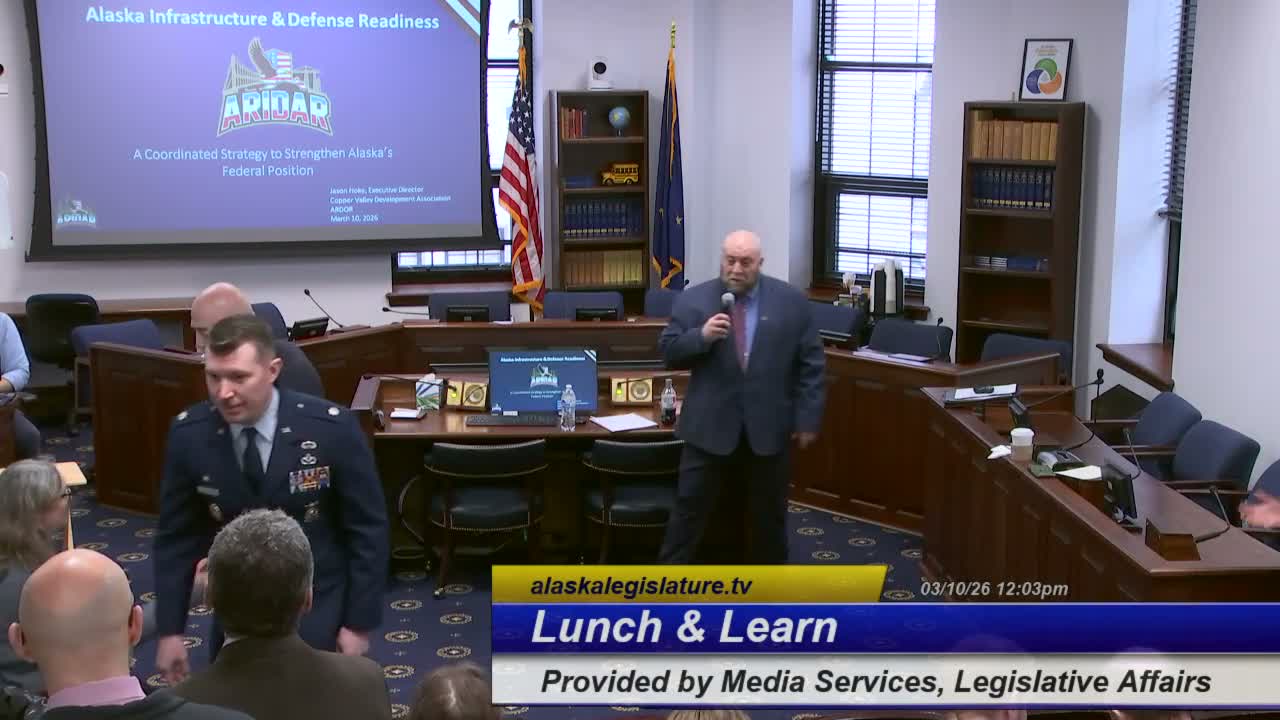
Summary
At a Juneau lunch-and-learn, regional and military officials urged the Alaska Legislature to endorse a concise white paper and coordinated messaging to help unlock an estimated $23 billion in federal defense investment; presenters also detailed housing and "warm storage" needs at Eielson and elsewhere.
Jason Hoke, executive director of the Copper Valley Development Association, told lawmakers at a Juneau lunch-and-learn that Alaska needs a unified, federal-facing infrastructure plan to speed defense-related funding.
"It's estimated that the state of Alaska should receive about 23,000,000,000 in the next 5 to 8 years," Hoke said, and he urged the Legislature to provide "strategic alignment on messaging" rather than immediate funding to reinforce federal conversations. Hoke described an effort to compile existing regional studies into a concise 1–2 page white paper with a digital companion to show cost phasing and regional priorities to federal decision makers.
The panel framed the white paper as a practical tool to reduce uncertainty for federal staff and to connect infrastructure priorities — energy, telecommunications, transportation, housing, food security, education and medical care — to defense readiness. Hoke said the project was undertaken "at the behest of Senator Murkowski, Senator Sullivan" and that the white paper would be ready by Nov. 1.
Colonel Scott Johnson, who led the military portion of the briefing, said bases such as Eielson Air Force Base are strategically critical but face local constraints that could limit readiness. "We have a real issue with housing," Johnson said, arguing that the arrival of additional airmen and their families would overwhelm local housing stock and push up prices. He described a need for both base and off‑base housing solutions and for protected "warm storage" for equipment currently exposed to harsh weather.
Johnson said Eielson can support a range of missions and has extensive on‑base capacity — including a large fuel pipeline and tens of millions of gallons of fuel storage — but that some needs require partnerships with the state and private developers. He described an enhanced use lease (EUL) approach to allow private builders to develop underutilized base land: "We have about 4,300 acres on our base that we could get a contract with a for profit to build homes," Johnson said, and he estimated a 200,000‑square‑foot warm‑storage requirement for certain capabilities.
Zach, representing U.S. Special Operations Command North, framed SOCOM requirements around multiuse and dual‑use facilities that can support both military deployments and community needs. "We deter, we deny, we disrupt," he said, and he emphasized that warm storage and dual‑use port or communications facilities across interior and western Alaska would serve both military operations and local resilience in crises.
During a question-and-answer period, attendees asked whether the effort was coordinating with military and veterans affairs offices and with the Military Affairs Commission; presenters said further meetings were scheduled with the Denali Commission, the Office of Local Defense Communities and other partners. Organizers asked legislators to expect a forthcoming resolution of support for the coordinated Alaska infrastructure and defense readiness effort; no formal vote or legislative action occurred at the event.
Panelists stressed the tempo and practicalities: the EUL process is already under way and can take roughly 18 months, they said; they cited an illustrative need for about 305 three‑bedroom-plus homes in the interior and noted current construction of roughly 30 homes per year in the region. The white paper and digital companion are intended to show existing studies, cost phasing and regional priorities so federal dollars can move more quickly once state and local partners align.
Organizers said the request to the Legislature is limited to strategic messaging and coordination to demonstrate bipartisan Alaskan support for the buildup; presenters repeatedly emphasized they were not seeking immediate state appropriations at the briefing.
Next steps: presenters said the ARDAR (Alaska Regional Infrastructure and Defense Analysis and Recommendations) white paper and a companion website will be completed and circulated to state partners and the congressional delegation, and a resolution of support will be filed for legislative consideration.